



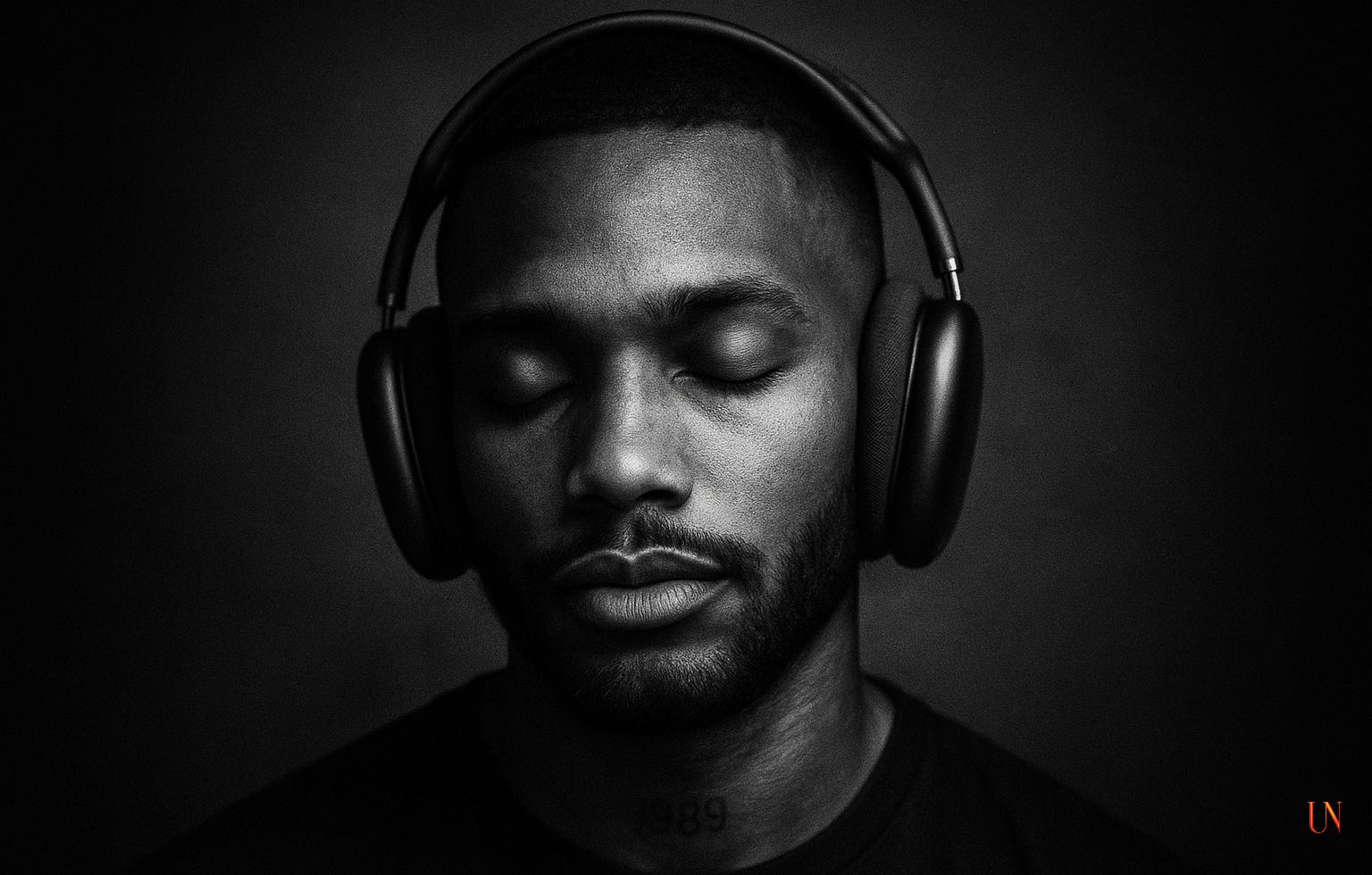

This is where the music thinks back.
Where the B-side—the quieter, truer cut—becomes conversation.
Each essay listens for what remains after the song fades:
the memory, the ache, the untranslatable thing that art leaves behind.
“Too much time has passed for you not to decide.”
— Rae Khalil, Hot Track
I. The Heat
The heat never left my chest—
it only learned rhythm.
I grew up on borrowed brightness,
streetlights pretending to be stars,
a faith stitched from the fabric of other people’s music.
I learned that rise means risk.
That the fall is just another form of gravity.
Some nights I talk to my reflection
like it’s a younger cousin who still believes
talent will save us.
I tell him:
the price of every lyric is a bruise,
the cost of being seen is to be misunderstood.
But listen—
if you stay long enough in the fire,
you’ll stop burning and start glowing.
That’s what the track taught me:
the body is just a drum
waiting to be played back into itself.
II. The Return
When I first heard Hot Track, I was standing in my kitchen half-awake, coffee cooling beside me, the day already pressing in. The song began like something older than melody—part confession, part command. Rae Khalil’s voice didn’t ask to be understood; it simply existed, full and defiant, like a truth that had outgrown apology. Within seconds, I felt the air change. Some art does that—it rearranges the atmosphere until you realize you’ve been holding your breath for years.
The lyric that caught me—“Too much time has passed for you not to decide”—felt less like advice than indictment. I heard it and thought of every season I’d spent mistaking motion for progress, silence for stability, composure for healing. Decision, I realized, is its own language. For people who’ve had their choices stolen or scripted, to decide for oneself is a sacred act. It’s a kind of self-naming, a refusal to let the world continue drafting your life in its handwriting.
Later, when she sings, “I grew up on MJ and in poverty, but I seen big hills and bright lights a couple times,” I thought about proximity—how some of us spend our lives almost touching the world we were told we could never enter. I know that ache intimately: to glimpse the promise of arrival and still feel like a guest in the room your work built.
The song became a mirror for the way I’ve lived: chasing structure, curating calm, worshipping order because it looked so much like safety. But underneath all that arrangement was fatigue—the kind that polite ambition hides. Hot Track reminded me that rhythm isn’t a straight line forward; it’s a circle that keeps returning until you finally listen.
What Khalil does with her voice—balancing ache and authority—is what I’ve always wanted to do with language. She sings the way many of us survive: with beauty that doesn’t deny the bruise. I think of the generations before me who used music as both map and medicine. In our house, sound was inheritance. My mother’s hum while cooking, my father’s off-beat percussion on the steering wheel, the choir that refused to surrender its harmony even when the lights went out—these weren’t performances. They were proof.
To grow up inside that kind of noise is to learn that creation is never clean. Every song carries the static of what it cost to make it. That’s what I hear when Rae says, “We all pay the right prices … I got a lot of vices.” It’s not confession; it’s currency. It’s the cost of staying human in a system that trades authenticity for applause.
I used to write from the distance of aftermath, once the flames had cooled and language could be arranged neatly around the pain. But lately I’ve begun to understand that the real work happens inside the burning. Writing, like music, isn’t what we do after the chaos; it’s how we translate the chaos into coherence. It’s how we turn noise into knowing.
Hot Track gave me permission to stop performing resilience as if it were the prize and instead to inhabit it as practice. It reminded me that heat is not the enemy of clarity—it’s the process that makes clarity possible. You stay long enough in the fire and you begin to see shape, pattern, rhythm. You begin to recognize yourself not as the one being scorched but as the one being tempered.
When the song ended, I didn’t feel inspired; I felt recognized. There’s a difference. Inspiration asks you to move; recognition asks you to stay still long enough to understand what the movement means. I played the track again, louder this time, and let its weight settle. I realized I wasn’t listening to a song—I was listening to evidence that survival, too, can sound like art.
And maybe that’s the decision Rae was calling for: to stop running from the heat and name it as home.
Even after the music faded, the air kept humming, the room still warm—as if the song had decided to stay.
Let that be enough—for now.
B-SIDE COMMENTARY is part of the UNSPUN collective—where sound becomes language and reflection becomes record.
Each piece lives at the intersection of music and meaning, tracing how art remembers what we forget.
To listen deeper, follow UNSPUN / Side B for new essays, playlists, and dialogues on sound, soul, and the afterlife of feeling.
If something in the music stayed with you, that staying is the point. Keep listening for what still hums beneath the silence.
Every word here is researched, written, and sharpened by one person—me. If you value work that names what others won’t, consider becoming a paid subscriber. It keeps this space independent, and it keeps pieces like this possible.