

Cornbread and Sweet Tea
Notes Toward a Black Queer Communion


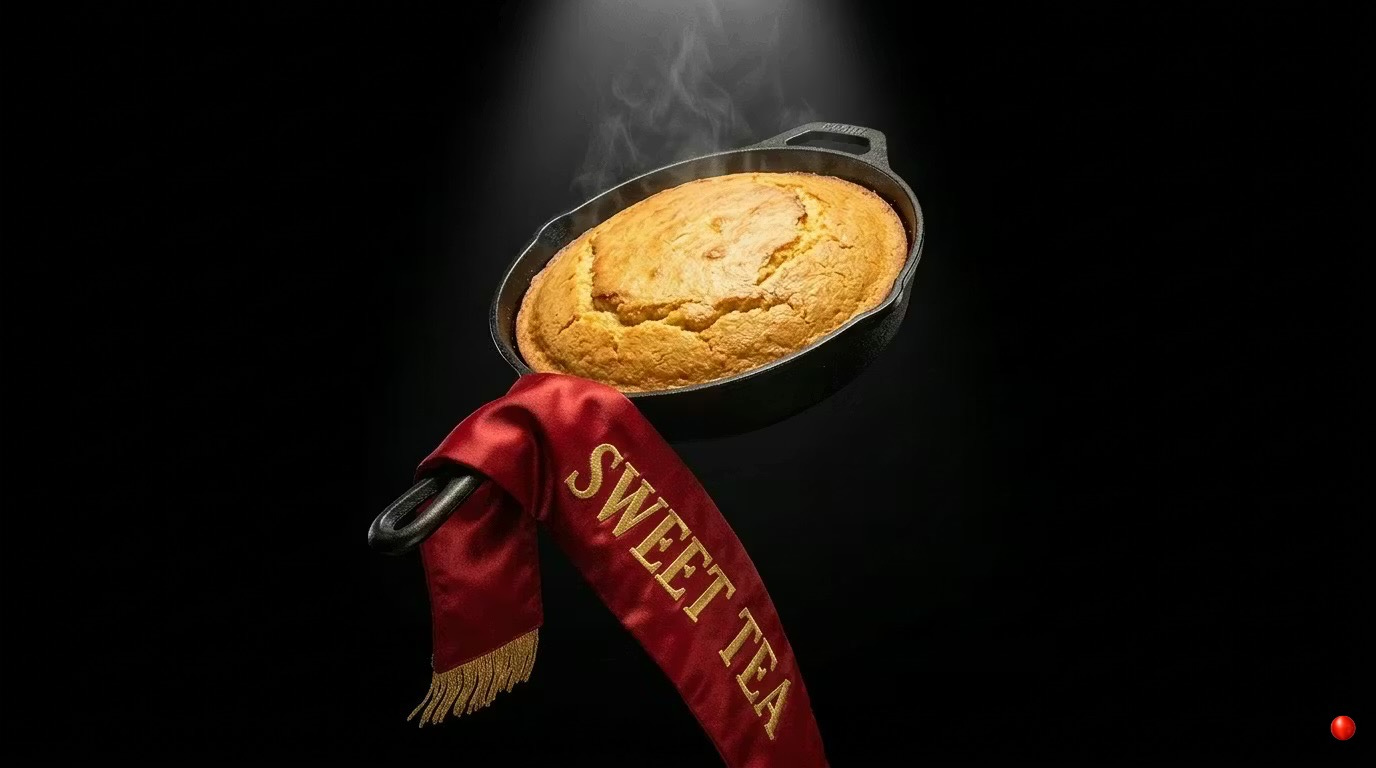
“In America, I place my trust and body in the hands of strangers.”
— Essex Hemphill
The room is the night you almost left.
Not a grand decision, not a letter on the dresser. Just that slow, familiar narrowing of options until every future feels like a lie. The bed unmade. The phone face down. The half-eaten something sweating on the counter. Your chest tight in that way that is not dramatic enough for television but specific enough that your body knows what it means.
You do not trust yourself alone with your own thoughts, so you go where other bodies are. Not because you want to be saved. Because you are not ready to be found in the morning.
You walk into a room that smells like frying oil and old candle wax. Someone is laughing too loudly. Someone is washing dishes like they are mad at the sink. There is a pan of cornbread on a table that looks like it has collapsed before and been forced back into service. A pitcher of sweet tea already leaving rings on the plastic.
No one here knows how close you came to not coming.
They do not ask why your hands are shaking. They ask if you have eaten. They ask if you want a plate. Someone makes room on the couch without looking at you directly; someone else slides the cornbread closer.
You realize, with a kind of quiet horror, that this is the safest you have felt in months.
You also realize you do not fully trust it.
You sit anyway. You take the plate.
You listen to other people talk around their own edges. You feel your heartbeat matching the small chaos of the room. Nothing is resolved. No one lays hands on you. No one quotes a verse.
At some point, someone says, “We should pray,” and the silence that follows is so thick you could cut it.
Nobody moves.
Finally, someone shrugs and says, “We can eat first.“

The night I almost did not make it, no one read from a Bible.
There was no choir, no altar call, no organ dragging us toward a scripted redemption.
There was just a cheap folding table, a pan of cornbread someone remembered to cover with foil, a pitcher of sweet tea already sweating through its own body, and the quiet, stubborn fact that we were still here.
Somebody said, “We should pray,” and nobody knew what that meant anymore, so we ate.
The Elements
The bread is cornbread, made the way Grandma did when she still believed the church would make us safe.
Iron skillet, buttermilk, a little too much sugar. She always said life was bitter enough on its own, no sense baking the hardship in. Years later, when a pastor stood in the pulpit and used the word “abomination” like it was a verse instead of a weapon, I realized she had been doing theology with that sugar.
We do not bake bitterness into the few things we control.
The wine is sweet tea. Not the diet kind.
Not the “we are watching our figure” kind.
Tea brewed strong enough to jolt the tired parts of us that decided hope was a childish habit, then drowned in sugar like a dare. Every glass a small refusal of scarcity. The world keeps insisting joy is a privilege reserved for people who never had to fight to stay alive. We drink until that lie loosens its grip on our tongues.
The table is whatever will hold us without complaint.
Kitchen table with one wobbly leg. Coffee table stained by old candle wax. The front steps that catch whatever breeze the street will spare. The hood of a car unbothered by how many times it has been nearly repossessed. The park bench that smells faintly of weed and rain.
The congregation is whoever shows up.
Blood family who stayed after we said the quiet part out loud. Chosen family who met us in comment sections and group chats and DM threads, then showed up in person with Tupperware. Friends who know that spiritual community can grow in the cracks of failed churches. Lovers who understand that intimacy is a kind of prayer and also that prayer does not entitle anyone to our bodies. Strangers who thought they were coming for food and realize halfway through the meal that they have walked into a different kind of hunger.
No ushers, no membership classes, no offering plate.
The only price of entry is need.
The Invitation
“Come as you are” has been used as bait before.
Printed on flyers, whispered from pulpits in churches where the welcome stopped at the door of the bathroom stall. I grew up learning the small print: come as you are, but do not stay as you are. Come as you are, but leave your pronouns at the coat rack. Come as you are, but keep your lovers invisible and your questions rhetorical.
Here, it is not slogan. It is command.
Come in the dress that makes you feel like a miracle, even if your mother said it was “too loud for someone with your body.” By “someone with your body,” she meant someone whose flesh refuses to forget its history. She meant someone whose hips carry stories the church never learned to tell at the microphone. She meant you.
Come with your voice torn raw from another funeral where the cause of death will be listed as overdose or suicide or “unknown circumstances,” as if this country has not spent centuries perfecting the art of slow killing.
Come with dirt under your nails from the job that grinds your spine down one shift at a time and still does not cover rent on the first attempt. From the garden you coax out of a strip of hostile soil behind a building that never planned on growing anything but mold. From the half-finished painting or verse or beat on your laptop that is the only place you get to be honest.
Come with your doubt folded around you like another layer of skin.
Doubt that God could ever want anything to do with you after what you have done to survive. Doubt that community is anything more than another word for disappointment. Doubt that communion is not just another performance of inclusion waiting to turn into exile.
Also come with the ugly parts you were told are impolite to bring into holy spaces. The envy that flashes when you see other queers with accepting families. The resentment that gnaws when someone posts their “found family” photos and you cannot help counting all the people who left you behind. The boredom that creeps in when the talk turns to healing and you are still at the stage of not wanting to text anyone back.
Come anyway.
Come because something in you is still restless. Come because you are tired of pretending you do not need anyone. Come because, secretly, you would like to be wrong about the impossibility of being fully known and not abandoned.
The invitation is not a promise that we will never fail each other.
It is a promise that when we fail, we will tell the truth about it.
The Breaking
We break the cornbread with our hands.
No knife. No clean, symmetrical slices.
Pieces tear ragged and uneven, like the lives that reached for them.
We break bread like we learned to break silence: slowly at first, carefully, terrified of making a mess.
Then, one day, you say the thing out loud and the world does not end, and your hands remember that sound. The first time I told a room full of strangers that I stayed in a church that was killing me because I did not know where else to go, someone across the circle nodded so hard they cried. That nod broke something in me more cleanly than any exorcism.
We break bread against the memories that tried to break us first. Sermons cataloguing our bodies as temptation. Parents insisting they loved us “in spite of” what we were, as if our existence were a stain on their otherwise acceptable life. Lovers who said we were asking for too much by wanting to be desired and believed at the same time.
Sometimes the loaf resists us, crust holding on like a habit. Sometimes it falls apart in our fingers without effort, collapsing the way we did when the first person we trusted used the word “phase” on a part of us that never felt temporary.
The breaking is its own liturgy.
Tears break loose after weeks of “I’m fine.” Laughter breaks out in the middle of a story that should have ended with a police report. Voices break when we finally say, “I thought I would rather die than disappoint them,” and someone answers, “I thought that too.”
When I break bread in your presence, I am saying:
I am willing to let you see me ungenerous.
I am willing to let you see that I do not always know how to share without keeping the biggest piece for myself.
I am offering you the part of the loaf I was raised to call mine.
When you break bread in mine, you are saying:
I trust you enough to be clumsy around you. I trust you enough to risk taking too much, or not enough, and believing you will tell me when I have hurt you instead of leaving quietly.
We do not pretend the breaking is always noble.
Some of us eat fast, hoarding crumbs as if the world might snatch the plate away at any moment. Some of us offer pieces we resent giving.
Communion does not require purity of motive.
It requires honesty about what our motives actually are.
The Body
“This is my body, broken for you.”
In most churches I grew up in, that line landed like distant thunder. A story about an ancient, spotless man whose pain had nothing to do with mine.
It hits differently when the body you are thinking about looks like yours.
Our bodies were declared problem before we ever learned to read. Security guards followed us through stores where we had not touched a thing. Teachers commented on how “developed” we were and then blamed us for the attention. Doctors dismissed our symptoms, misgendered us on charts, and wondered out loud if we “really needed” the care we were asking for.
Systems broke us. Families broke us without meaning to, rubber-stamping theology they inherited without ever asking what it cost us to stay. Lovers broke us quite on purpose and called it passion.
There are parts of my body I still only look at in passing. On certain days, my reflection feels like a crime scene. Other days, it feels like a miracle I am almost afraid to touch.
But also: this is my body, blessed by you.
Blessed by the friend who sat in the waiting room outside the clinic and texted me memes until my name was called. Blessed by the lover who asked before reaching for the scars, who did not flinch when they saw where the skin did not match the story my clothes were telling. Blessed by the elder who leaned over a pot of greens and said, “Baby, God did not mess up on you,” with the same tone she used when she told us never to overcook the meat.
Blessed by pronouns that fit like a shirt that finally sits right on the shoulders. Blessed by names that taste correct in the mouths of people who refuse to shorten or soften them for anyone else’s comfort. Blessed by nights spent dancing in a room full of Black queer bodies where no one was on display and everyone was beautiful.
My body has been broken more than once.
The miracle is that it still knows how to sit at a table without apology.
When I lift the bread to my mouth, I am not reenacting someone else’s martyrdom.
I am saying: this is my body, and I have decided it belongs to me.
The Blood
“This is my blood, shed for you.”
We know a little too much about shed blood.
Blood on hospital floors labeled “incident” instead of “assault.” Blood on sidewalks scrubbed away before the morning news. Blood on bathroom tiles after nights where shame turned affection into something sharp. Blood absorbed into the dark of car seats on highways that do not have enough streetlights for anyone to see what is happening inside.
Sometimes the shedding is not physical. There is the blood we lose in little leaks. The steady draining that happens when we contort ourselves into something palatable enough to survive the meeting, the holiday, the family reunion. The exhaustion after yet another conversation where we translate our existence for people who have no intention of learning the language.
But blood is also the thing that keeps circling back, insisting on life.
This is my blood, shared with you.
Shared when we pool money for each other’s rent in the last week of the month. Shared when someone passes along a vial of hormones sourced through back channels because the clinic refused to see us as urgently as we needed to be seen. Shared when we stay up on FaceTime all night with a friend who keeps saying they are “fine” and whose eyes keep telling us they are not.
We build kinship with this circulation. We call each other cousin and sis and bro and sibling and beloved long before we know each other’s last names.
Our lineage is not secured by DNA tests. It is confirmed by who shows up with soup when we are sick, who knows our dating history well enough to tell us that texting our ex is a bad idea, who remembers the anniversary of the day we almost did not make it and quietly sends us a message that says, “I am glad you are still here.”
When we drink the tea, we are not pretending it is anything other than what it is. We are acknowledging that our lives are bound together now. That what runs through you has consequences for me, and what I hoard from you will come back as hunger I cannot name.
The Ritual
We do this in remembrance, but not only of one crucifixion centuries ago in a place most of us will never see.
We remember the ones the world did not bother to name saints.
The queer uncle who never had children but bought everybody’s school supplies and was quietly not invited to certain family events. The stud aunt whose “roommate” stayed in her house for twenty years and whose obituary removed every pronoun that made their relationship legible. The ballroom mother who opened her door to every kid the church would not bury properly.
We remember the ones who did not stay.
The friend who took their own life after being told one more time that God could not love them like this. The lover who went back into the closet because survival looked easier that way. The cousin who married someone they did not like because they were tired of arguing with their parents and thought, maybe, peace was worth that price.
We remember the selves we left behind.
The child who sang too loudly in Sunday school before they learned which notes were “too much.” The teenager who practiced a straighter walk, a lower laugh, a smaller gesture. The version of us that tried so hard to be what everyone wanted that we nearly disappeared in the process.
The ritual is not complicated.
We gather.
Somebody brings food that tastes like home or at least like effort. Somebody else confesses they are tired. Someone says, “I thought I was over this.” Someone else answers, “I said that last week.”
We do not rush to fix each other.
Advice is offered like salt: sparingly, and only if asked for.
We listen until the story is finished or at least until the teller has no more breath for today. We pass plates. We refill cups. Sometimes we argue. Sometimes someone storms out. Sometimes reconciliation has to wait.
Not every evening is luminous.
Some nights feel ordinary and clumsy. Someone forgets the sugar. Someone gets the time wrong and shows up an hour late. Someone makes a joke that lands wrong and has to apologize.
The Refusal
Communion language can turn sentimental if you let it.
There is an easy version of this story where we all hold hands, cry, and walk away healed of our suspicions. That is not what happens.
Sometimes I leave the table still angry. Angry that the room was not as gentle as my fantasy needed it to be. Angry at how impatient I am with other people’s slow learning when I expect endless patience for my own. Angry that even in queer spaces, some bodies are treated like wisdom and others like warning.
Sometimes I do not come. I silence the group chat. I decide I am tired of carrying the weight of other people’s confession when my own feels heavy enough. I convince myself no one will miss me. Then I see the pictures later and feel both relieved and wounded.
This is part of the communion too.
The refusal.
The choosing not to show up. The sulking and the staying away and the eventual return. If we pretend community is only the good nights, the easy laughter, the shared recipes, then we are lying. The lie will crack in the worst moments, and someone will leave for good believing the break is their fault.
The hardest part of this ritual is admitting we can harm each other here.
The second hardest is committing to name that harm instead of swallowing it like another wafer.
The Transformation
Communion does not owe us transformation.
There are nights when nothing shifts. No great revelation arrives. No lifelong wound closes. We eat, we talk, we scroll our phones, we wash dishes, we go home. On those nights, the only miracle is survival, and that has to be enough.
And yet. Something accumulates.
A hand that used to flinch at every sudden movement slowly learns the contours of a friend’s shoulder. A person who always took the burned edges of the bread without thinking starts reaching for the soft middle without apologizing. Someone who once swore they would never cry in front of other people sits at the table with tears on their chin and no one rushes to wipe them away.
Connection works like sediment.
Small layers of trust settle over time, compacted by repetition.
One day you realize the ground under your feet is thicker than it used to be. The bread stays bread. The tea stays tea. The people leave just as complicated as they arrived.
The transformation is not in what they are but in what they know now. They know there is a place they can go where their name will not be twisted, their pronouns will not be debated, their fear will not be used as a sermon illustration.
Sometimes that knowledge is all that stands between them and disappearing.
The Mystery
I do not understand how a pan of cornbread and a few plastic cups manage to do what so many sermons could not.
I admire the Black trans saints who built entire prayer books because no existing liturgy could hold their bodies without harm. I have read the queer theologians who gave us language for what we were already practicing. None of it explains the particular quiet that falls when someone at our table whispers, “I almost did not come tonight,” and another person, without fanfare, forks a piece of bread onto their plate.
The mystery is not abstract.
It is as ordinary as a shared meal and as specific as the text at 2:17 a.m. that says, “Are you up?” when what they mean is “Are you still here?”
I do not understand why sometimes I look around this room and feel nothing but irritation, and other times I feel something that might be called God if I trusted that word. I do not know why some nights I leave feeling heavier and still choose to return.
I only know this: the closest thing I have to proof that love is real is the fact that we keep making room for one another when it would be easier to eat alone.
The Continuation
This is not the last supper. It is one supper in a long line of suppers that started before we were born and will continue after we are gone.
Tomorrow, somewhere, another table will appear.
It may be in a cramped studio where two trans girls split a takeout plate and talk each other out of texting people who hurt them. It may be in a sober living house where someone passes the cornbread and says, “I have been clean for fourteen days,” and everyone else claps like that is the only miracle that matters. It may be at a Pride picnic where the music is too loud and the grill smoke stings, and still, in the middle of all that chaos, someone finds a quiet corner to say, “I am not okay,” and someone else answers, “Do you want a plate?”
Tomorrow there will be someone sitting in a parked car outside of that table. They will remember every other room that called itself safe and was not. They will think about driving away.
If they decide to stay, if they kill the engine, if they walk up the stairs, if they knock, the door should open.
On good nights, someone inside is already watching the window, scanning for headlights, saying, “They are here.”
On bad nights, nobody notices until the new person coughs, or laughs, or drops their keys. Either way, we make space.
Come as you are because “as you are” is the only honest place to start.
The table is ready, even if the napkins do not match. The bread is broken, sometimes neatly, sometimes in pieces that look unpresentable and taste like survival. The wine is poured, even if tonight it is sweet tea in plastic cups or lukewarm soda in paper ones.
You are invited because you showed up.
You crossed a distance no one can measure from the outside.
You let your body enter the room.
Take. Eat. Drink.
Stay as long as you can stand the honesty.
Let that be enough—for now.
Author’s Note
I did not sit down to write about cornbread and sweet tea.
I sat down because I could not shake the memory of a cheap folding table on a night when I did not trust myself to see tomorrow.
This essay began as a way to name that room without romanticizing it, to admit that what kept me here was not doctrine or discipline but the quiet, ordinary insistence of other Black queer people refusing to let me disappear.
Writing it forced me to confess the parts of myself I have been more comfortable narrating in the collective.
It is easier to say “we” are angry, “we” are petty, “we” stay home from the table; on the page I had to admit that often I am the one sulking, the one withholding, the one scrolling past invitations and then resenting not being missed.
The section on refusal is the only part I almost cut.
Leaving it in means I can no longer pretend my politics of community have ever matched my practice.
I grew up in churches where communion was a ritual I watched other people approach with reverence and fear, never quite convinced my body was welcome at the rail.
Some days those pews are still the first place my body remembers when anyone says the word “holy.” Writing this piece did not reconcile me to those rooms. It did something stranger: it made me responsible to the tables I am part of now. Once I admitted that our makeshift gatherings have saved my life more than once, I lost the right to treat them as optional.
What I cannot take back is the claim that shows up near the end: that the closest thing I have to proof that love is real is our stubborn, imperfect decision to keep making room for one another when it would be easier to eat alone.
If that stops being true, it will not be because the sentence lied.
It will be because I did.
UNSPUN publishes longform essays, editorial encounters, and visual documents tracing the language of power as it operates in real time.
This work appears as part of UNSPUN’s ongoing inquiry into how authority circulates, how permission is granted, and how silence functions as structure rather than absence.
If something in this piece altered your footing, that alteration is intentional.
What follows does not ask for agreement. It asks for attention.
UNSPUN continues for those willing to stay with the work as it unfolds.