

Did You Get You Some?
An Essay


“We save what we can, melt small pieces of soap, gather fallen pecans, keep neck bones for soup.”
—Natasha Trethewey, Domestic Work
PREFACE
This essay began in a pantry. Not mine, my parents’. The same pantry where one plastic bag holds all the others, where the recursion of preparation lives in plain sight.
I have watched my mom’s hands tie double knots on bags of leftovers my entire life. I have heard my dad ask the question that titles this piece every time I prepare to leave their house. The bag is always offered. The question is never really a question.
What follows is an attempt to read what the plastic bag knows. Not what we project onto it, but what it has witnessed across decades of Black households preparing for what America has always required us to anticipate.
This is not nostalgia. This is not a celebration of poverty. This is a study of intelligence that built itself in the absence of infrastructure, and a recognition that in 2025, the bag has not left our cabinets because the conditions that put it there have not left our lives.

D’jeet?
The question arrives the same way every time. Not when you walk in, but when you prepare to leave.
My dad asks it from the kitchen while my mom is already moving toward the refrigerator, opening containers, assessing what can travel.
Did you get you some?
The grammar is deliberate, not careless. You some, not yourself some, not some for yourself. The phrase carries its own logic, a compression of care into four words that assume need without naming it, that offer provision without requiring you to ask.
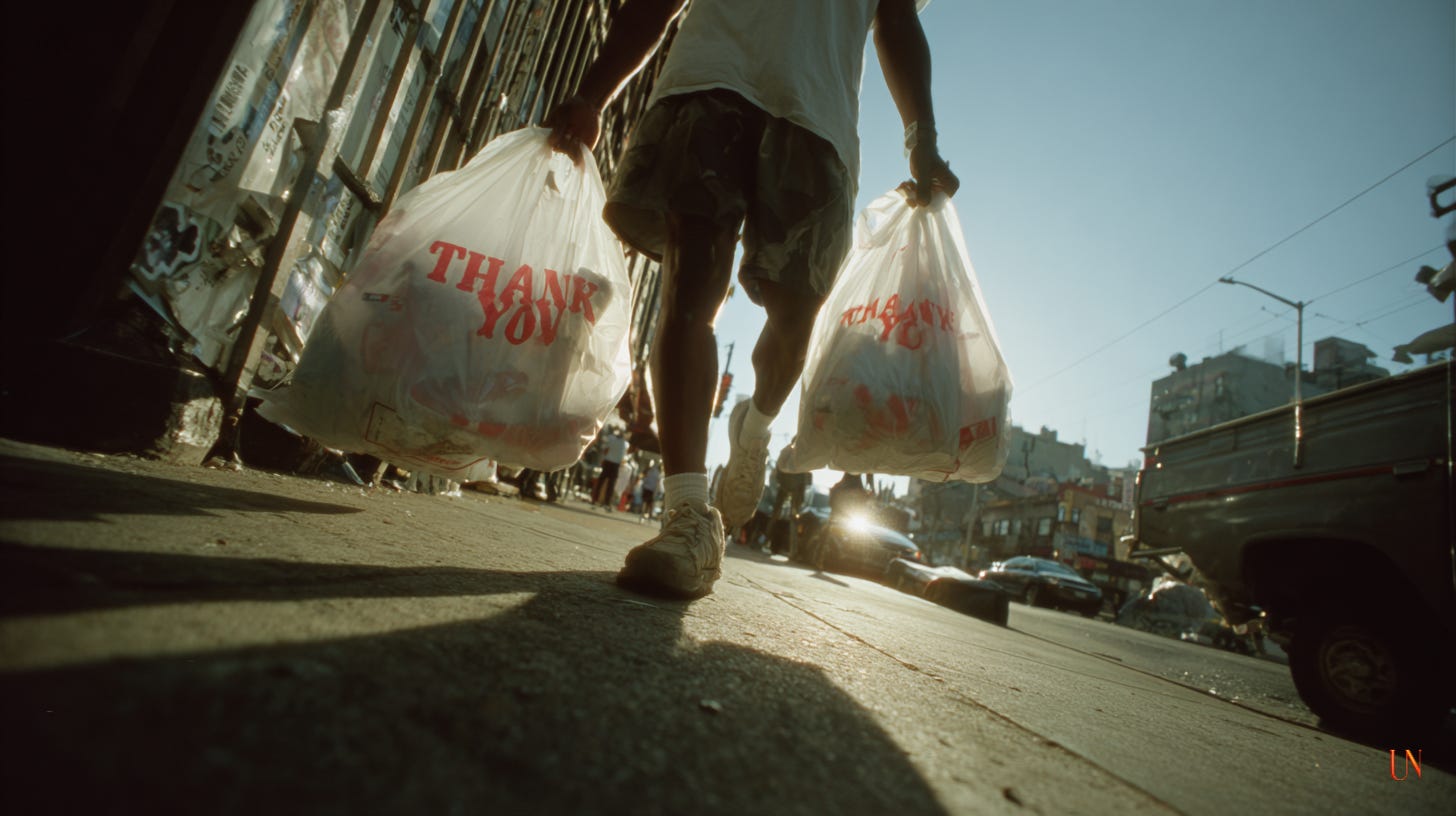
I have heard this question hundreds of times. I will hear it hundreds more. It arrives with the same dependability as the plastic bag that follows it: thin, translucent, stamped with red letters that repeat THANK YOU down the length of the bag like a mantra or a warning.
The bag appears in my mom’s hands already filled: Tupperware of greens, foil-wrapped cornbread, a Ziploc of grilled chicken thighs. She ties the handles twice, the motion automatic as breathing. The double knot is not caution. It is style. It is the flourish that says I am sending you into the world prepared.
This ritual is not unique to my family. Every Black household I have entered contains some version of it. The bag in the pantry holding other bags. The assumption that departure requires provision. The hands that know how to tie plastic tight enough to hold weight but loose enough to untie when you get wherever you are going.
What I am trying to understand is not the sentiment—I have always understood that this is love—but the intelligence beneath it.
What does the plastic bag know that we have learned to know alongside it?
Act like you know
The bag itself is unremarkable. Thin enough to see through, cheap enough to be everywhere, designed to be used once and discarded.
But in Black homes, the bag gets a second life, then a third, then an indefinite run of service that its manufacturer never imagined. The bodega bag becomes the vessel for flour and cornmeal when you are seasoning fish, shaken until the coating clings. It becomes the small trash bag hooked on a cabinet knob during meal prep so you do not have to pause your rhythm to walk to the garbage. It becomes the liner for bathroom waste bins, the protector of wet umbrellas, the organizer of small things that would otherwise scatter.
This is not quaint. This is not the kind of resourcefulness that gets celebrated in heritage months and then forgotten. This is ongoing intelligence, practiced daily, taught without instruction manuals.
My mom never sat me down to explain the uses of a plastic bag. I learned by watching her hands. I learned by needing something sealed, something carried, something contained and finding the bag already waiting in her palm.
The knowledge is inherited the same way language is inherited: through immersion, through repetition, through witnessing what works.
What the bag teaches is a way of thinking about the future. Not hope, exactly, but something more practical. Anticipation.
The bag in the pantry is not there because someone believes they will need it tomorrow. It is there because someone knows they will need it, because need is not a possibility but a given, because the world is structured to require more from us than it provides for us.
The bag is prophecy rendered in plastic.
Each one teach one
There is a history here that the bag makes visible if you know how to look.
Black people in America have always built systems in the spaces where institutional systems failed us or excluded us entirely. Mutual aid societies in the 1780s. Church benevolent funds. Neighbor networks that functioned as safety nets when government safety nets had holes cut specifically to let us fall through.
My grandmother saved bacon grease in a coffee can on the stove, saved glass jars for canning, saved fabric scraps for quilts that would never be finished but whose pieces might be needed. She never explained why. She just did it, and my mom watched, and I watched my mom, and now I do it too.
The plastic bag is the domestic cousin of this tradition: small-scale infrastructure created in the kitchen, the bedroom, the bathroom. It is what you do when you cannot rely on what is supposed to be there being there.
My grandmother never threw away glass jars. Baby food containers became storage for buttons, screws, the small mechanisms of repair. Bread bags were washed, dried, reused until they tore.
She did not explain this practice to my mom. She simply practiced it.
And my mom watched.
And now I watch my mom do the same with plastic bags.
The teaching happens through hands, through repetition, through the quiet accumulation of small preparations that add up to a system. This is how knowledge moves when it cannot move through institutions that were never built to hold it.
My parents grew up in the South in the 1960s and 70s, in homes where running out of something was not inconvenient but dangerous. You did not run out of flour. You did not run out of rice. You did not run out of the things that turned scraps into meals, pennies into portions.
The bag of bags in their pantry now is not a relic. It is a continuation.
It is the knowledge that even in 2025, even with relative stability, even with access that their parents never had, you still keep something extra. You still prepare for the moment when what you thought you could count on stops counting.
The bag in their pantry looks different than the ones their parents saved. The logos have changed. The plastic is thinner, cheaper, breaks more easily. But the logic is identical.
What my parents inherited was not the specific practice of saving plastic bags—it was the understanding that institutional promises are conditional, that access is provisional, that what you think you can depend on can disappear without warning.
This is the knowledge that travels through generations not because we want it to, but because the conditions that require it keep reasserting themselves in new forms.
Integration gave us access to schools that had been denied, but not to healthcare systems that treat us equally. Voting rights legislation passed, but voter suppression adapted. Fair housing laws got written, but homeownership gaps remained or widened.
The bag stays in the pantry because the bag knows what official narratives about progress refuse to admit: that fundamental structures of exclusion have not been dismantled, only redecorated.
So the intelligence required to survive those structures must also persist.
This is what I mean when I say the bag knows something.
It knows that Black people built the railroads, the highways, the cities, the entire infrastructure of American wealth while being denied access to the systems we built.
It knows that in 2025, we are still fighting for basic human rights: healthcare that does not kill us, housing we can afford, voting access that is not actively suppressed.
The bag knows that the distance between what we have been required to build and what we have been allowed to access has never closed.
So we keep building.
We keep saving.
We keep preparing.
The bag is not sentimental. It is evidence.
Some folks don’t believe fat meat is greasy
Let me be specific about 2025, because the bag is not metaphor.
Black maternal mortality rates rose between 2022 and 2023 while declining for other groups. Black homeownership sits at 43.9 percent, the lowest rate since 2021. Funding cuts to diversity initiatives are being called “the largest rollback since Reconstruction” by historians who study these patterns. Voting suppression continues through new legislation that makes the act of casting a ballot an obstacle course designed to exhaust.
These are not abstract statistics. These are the conditions under which the bag remains necessary.
When healthcare systems kill us at higher rates, we keep extra supplies. When housing remains inaccessible, we hold on to what we have. When institutions that claimed progress dismantle the scaffolding before the building is complete, we remember that we have always had to build our own scaffolding.
The bag of bags in the pantry is not nostalgia for harder times. It is recognition that the times have not stopped being hard—they have only changed their wardrobe.
My parents are in their 60’s now. They own their home. They have retirement accounts. They have achieved a version of stability that their parents could not have imagined.
And still, the bag cabinet remains full.
Not because they cannot afford to waste a plastic bag, though waste remains a reasonable concern. But because the logic that put the first bag in that cabinet has never stopped being valid.
You save what you can because you have learned, across generations, that what you think you can count on has a way of disappearing precisely when you need it most.
This is not paranoia. This is pattern recognition.
This is the intelligence of people who built the infrastructure of a nation and were then told they could not use the doors of the buildings they constructed.
The plastic bag is the descendant of that knowledge. It says: do not trust that what should be there will be there. Prepare anyway. Prepare always. Prepare as though your life depends on your preparation, because history has taught you that it does.
God don’t like ugly
I am in my parents’ kitchen again. I have eaten. I have talked. I am preparing to leave, and my dad’s voice arrives from the other room:
“Did you get you some?”
My mom is already at the refrigerator. The bag appears. The handles are tied twice. I carry it to my car, place it in the passenger seat, drive home with the bag beside me like a passenger who knows the route by heart.
What I carry is not just food. What I carry is the logic of people who have been preparing for catastrophe since before I was born, who learned that preparation from people who were preparing before they were born.
The bag is continuity. It is the material form of knowledge that cannot be unlearned because the conditions that necessitated the learning have not been unlearned by the country that created them.
“Did you get you some?” is love, yes. But also indictment.
The question assumes you will need something because it knows you will need something, because America has structured itself to ensure you will need something. Access and provision are not equivalent.
What you helped build is not what you are allowed to fully inhabit.
Tender, the question is also a diagnosis of everything that remains broken about the nation we built with our hands and our backs and our brilliance while being told we did not belong in the rooms where decisions were made.
The plastic bag will leave Black households when the conditions that put it there leave American policy. Until healthcare stops killing us. Until housing becomes accessible. Until voting is not treated as a privilege we must fight to access. Until the infrastructure we built becomes infrastructure we can use without surveillance, without suspicion, without the constant calculation of whether we will be allowed to stay.
Until then, we save what we can.
We keep the bags.
We tie the knot twice.
We ask the question that is not really a question.
We prepare.
Let that be enough—for now.
AUTHOR’S NOTE
I wrote this essay because I wanted to understand what my parents were teaching me every time they sent me home with food I did not ask for.
I thought it was about love, and it is. But it is also about something else, something harder to name. It is about the intelligence required to survive a country that demands your labor and then questions your right to exist. It is about the objects we keep, the rituals we maintain, the questions we ask that contain entire histories in their grammar.
The plastic bag is unremarkable until you pay attention. Then it becomes evidence. Evidence of preparation, of resourcefulness, of the refusal to be caught unprepared by a nation that has always been unprepared to treat us as fully human.
This is not a story about overcoming.
This is a story about ongoing.
About what we keep doing because we have to, because it works, because it is how we take care of each other when the systems designed to take care of us have always had our names on the list of people they were not designed for.
We save what we can.
We always have.
We will continue.
UNSPUN publishes longform essays, op-eds, and visual documents tracing the language of power in real time.
This piece appears in UNSPUN, the publication’s central body of work interrogating truth, language, and the systems that shape both.
To engage or contribute, write to taylorallynofficial@gmail.com, or follow UNSPUN for new releases and ongoing dialogues.
If something in this piece stirred you, that stirring is the point. Subscribe below to keep listening for what language can still heal.

Every word here is researched, written, and sharpened by one person—me. If you value work that names what others won’t, consider becoming a paid subscriber. It keeps this space independent, and it keeps pieces like this possible.
I didn't read this yet, and will have a better comment when I do, but the title popped up in my notifications and I immediately started singing a song to myself by Busta Rhymes and Q-Tip called "Go Get You Some" and wanted to thank you for reminding me of it 😂
"because the world is structured to require more from us than it provides for us."
This line stuck with me through the entire article. It felt like the fuel that kept it all moving. People all across this supposed land of opportunity, are expected to put in more than they will ever receive, an inherent and unending poverty built into the systems that claim to support us, claim to be necessary. Where would these systems be without the labor that built them? Where COULD these systems be if they put back into those laborers the same energy that was given?
I love the real community created by the things you speak on in this article, it is beautiful, collective, and very literally what this world needs more of, but I am always disappointed about the conditions which have forced people to create these communities. That said, this is the stuff that makes me believe in people, believe in my "crazy beliefs" that we don't need money to survive, let alone grow. People will provide for each other, and as you stated it's more than love, it's practicality. It makes rational sense to give to each other because what you give to others will come back to you. It is sad that we live in a world that doesn't recognize the beauty of community, one that forces people to build community from trauma and fear, rather than love and collectivity. Thank you for this discussion, my gratitude extends to your parents who taught you the importance of preparation and collective care. It is because of people like them that I believe humans will one day find their place, even if that day comes after I leave this world.