

Donation Prompt
On Becoming Evidence


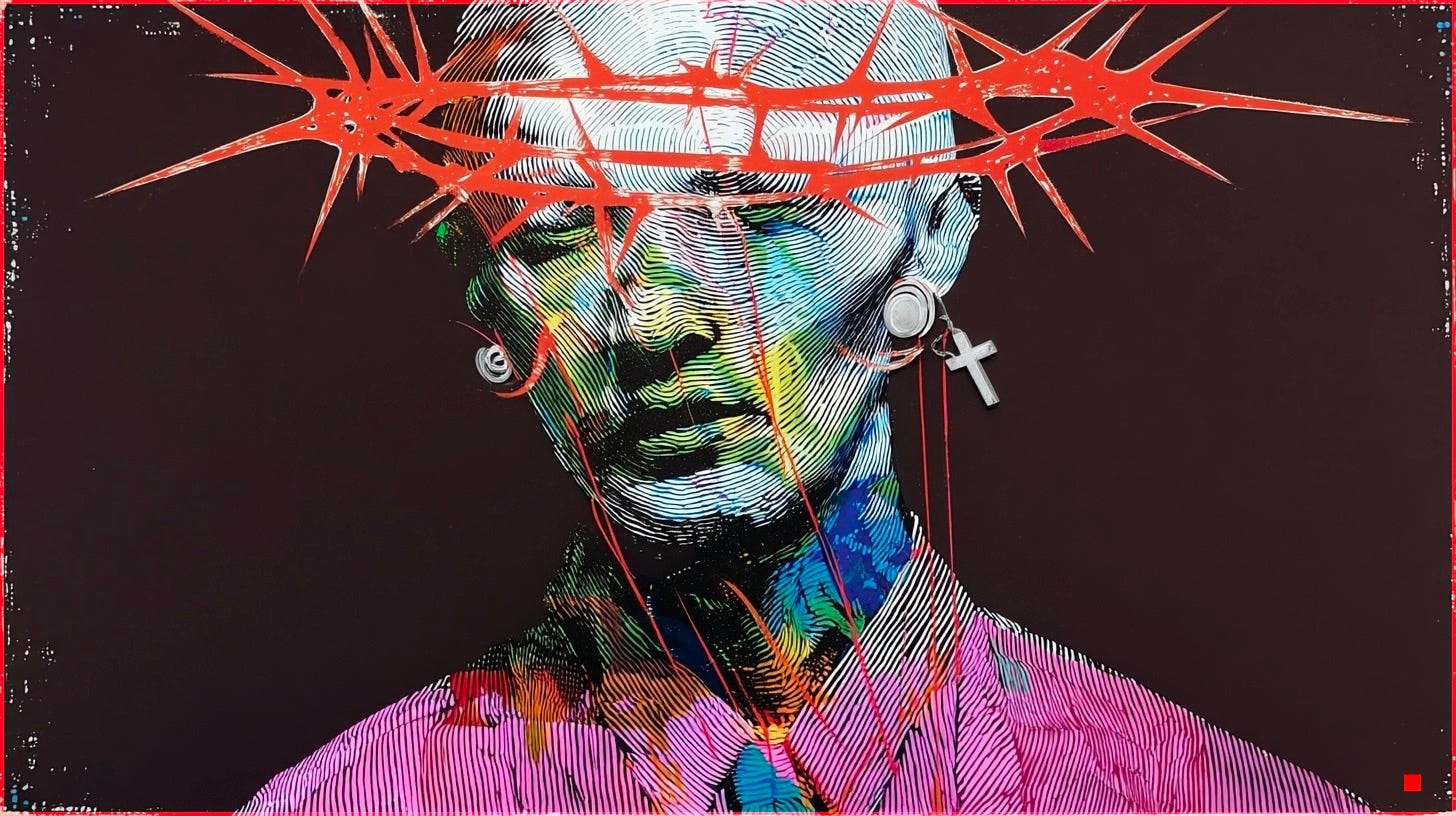
“The body that survives is not always the body that is believed.”
— Cyrée Jarelle Johnson
I wore couture to my own erasure.
Off-white silk cut into strips by my hands, some trailing to the floor. Black tailored pants. Seven-inch platforms I’d only survived once before, on Halloween, when height could still be costume instead of confrontation. The top took hours the day of the event, each ribbon placed like I was preparing to be seen, not studied.
When I walked into the Sheraton ballroom for DIFFA Dallas 2024, people called it haute, exquisite, said I looked like I belonged on the stage instead of the floor.
My best friend’s painting hung near the auction block, acrylic hours waiting to be converted into someone else’s tax deduction. Chosen family filled our table, the people who kept me living long enough to be eligible for nights like this. Around us, hundreds of bodies in black tie, mostly white, mostly comfortable. Gay men in well-cut suits, white lesbians in their variations on formal, a scattering of Black and brown faces if you squinted.
The thought arrived before the salad:
How many people in this room only remember us tonight?
Later, I would look up the numbers.
In that moment, I understood my role. I was not guest, not exactly.
I was evidence.

The man on the screen looks like someone you might know.
He is laughing, teeth bright, shoulders soft, body positioned in that careful intimacy advertisers love, close to friends but not touching too much. He is on a rooftop, or a living room couch, or leaning against a mural designed to say urban without saying where. The colors are saturated but tasteful. His T shirt fits like it was measured in focus groups. Behind him, a city blurs into bokeh.
The copy says something like You can’t tell by looking. The voiceover says Keep being you. The small print says what they are really here to deliver: Talk to your doctor about prevention.
He is Black.
Of course he is Black.
Sometimes he is the only Black person in the frame. Sometimes he is surrounded by a perfectly curated mix of friends that signals diversity without disrupting whiteness as default. He laughs, jogs, clinks glasses, walks down the street in slow motion.
Black men are the face of risk and responsibility.
The commercial calls itself education and hands the audience a script on who to fear, who to watch, who to want.
The camera does not just warn. It lingers. It traces his jawline, the angle of his smile, the way his shirt hangs off his chest. It teaches people how to look at Black men: as danger wrapped in desire, as sex wrapped in statistics.
Living with HIV appears in clean sans serif font, white on blue or yellow on black, a phrase that flattens the entire expanse of a life into one continuous with. The living is background. The with is the point.
You see it in your inbox later. Messages that open with I love poz guys or Always had a thing for Black poz men. Someone calls you toxic dick like it is a compliment. Someone says they like it risky and adds breed me if you dare.
They have learned to want you.
Not in spite of the virus, but because of the script the commercial wrote on your skin.
The language travels.
Living with. Brave. Survivor.
Words from clinic pamphlets and World AIDS Day posts show up repurposed as dirty talk. Love how brave you are about your status. Hot that you’re living with it and still out here. Awareness turns you into an object lesson and an object of fantasy at once.
Then the other side of the lesson.
You are on a date, or on a couch, or in a parked car where the windows are starting to fog. There has been laughter, hands on knees, maybe a palm resting easy on your thigh through denim. Breathing is synced without anyone naming it. You disclose the way you have practiced: steady, clear, no apology tucked into the wording.
There is a pause. Sometimes it is a fraction of a second.
Sometimes it is long enough to hear the HVAC. You feel the air change texture. The body across from you does not leap away. That would be too honest.
But something pulls back just beneath the skin. The hand on your leg lifts, hovers, lands somewhere safer, like the arm of the couch. Eye contact starts to skid. They blink more. They swallow. The room rearranges itself around the word you just released.
You watch them remember every commercial they have ever seen. They recall slogans about undetectable equals untransmittable, but the lesson that sticks is older: do not catch it.
As if the virus can leap through fabric, through air, through the half inch of space widening between your bodies. Touch that was casual, easy, invisible a moment before becomes a calculus problem.
Their breathing goes shallow, then controlled. They smile to prove how okay they are, but their shoulders lean toward the door.
Prevention turns your body into a cautionary tale even in rooms where no one is saying the word risk. Awareness trains them to see you as a walking infographic. The virus cannot survive outside the body, but people act as if you are spillable. As if every brush of your sleeve requires a moral decision.
And somewhere far from that room, under chandeliers and branded step and repeats, 50 million dollars have moved through a ballroom over more than 40 years. Long tables, black napkins, speeches about community support and serving the needs of the LGBTQ+ community. The beneficiary list reads like a litany, but when you scan it, you do not see many organizations led by people who look like the man in the commercial.
One of the few, Abounding Prosperity in South Dallas, was founded to address HIV and other disparities among Black men and their families. A separate institution built to catch what the others kept missing. Year after year, the money consolidates around institutions fluent in grant language rather than those fluent in the bodies most at risk. The money flows steadily to foundations, centers, coalitions. The bodies that made the crisis legible are thanked from the stage and rarely trusted with the checkbook.
On Saturdays, you stand in a different line. No gowns, no tuxes. Plastic trays instead of plated dinners. The room smells like steam and canned tomatoes and overworked dish soap, that heavy warmth where hope and despair simmer in the same air. Gloves snap. Carts rattle. You are toe to toe with people whose lives will never appear in a gala slideshow. No one calls this brave. No one uses the phrase living with as a compliment.
You learn the names of the men shaking in oversized coats, the women who count their belongings twice before sitting down, the kids who have learned to sleep light. Here, nobody needs a commercial to know what survival looks like.
Their one night in black tie, your weeks of showing up in jeans. Their community support logged as line items and impact reports, your conversations with people who do not know your status and do not need to because they are too busy keeping their own hearts beating.
The man in the commercial never speaks. Neither do you in rooms that claim to remember.
Who gets to be protected.
Who is just proof the protection looks good on camera.
They hand you a clipboard before they hand you water.
Name, they ask first. Date of birth. Medical record number. The pen moves faster once the boxes start. Sex at birth: M or F. Current gender: a short row of letters and a line for Other. A whole life in that blank inch.
Race, but only one. Black or African American sits at the top of the list, waiting for its checkmark. Below that, the real questions: HIV status, date of diagnosis, viral load, CD4. A line for primary risk factor with its little alphabet of suspicion, MSM, IDU, heterosexual contact, other. At the bottom, a choice between compliant and non compliant. Your entire history with pills and poverty and trust, circled in blue ink. Before anyone looks up to see your face, the paper has already decided who you are.
Then there is the second layer, the one you never see but can feel in the way people talk around you. Services rendered: one line in a database that reads like a receipt. Intake completed. Benefits screening. Transportation voucher. Medication adherence counseling. Each visit broken into billable units, quarter hours stacked like bricks until you become ninety minutes of direct client contact. Somewhere, a report will say: 127 unduplicated clients served. 92% retained in care. 87% virally suppressed.
You are in that math, but not by name.
You exist as a percentage point, proof that the program is effective in improving health outcomes among high risk populations. Your appointments become outcomes achieved. Your crises become justification for continued funding at current or increased levels. The same viral load that once terrified you now appears as evidence that the intervention worked, first as a number too high, then as a number low enough. Both states useful, so long as they can be counted.
In the file, you stop being patient and become client.
Client presents as calm, well groomed, in no acute distress. Client reports adherence most of the time. Client denies current suicidal ideation. Client endorses occasional alcohol use. The verbs pile up like disclaimers, presents, reports, denies, endorses, each one a reminder that what you say will be translated before it is believed.
Affect: appropriate. Mood: okay. Orientation: person, place, time, situation. Insight: fair. Judgment: fair.
The word fair repeats, a polite way of saying not good enough yet.
In the margin, a note: client appears guarded but cooperative. No one writes that you have learned what happens when you are not.
They never use your name in these notes. Not the one your grandmother gave you, not the one your friends call across crowded rooms. Client missed last appointment. Client unable to provide documentation. Client encouraged to explore additional resources. Even your failures are written in the passive voice, gently pinned to the page like butterflies, wings spread for inspection.
The funding story never uses your voice. It uses your body.
In the proposal, you appear as projection first. We anticipate serving 150 HIV positive Black men in the coming grant year. You are need in future tense, a number that makes the crisis legible on page three.
Later, you return as success: Since project inception, the program has demonstrated significant improvements in viral suppression and retention in care among high risk populations. Your fear, your pills, your bloodwork, translated into evidence based.
They describe you as disparity, as burden, as gap. Our program addresses persistent health inequities affecting Black MSM in the South. They mention transportation barriers, housing instability, stigma. They do not mention your name. Charts bloom in the appendix: bar graphs of clients reached, line graphs of viral load reduction over time. Somewhere near the end, the ask: Continued funding at current or increased levels will allow us to expand these life saving services.
Your life is the footnote that makes the numbers honest. Your story opens doors in rooms you will never enter. You sign nothing, but your body co signs every dollar.
Tuesday afternoon, I am arguing with a sentence.
The clause is too heavy at the front, so I move it to the end. I test where the breath should fall, where the consonants should land, whether the word still belongs in the middle or needs to be cut entirely. The laundry buzzes finished in the other room. My phone lights up with a notification I ignore. I say the line out loud three times, listening for the exact moment it stops sounding written and starts sounding inevitable.
Outside, someone is mowing a lawn. The sound comes in waves through the walls of my home, a rise and fall that keeps time with my revisions. I am thinking about the shade of red in the painting my friend made, whether it will clash with the teal I chose for the cover mockup, whether the image needs more white space. I am wondering if I have enough garlic for dinner. I am not thinking about my viral load.
But if you filmed me from the right angle, this becomes a lesson. Black queer person at a desk, laptop open, pill bottle just out of frame. Caption about resilience, about living with, about how far we have come that people like me can sit in homes and work on essays instead of dying in hospital beds. My Tuesday could look like a victory against something.
It is just a day I am trying to get a paragraph right.
Most days are like this, small decisions no one will ever put on a brochure. Which mug to use for coffee, which playlist is loud enough to drown out the busyness of suburbia but soft enough that I can still hear my own mind. Whether I answer a text from someone who only reaches out when they want to feel enlightened for knowing me. How long I can sit in silence before the urge to check email wins.
The way I stand too long in the detergent aisle, reading the backs of bottles for a scent that smells like my grandmother’s house but does not exist anymore.
In the grocery store, I am there to make healthy choices, proof that people living with can manage their wellness. I am usually comparing prices on pasta, wondering whether I can justify the good olive oil this week.
At home, when I forget a dose and remember hours later, the story they would tell about that moment is discipline, responsibility, adherence.
The story I tell myself is simpler:
I am human, distracted, trying not to burn the onions.
They always call it an opportunity.
An email from a health nonprofit lands in my inbox with too many exclamation points. We would be honored if you could share your story at our upcoming forum. Your lived experience would really help people understand the impact of HIV in our community. They offer a $50 gift card and networking with community leaders as compensation. Attached is a flyer draft with a silhouette meant to be me, brown, head tilted back, mouth open like testimony is a reflex.
They already know what part of my life they want. Not the Tuesday afternoons with garlic and sentence structure, not the detergent aisle, not the shelter line conversations that never make it into recaps.
They want the diagnosis year. The hospital room. The disclosure that went bad. They want me to bleed on stage in a way that looks like healing.
When I finally reply, I ask what they need me to cover. The answer comes back fast: stigma, resilience, the importance of staying in care. Three bullet points, like a sermon outline. My grief, preformatted.
When I say yes, the script is already written.
The moderator introduces me with numbers first. Rates of infection. Disparities. A slide with bar graphs in red and blue. Then my name, like a citation. I walk to the podium and feel the room lean forward. Hungry in that quiet, earnest way. People who think they are about to learn something that will make them better.
I tell the story they asked for: the night of the diagnosis, the first time I took the pills, the friend who stopped touching me after I disclosed. Laughter where I have learned to pause. Silence where I have learned to hush them. I can feel myself narrowing to fit the shape they built.
During questions, they rarely improvise. How did your family react. When did you finally accept it. What advice do you have for someone who just found out. Someone asks if I am dating, if I disclose right away. Someone else wants to know what my lowest point was, like there might be a diagram in the answer. They thank me for my vulnerability as if they did not just mine it. They tell me I am so brave, that my story really puts things in perspective. I watch them file out with full hearts and empty hands.
When I say no, the tone shifts.
The next paragraph opens with Of course we understand if you are not able to participate at this time, then gently reminds me how important it is for people living with HIV to be visible. Sometimes they add a line about how my perspective could really make a difference for others.
The subtext is clear: refusing to perform my pain is a kind of negligence. I am withholding a resource. I am not doing my part.
Advocacy loves a useful body. A survivor who can hit all three talking points and still smile for photos. A story tidy enough to fit into a ten minute slot between a keynote and a coffee break.
They do not ask what it costs to open the wound again.
Only whether I am available on Thursday. Whether I consent to being recorded for future trainings.
I am not a teachable moment.
I have given enough blood to labs and enough words to rooms that only wanted my ruin in digestible form. I have watched people take notes on my worst nights like they were collecting recipes. I have listened to strangers tell me what my story means for public health, for policy, for hope. I am done letting other people decide what my life is evidence of.
I refuse to be the brave one on command.
I refuse to turn my diagnosis into curriculum for people who will go home unchanged except for feeling slightly more enlightened.
No more panels where my presence is the only Black body on stage and someone calls it progress. No more questions that treat my trauma like an open book exam.
I choose where my body goes now.
Sometimes. When I have the leverage.
Not to prove that services work. Not to prove that stigma still exists. Not to prove that people living with HIV can thrive. I already know that.
If you want to know the cost, look at the forms, the metrics, the case notes. My silence will be data enough.
I will write what I want, when I want.
For the people who meet me as person first and politic second. I will stand in the shelter line without announcing it online. I will argue with my sentences without turning every paragraph into testimony. I will keep my ordinary days for myself, my garlic and playlists and detergent aisle grief, unless I decide otherwise.
If you need a story to justify your funding, find another body.
If you need a survivor to make your gala feel urgent, call someone else.
I am not your impact statement. I am not your lesson.
I am here, still living, without the with.
And I am tired of saying so.
Let that be enough—for now.
Author’s Note
I have been doing this long enough to tell the difference.
15 years of clinics, coalitions, campaigns, long enough to know who comes with questions because they are willing to change, and who comes because “learning about HIV” looks good on a grant report or a dating profile.
I can feel it in the first ten seconds.
The tilt of the head.
The way they say thank you for your transparency like it is a favor I did for them and not work I did on myself to stay here.
Writing this did not cost me invitations. It cost me patience.
And something else I am still measuring: the ability to sit quietly in rooms where extraction is happening and not say anything.
I used to be able to do that. I used to be able to smile through the panel, cash the gift card, and go home knowing I had participated in something that would not change anyone. I cannot do that anymore without the words from this essay sitting in my throat.
What I cannot take back now is the standard I have set in public.
I have said out loud that I deserve more than performance from the people who claim to stand beside me. That means I have to hold that line, even when I am tired, even when silence would be easier, even when saying so costs me the room.
Some doors will close because I wrote this.
They were doors I was tired of walking through anyway.
UNSPUN publishes longform essays, editorial encounters, and visual documents tracing the language of power as it operates in real time.
This work appears as part of UNSPUN’s ongoing inquiry into how authority circulates, how permission is granted, and how silence functions as structure rather than absence.
If something in this piece altered your footing, that alteration is intentional.
What follows does not ask for agreement. It asks for attention.
UNSPUN continues for those willing to stay with the work as it unfolds.
“Black men are the face of risk and responsibility.
The commercial calls itself education and hands the audience a script on who to fear, who to watch, who to want.
The camera does not just warn. It lingers. It traces his jawline, the angle of his smile, the way his shirt hangs off his chest. It teaches people how to look at Black men: as danger wrapped in desire, as sex wrapped in statistics.”
You take my breath away, Taylor. Lord, what a gift. 😭