



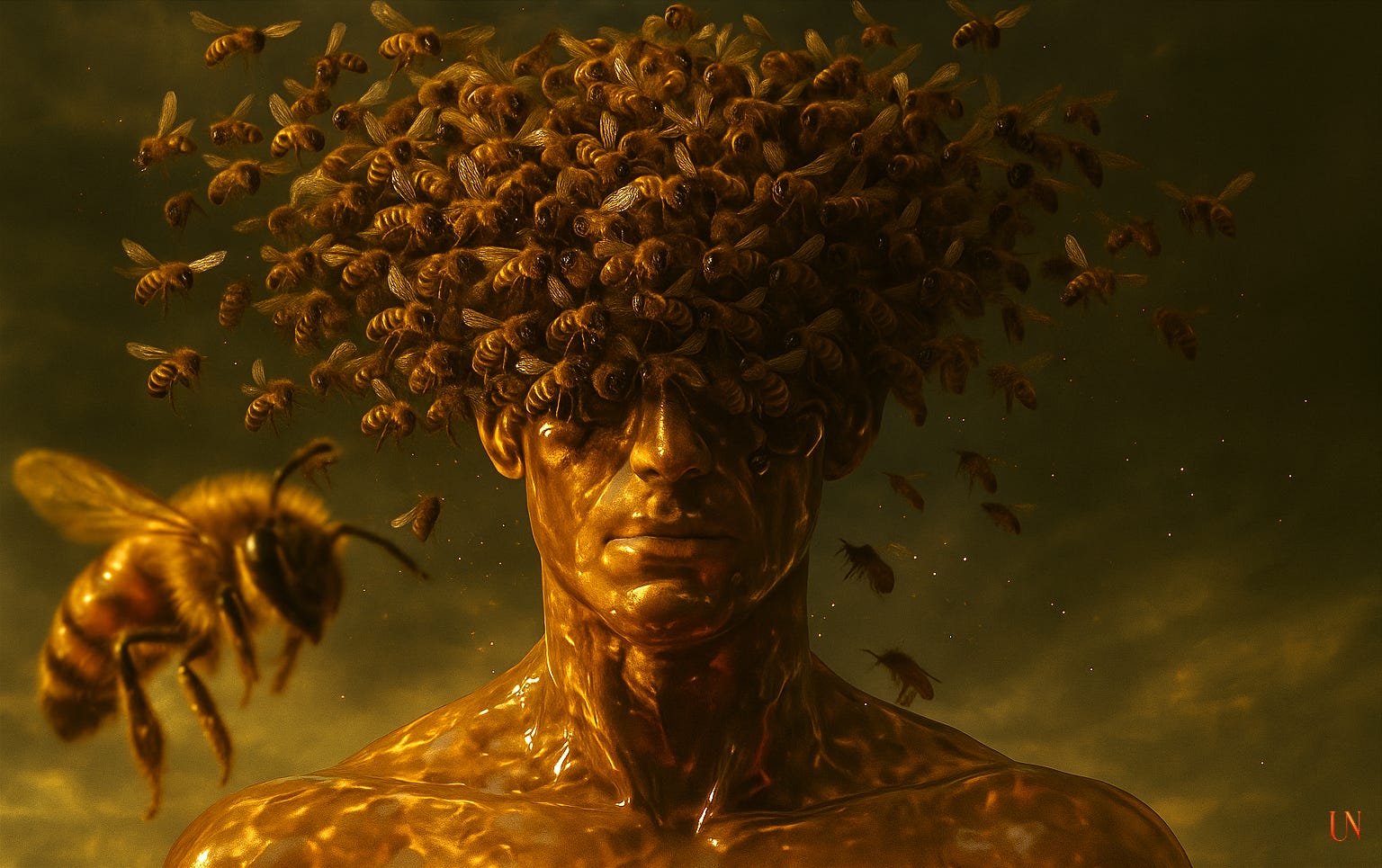
“We hid in plain sight, waiting, watching. Time collapsed; there was only smoke and ash.”
— Apis Dea
Before the Wing Moves
(Preface)
Some work asks to be hurried through. This is not that work. The Bee Emissary warrants a slower reading, one that honors its careful weather and the people who move within it. Across forty-nine chapters currently, Apis Dea composes an archive of tenderness: a grandson, a grandfather, a country on edge, and a living chorus of bees that keep insisting on continuity. What’s astonishing is how the language itself hums—low, deliberate, like wings held just above water. Few serialized fictions sustain both wonder and precision this way; Apis does, chapter after chapter.
The early chapters begin in sunlight and field, then carry us through airports, kitchens, workshops, and the quiet rooms where grief changes the air. Patience becomes form. Care becomes plot.
This feature will unfold in parts because the work itself unfolds that way. To compress it into one pass would flatten the very qualities that make it sing: its restraint, its moral clarity, its belief that small, faithful gestures carry the most weight.
Part I attends to Chapters 1 through 16, the foundation. Here we meet Robbie and his grandfather, the keepers of hives and histories. Here the hive speaks in a collective we, and a buried box turns preparation into love. Here the fire arrives the way real catastrophe does—by logistics and silence—and the sentence that follows refuses spectacle: “There was no past, present, or future. There was just smoke and ash.”
What follows will braid two lenses, literary and soul. The first studies craft, structure, voice, and the disciplined transparency of Apis’ prose. The second listens for what the work holds beneath the lines—the theology of maintenance, the weather of love, the insistence that listening is a technology.
I will quote the work directly throughout, not to decorate the review but to let it testify to itself.
Part II and Part III will arrive in rhythm with that same ethic—deeper into science, aftermath, and continuance.
For now, we begin where Apis begins: with attention.

The Hum Before the Fire
(Chapters 1–6)
Before the ash, there is only quiet work. Apis Dea begins The Bee Emissary in the voice of the hive itself—an audacious choice that lands with eerie grace. “We hid in plain sight, waiting, observing,” the narrator declares, and with that, the work folds myth and science into one breath. The bees speak not as ornament but as witness, as a consciousness older than the human timeline they watch over. Their collective voice opens the work like a prayer that knows its own extinction is coming.
Apis writes with the calm precision of someone who trusts restraint more than spectacle. “The morning sun filtered through the hive’s opening, revealing motes of golden dust,” the text observes, and suddenly the natural world feels devotional—science bent toward reverence. What distinguishes this early section is not plot but listening. The bees do not rush the reader toward apocalypse; they linger in the labor of noticing. The hum is language, vibration, warning. Even the silence has texture, like air thick with the memory of smoke not yet born.
Then, without sentiment, the focus narrows to Robbie Apoidea, the grandson whose surname quietly carries the Latin for bee. Robbie’s bond with his grandfather, Bob, feels unforced—rooted in shared observation rather than dialogue. “Grandpa talked to the bees and believed they talked back.” A line like that carries its own theology, one that collapses the boundary between communion and research. In lesser hands, this might read as fable; under Apis’ discipline, it becomes fieldwork of the soul.
By Chapter 4, the work’s moral weather begins to shift. The family’s separations—his mother overseas in military service, his grandfather tending his hives in Door County—mirror a country stretched thin between devotion and disaster. Yet even here, tenderness persists. When Robbie says, “I sent mail to the base in Germany, and they forwarded it,” the sentence lands with quiet ache. Distance becomes another kind of correspondence, faith extended by postage.
Apis’ pacing through these opening chapters is deliberate. The prose mirrors bee movement—precise, methodical, rhythmic. Each sentence builds toward the first rupture without ever announcing it. When the Door County fire arrives, it does not feel sudden; it feels inevitable, the fulfillment of a warning the bees have been murmuring all along.
“Black and gray ash covered the streets and sidewalks, with some becoming airborne with each of my steps.” That single sentence, plain and unembellished, carries the emotional gravity of a eulogy. Apis understands that restraint can wound more deeply than description. In the silence that follows, the reader feels what Robbie cannot say: that loss is not loud—it smolders.
This early stretch places Apis within a lineage of world-builders who treat science as sacrament—writers like Le Guin, Powers, and Okorafor—each turning data into devotion. Yet Apis does something rarer still: binds ecological grief to familial tenderness without ever preaching it. The result is not a warning but a witness.
Science becomes liturgy; grief becomes inquiry. The reader is left holding a question the serial will spend its next forty chapters answering:
What does it mean to speak when every living thing has already warned us?
The Fire and the Algorithm
(Chapters 7–12)
Grief enters Apis Dea’s world the way weather does—not as plot but as pressure. The Door County fire, which levels both land and lineage, turns The Bee Emissary from a story about ecology into a study of what survival sounds like. By the time Robbie reads that no one north of Valmy has “registered at any shelter since the fire began,” the language itself has thinned. Each sentence feels inhaled through smoke.
Apis resists the sensational. There are no cinematic flames, no orchestral panic. Instead, the fire reveals itself in fragments of logistics: lines of displaced bodies, halogen lights over grief, an aid worker’s soda can glinting in the exhaustion. “The tent was huge, feeling like an indoor football field…halogen lights illuminated the interior so brightly that it felt like a sporting event—the hum of conversations blended with the hum of the power generators.” The repetition of hum isn’t accidental. The bees’ collective sound has transmuted into human machinery, a sterile echo of what the natural world once offered freely.
The passage where the firefighter gives directions—“Go to the bathroom before you get in line and bring that water and chips. You’re going to be there awhile.”—is quietly devastating. Apis shows compassion through instruction, tenderness through bureaucracy. This is one of the work’s great strengths: emotion delivered through procedure.
When Robbie finally reads the news on the Resch Center Jumbotron—“No one north of Valmy had made it out so far”—the page feels like a held breath. Apis does not dramatize his grief. He sleeps in a stairwell instead. He wakes to “a body aching.” He eats but “tasted nothing.” These ordinary verbs—sat, leaned, ate, woke—become the syntax of trauma.
From that ash, a new element enters: the scientific instinct to translate pain into inquiry. Twany Retton, the computer scientist from British Columbia, arrives like an emissary of the future. Her introduction is light, almost flirty, but Apis writes her with the precision of someone crafting an instrument. “She wore a white T-shirt and black pants. White socks and black tennis shoes completed her outfit. Had she worn chains, I might have assumed she was Goth.” It’s a small detail, but it shows Apis’ restraint: the camera lingers not to fetishize but to notice, to humanize the presence that will soon reshape Robbie’s entire understanding of communication.
Twany’s research—to “develop an algorithm for an acoustic-video model to understand bees’ language and turn that understanding into human-bee communication”—is the work’s hinge. Here, grief and science begin to rhyme. Robbie’s grandfather listened to bees with faith; Twany listens with code. Twany’s code becomes a new kind of listening, a syntax of devotion disguised as circuitry. Where his grandfather prayed to bees, she programs them. Both are acts of faith in translation.
Apis handles this shift without collapsing into allegory. The prose remains grounded in the tangible: “A book entitled Infra-acoustics and Insect Language fell out, along with a note…This book may interest you and your grandpa.” Objects replace sermons. Letters, emails, brown envelopes—each one becomes a form of communion across death.
The emotional centerpiece of this section belongs to Ned, the grandfather’s friend who survives the fire by taking “his fishing boat out into Lake Michigan till I ran out of gas.” His call to Robbie gives the story its most human line: “He said you’d know where to find it if anything happened to him.” The mysterious box becomes the serial’s first moral equation—the thing left behind, the inheritance that is both literal and spiritual.
And when Robbie finally walks the charred ruins of Door County, Apis turns language to near-ashes:
“Did the world fall silent and mourn along with me? If my grief had a voice, would it break this silence with a scream?”
That line reads like scripture in lowercase. It’s also the emotional thesis of the entire work: grief as frequency, silence as proof of love.
By the time the chapter closes, with Robbie watching the President promise restoration, we understand that The Bee Emissary is less about apocalypse than aftermath—the long ache of surviving a world still on fire.
Apis merges ecological realism with speculative ethics, making the fire not a disaster story but a creation myth in reverse: a godless Genesis told from the smoke outward.
Where most writers would mourn, Apis measures; where most would measure, Apis listens.
The Hive Thinks Back
(Chapters 13–16)
By the time Twany returns to the page, the fire’s silence has hardened into structure. Absence is no longer smoke; it’s method. Apis Dea shifts tone again—from elegy to experiment—without breaking the emotional current. “The morning after returning from Door County, I buried my grief and uncertainty by throwing myself into work; I read all the literature on bee communication, and then I called Twany.” The sentence feels procedural, but it’s also confession: research as resurrection.
Twany answers, and the room fills with human sound again. “Rob! I’m so sorry… you must be gutted.” That single word—gutted—opens the work’s next chamber. The scientific project becomes an exoskeleton for loss. In her company, Robbie finds a language sturdy enough to hold absence. The algorithm is not a replacement for prayer; it’s what prayer evolves into once belief learns to code.
Apis renders this partnership with restraint that borders on tenderness. “She reached across the table and took my hand. ‘Hey, it’s going to be okay.’” There’s no flourish, no narrative manipulation, only the soft choreography of care. Yet beneath that quiet scene, the work’s central transference occurs: communication passing from grandfather to grandson to colleague, from voice to vibration to data.
The chapters that follow—dense with lab detail, camera arrays, and sterile corridors—could have dulled under a lesser writer. Instead, Apis uses precision as intimacy. “Each sentence builds toward the first rupture without ever announcing it,” you could say of this section too. We watch Twany and Robbie walk through the double doors of the apiary, dressing in “bunny suits” and filtered air, an environment as sterile as the world outside is scorched. Yet every description hums with something organic: fear, curiosity, attraction.
Apis lets humor flicker like light between them. When Twany jokes, “I bet you look dashing dressed in white,” and Robbie blushes, the moment lands like sunlight after ash. Their rapport builds trust not only between characters but between disciplines. “We need to know that for camera and microphone placement,” she explains, describing how “100 miniature cameras” will map bee behavior across petabytes of data. In Apis’ world, measurement becomes an act of devotion; the experiment, a form of prayer.
“The customized software used to run the equipment enables each camera to follow the behavior of each of 100 bees. The microphones are sensitive to the location of each of the 100 surveilled bees, allowing us to match movement with sound.”
It reads like scripture for the digital age—precision elevated to liturgy. Robbie’s ache no longer collapses him; it mobilizes him. The work transforms mourning into methodology.
And still, politics circles the lab like static. In Chapter 15, Dr. Carlson’s course The President and the Environment becomes the crucible where Apis tests faith against ideology. The dialogue reads like a mirror held to our own moment:
“Many consider Nixon the consummate politician…Are you surprised politics motivates politicians, not morals?”
When the students rebel, tearing their syllabi, the gesture feels apocalyptic in miniature—a symbolic burning that mirrors Door County’s physical one. Apis makes the classroom feel like an ecosystem in decay—each student reacting like species under heat. The eruption exposes the novel’s deeper thesis: that ecological collapse and political collapse share the same origin—an impatience with interdependence.
“Historically, extreme emotions have led to extreme choices, which rarely end well for a democracy,” Dr. Carlson warns. What follows is not despair but revelation: in a world deafened by outrage, even a bee’s hum becomes radical.
Chapter 16 seals the transformation. Robbie’s neighbor, packing to flee the country, tells him, “Our parents insisted we return home at once…they feel that if elected, General Walters will no longer welcome foreigners, especially Muslims, in your country.” The novel’s scope widens again—from ash to algorithm to authoritarianism. The hive becomes metaphor not for order but for conscience: a fragile collective mind that knows when its queen has turned cruel.
By the final paragraphs, with Walters elected and silence falling like soot, Apis leaves us inside a void charged with signal. The old hive has burned. A new one, digital and uncertain, hums somewhere in the circuitry. What began as mourning now speaks fluently in the language of systems.
It’s tempting to read this as dystopia, but The Bee Emissary offers something subtler: endurance as syntax, communication as love. Every signal Robbie and Twany decode—every camera, every hum—is a form of faith that refuses extinction.
The hive thinks back. The world, though wounded, still answers.
What the Hive Remembers
There are stories that end with revelation, and then there are stories that end with return. The Bee Emissary belongs to the latter—the slow homecoming of attention to itself. After sixteen chapters, what began as a family narrative and ecological parable becomes something vaster: a record of how intelligence survives grief.
Apis Dea does not write spectacle. She writes weather. She lets the human and the nonhuman move through one another until their boundaries blur: memory as pollen, mourning as fieldwork, science as liturgy. The bees are not symbols; they are systems. They hum where faith used to be.
Throughout these early chapters, Apis builds a theology of maintenance—the idea that care itself is sacred infrastructure. The grandfather tending his hives, Robbie rebuilding his world through data, Twany listening for patterns in sound: all are different ways of staying. Of refusing the sedative of despair.
“Did the world fall silent and mourn along with me?” Robbie asks in Chapter 12.
The answer, through Apis’ hands, is no. The world was mourning with him all along.
What makes this work astonishing is its refusal to separate tenderness from rigor. Each paragraph feels balanced on a single filament of responsibility—to truth, to feeling, to form. Even when the story turns political, its pulse remains personal: the hive as mirror of nation, the algorithm as inheritance of prayer.
Reading The Bee Emissary feels like standing at the edge of a burned field and hearing something move beneath the ash. Not rebirth exactly, but recognition. A low collective hum, unafraid to remember what still moves beneath it.
The hive does not forget its dead. It builds around them.
WHAT FOUND ME
What I love about Apis’ work is how it reminds you that wonder is not naïve—it’s disciplined. To read her is to feel the weight of craft behind every quiet. She doesn’t announce brilliance; she practices it. Every scene, every silence, feels earned.
In these first sixteen chapters, I found something I didn’t know I’d been missing: reverence without performance. The kind that lives in gesture, in sustained attention. The kind that doesn’t need to convince you, because it already believes.
I thought I was reading a story about bees. Then about fire. Then about grief. But somewhere between the stillness of the grandfather and the circuitry of Twany’s lab, I realized what The Bee Emissary is really studying—continuity. How language, like a hive, can keep building even after loss. How communication can inherit what prayer leaves behind.
In her work, I found not only her truth but the quiet invitation to remember our own—to listen more carefully to what endures, to what hums beneath despair and still calls itself life. There’s something holy in that kind of listening, something almost ancient in how gently Apis restores faith in the unseen.
This is not a world in ruins. It is a world in translation.
And Apis, in her quiet way, is translating us back to ourselves.
Let that be enough—for now.
If this work moved something in you, let it. Leave a note below, share what lingered, what hummed after the reading. I’ll gather your reflections as we move into the next installment—listening, together, for what the hive remembers next.
Part II of “The Bee Emissary and the Weather of Love” arrives next Tuesday, continuing our journey through Apis Dea’s extraordinary world—from the language of survival to the architecture of consciousness itself.
MARGINS highlights voices shaping the contemporary canon—writers, artists, and thinkers who expand what language can hold.
This feature is part of MARGINS, an ongoing series dedicated to literary craft, witness, and the politics of imagination.
To engage or contribute, write to unspunworld@substack.com or follow UNSPUN for future features.

Every word here is researched, written, and sharpened by one person—me. If you value work that names what others won’t, consider becoming a paid subscriber. It keeps this space independent, and it keeps pieces like this possible.
Thank you for your tenderness and insightful analysis. This work is very much my prayer for my grandchild and for all children of the future.
I drew inspiration from Octavia E. Butler’s book Parable of the Sower. I want to share a quote from Earthseed: The Book of the Living, written by the character Lauren Oya Olamina.
All that you touch you change. All that you change changes you. The only lasting truth is change. God is change.
I hope others join me in the prayer.
You review with the same qualities you describe — attention, care, continuity.
There’s a quiet integrity in the way you read this world.
Stunning work, Taylor.