

Pearls
On Surviving a Famine No One Names


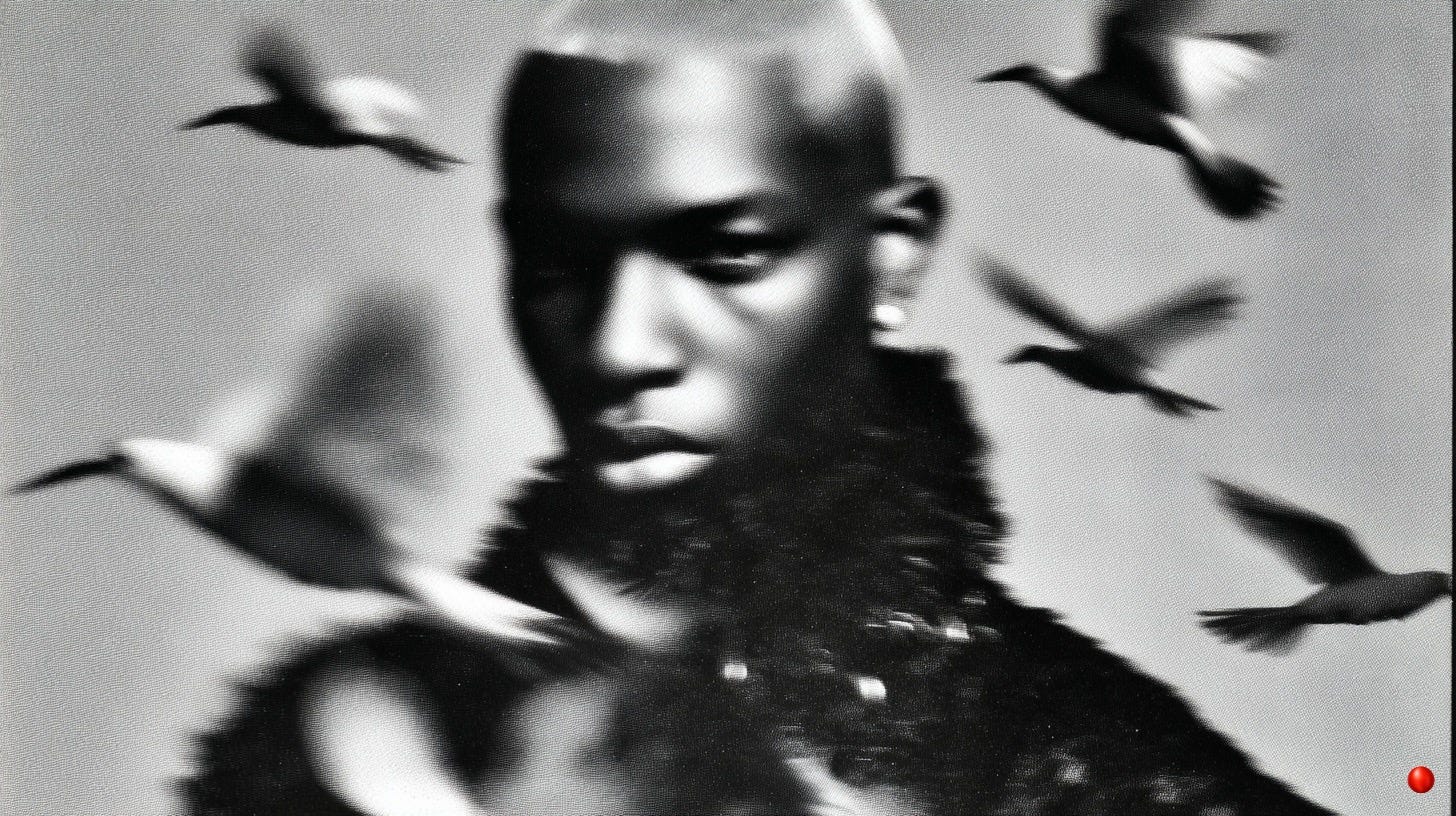
“There is a stone in my heart”
— Sade, “Pearls”
February always feels like a shortened sentence.
A month trimmed at the edges and handed back as celebration, as if the calendar has learned how to ration breath.
Black history pressed into twenty‑nine days. Black HIV stories pressed into a single date. A famine scheduled, then photographed, then forgotten.
I did not mean for this poem to wait here.
I wrote it in July, when the Dallas heat was a punishment and the country had decided the worst was over, at least on paper. I placed it at the front of a book that nearly killed me to finish, a small reliquary in case I could not bear to tell the whole truth in prose. Then I closed the cover. Let the boy stand where I had left him, gathering shadows I was not ready to name.
Some work refuses storage. It hums behind you while you pretend to be finished. It waits inside your own voice like a held breath.
When February came back with its polished posts and recycled saints, when Florida began treating HIV medication like a negotiable expense, the poem started knocking again. Not as memory. Not as tribute.
As a question about what it costs to survive inside a country that will give you an awareness day while it quietly pulls up the floor under your pills.
This is not an explanation of that poem.
This is what happens when I go back for the boy on the West Side during a month that would rather remember our martyrs than admit it is making new ones.

THERE IS A BOY ON THE WEST SIDE
He is not a metaphor I invented to comfort myself.
He is a person shaped by policy and weather, by bus schedules and pharmacy hours, by the distance between what a body needs and what a state is willing to provide.
When I say boy, I am telling the truth and betraying it.
He is old enough to remember friends whose refills did not arrive on time, old enough to count backward from the day his own bottle empties, old enough to know that HIV med delays are not accidents, they are decisions with a paper trail. Still the world calls him boy, because boy is easier to grieve than man, boy is what you say when you want a body to remain blameless and disposable at the same time.
West Side is not an aesthetic; it is a position. It is what happens when a city decides which neighborhoods deserve a hospital and which can make do with prayer. It is a zip code that appears in reports as a cluster of risk factors and never as a home. It is streets that crack early and stay cracked. It is the knowledge that if something breaks inside you, sirens will arrive late, if at all.
He is gathering shadows in his hands. That sounds lyrical until you realize shadows are what you get when people die out of sequence, without obituary, without mention on the evening news. Every man who stops returning calls. Every woman whose status is spoken only in fragments. Every friend whose absence becomes a rumor instead of a story. Shadows are what remain when a country has decided that your death is not a historical event, only a statistic to be updated annually.
He walks a road not built for him, and he knows it. The road passes through pharmacy counters that misplace paperwork, insurance systems that classify his blood as a cost center, clinics that are open during hours he cannot reach without losing wages he cannot spare. When the refill is late, they call it backlog. Logistics. Transition. Words that flatten the fact that the pills are the ritual of staying, and any interruption is a quiet invitation to disappear.
From a distance, he looks like anyone.
Up close, you can see the counting he does beneath his breath.
Days of medication left.
Days until the next appointment.
Days until February 7, when the country remembers Black HIV for twenty‑four hours and then moves on to more palatable grief.
He does not have the luxury of moving on.
He has the ritual. He has the stone.
He has the road that opens under his feet and calls it care.
THIS IS THE RITUAL OF STAYING
Not the miracle, not the triumph, not the poster language about resilience. Staying is smaller than that.
It is a sequence of movements repeated so often they stop looking like survival and start looking like habit.
Morning has its own liturgy. He wakes before the alarm, not because he is virtuous but because his body has been trained to expect the pill at the same hour, with the same glass of water, from the same chipped mug. The bottle rattles once, twice, as if it is answering roll call. He checks the number of tablets without letting himself count them.
Counting is dangerous before coffee.
Counting turns every swallow into a countdown.
There are other rituals no one photographs. The way he reads every unknown number as potential bad news. The way he scans his pharmacy app, not for the word “ready,” but for the phrase “in process,” because that is where the trouble hides. The way his shoulders tighten when a refill date lands on a holiday, or a storm week, or in the middle of a legislative session where someone he has never met is debating whether his medication is an essential benefit or an expense to be trimmed.
Staying is not only chemical. It is social triage. Which friends can handle the truth this week. Which conversations about policy he has the energy to start, knowing most people will blink politely and say they had no idea Florida tried to gut its HIV drug assistance program, no idea Black HIV gets one day in February, no idea delays are policy and not accident. He has learned to choose silence on some days because survival also means refusing to bleed out in public for people who will not even remember the acronym.
There is a spiritual ritual, too. Not always church, not always “Hallelujah,” but something like it.
A whispered thank you when lab results return undetectable. A bargaining prayer when an envelope from the insurance company arrives looking too thick.
A moment of stillness before each clinic visit where he rehearses his answers to questions about adherence as if they are confession.
The world calls it compliance. He knows it is something closer to devotion.
The hardest part of staying is that it never becomes past tense. Cancers have remission. Wounds have scar tissue. Even grief eventually finds a vocabulary that allows the mourner to say “back then.” The ritual of staying offers no such distance. Every day is proof of concept. Every swallowed pill is both cure and reminder. You are still here because you did the thing again.
He does not call it courage. Courage is what people say when they want to honor a risk they do not intend to share. He calls it Tuesday. Thursday. The day after the pharmacy finally texts. The day after Florida half‑reverses its cuts and calls that mercy, while other states write new rules saying delays cannot be called mere logistics. The ritual absorbs these swings without fanfare. The bottle empties, fills, empties, fills. The boy stays.
From the outside, it all looks ordinary. A man at a kitchen counter. A notification on a phone. A lab printout with small numbers. From the inside, it is a quiet, continuous refusal to die on schedule. It is breath after breath. Night after night.
It is the only thing standing between the stone and the bloom.
THERE IS A STONE WHERE HIS NAME SHOULD BLOOM
The first truth is literal: bodies like his are still buried earlier, still counted in charts that never learn how to say their names aloud.
The second truth is quieter: even when he survives, the world behaves as if the headstone is already purchased.
Stone is what the country offers when it has finished pretending to care. Memorial days. Panels. Quilts hung in museums for people who will never have to ask whether their next refill will arrive on time. The stone is smooth, engraved, respectable. It says someone loved him. It does not say that the same systems that now honor his absence once made his presence unbearable.
Bloom is what the body knows is possible.
Undetectable viral load. Near‑normal life span.
The science that says he can live long enough to be called old, that says his blood, properly cared for, is no threat to anyone. Bloom is not metaphor. It is an ordinary future: rent paid on time, knees that ache in winter, a lover who stays long enough to argue about groceries.
The gap between stone and bloom is where policy lives. Insurance rules that decide which medications are “preferred.” Clinics closed on the only day he can get off work. Politicians who discover fiscal restraint when the budget line has his name on it. They will not say they are choosing the stone. They will say they are choosing efficiency, redistribution, reform. The stone does not argue. It just waits.
For him, the stone is also internal. It sits where ease should be. It sits where a younger version of himself once believed he would move through the world without having to announce his body before he touches anyone. The stone is the memory of “positive” dropped into a room like a verdict. The memory of people who only learned to say his name when they needed a cautionary tale.
Bloom, when it appears, is suspicious at first. The father who listens without flinching. The mother who asks why he carried this alone and means it as grief, not accusation. The friend who texts after a policy announcement and does not ask for education, only asks if he has what he needs.
These moments feel like wildflowers growing through concrete.
They are real. They are not enough.
The cruelty of this era is that both futures exist at once. He can hold a lab report that promises decades and open the news to find another state treating his medication as optional. He can be told his life expectancy matches any other man’s and watch funding fall away from the programs that made that sentence possible. He is expected to celebrate the bloom while standing on the edge of the stone.
In the poem, the line is a cry to the night sky, as if God might be persuaded to trade granite for petals if he hears it often enough.
In this essay, the line is a record.
There is a stone where his name should bloom because someone chose it.
There is a stone because erasure is easier to manage than an aging, opinionated, ungrateful survivor who remembers every delay, every cut, every year they tried to pretend the famine was over while he was still learning how to stay.
EACH SILENCE FOLDED INTO BRITTLE MARROW
That is how it starts.
Not with a law, not with a diagnosis, but with the small decision to choose quiet over risk because you have learned that speaking can cost you more than your body can afford.
Silence arrives early. It slips in when the first question forms on the tongue and is swallowed because the room feels wrong. It settles in when a doctor rushes through an explanation and you nod as if you understand, because you were raised to be grateful for any attention at all. It thickens when the news announces another “controversy” about funding or curriculum and no one in your group chat brings it up, as if talking about it might make it too real.
Over time, silence changes texture. It moves from choice to reflex.
You start editing your own story before the words leave your mouth.
You say “health issue” instead of the name of the virus.
You say “friend” when you mean “lover.”
You say “I am fine” when the pharmacy app has been stuck on pending for three days and you are down to four pills.
The omissions feel practical, even protective. Until they do not.
The marrow is where the body builds its defenses. It is where blood begins. When silence reaches this deep, it does not just keep secrets; it alters what the body believes is worth protecting. You start to think of yourself as the problem, not the policy. You start to imagine that the delays are your fault, that the stigma is your shame, that the loneliness is the logical conclusion of what you carry.
Inheritance makes this more complicated. You were born into other silences long before HIV entered the room. Silences about what happened to certain relatives. Silences about what church really thought of boys like you. Silences about the first epidemic, the one people now teach as history, as if it were a closed chapter and not a lineage you are still inside. These older silences teach you how to behave when the new one arrives. They give you a script that says survival is the reward for secrecy.
The danger is that silence feels like strength.
You tell yourself you are protecting your family. You tell yourself you are protecting your job. You tell yourself you are protecting your lovers from information they did not ask for. You do not say that you are also protecting yourself from their reactions, from the possibility that they will confirm every fear you already hold. You wear the quiet like armor and do not notice when it begins to cut.
Inheritance is not only what you receive. It is what you pass on without meaning to. There is always a “next one.” A younger man watching how you answer questions. A teenager scrolling in February, seeing only sanitized posts about awareness, never hearing anyone in their actual life say the word aloud. A congregation that learns, year after year, that certain topics are prayed around but never into. They read your silences as instruction, even when you meant them as self‑defense.
To break this inheritance is expensive. It requires you to speak in rooms that have never earned your trust. It requires you to admit that the stone you have been carrying in your chest did not grow there by itself. It was placed, gently and repeatedly, by a world that prefers you quiet. It requires you to accept that when you finally open your mouth, some people will leave. Some institutions will close ranks. Some loves will not survive the sound.
And yet, there is another possibility.
When silence cracks, sometimes something else enters. A father who hears what you thought would break him and stays. A mother who grieves the years you carried this alone more than the virus itself. A friend who hears “positive” and does not flinch, only asks what time your next appointment is and whether you need a ride. These responses do not erase the cost. They do not undo the years of marrow hardened around secrecy. But they prove that the famine is not inevitable.
Each silence folded into brittle marrow is an inheritance, yes.
So is each sentence spoken aloud when it would be easier to nod and change the subject. The boy on the West Side is not only collecting shadows.
He is, slowly, collecting words. If there is a next one, and there will be, they deserve more than a stone and a scheduled day of remembrance. They deserve a language that does not require them to disappear in order to stay alive.
Hallelujah is the word they gave me when there were no answers left.
Not policy, not apology, not repair. Just a sound that could hold relief and exhaustion at the same time.
A sound that meant nothing and everything, depending on who said it and what they were trying not to name.
I learned early that Hallelujah belonged in certain rooms. Sunday mornings when the choir hit a note that scraped the ceiling. Funerals where the casket was closed and the pastor promised this was not the end. Testimonies that skipped over specifics and landed on “God brought me through” instead of “the hospital finally took my pain seriously.” Hallelujah was the curtain. The story behind it stayed untouched.
In the poem, it arrives without exclamation marks.
Just a flat declaration, set down like a stone. Hallelujah. Hallelujah.
Not shouted. Not explained. A word spoken by a boy west of mercy who has every reason to doubt the moon is listening and chooses to say it anyway. A word that sounds less like triumph and more like a tired agreement to keep breathing.
I have said Hallelujah for lab results that came back undetectable, even when I knew the science deserved the credit more than the church did. I have said it at the news of a policy reversal that was only temporary, knowing the same officials could decide again next session that my medication was too expensive to protect. I have never known whether I was thanking God for intervening or thanking myself for surviving a world that keeps calling negligence fate.
There are Hallelujahs I refuse now. I will not shout over a choir that still will not say the word HIV into a microphone. I will not dance to a praise break in a sanctuary that would rather preach against queerness than admit how many of its members are living with the virus in silence. I will not offer that word to anyone who treats my existence as a moral test they are passing.
Still, the word stays in my mouth. Some nights it is the only one that fits. Not because I am certain, but because language runs out before experience does.
Hallelujah for another refill, even if it arrived at the last possible hour.
Hallelujah for every boy on the West Side who is still here in a year when they were not supposed to make it this far. Hallelujah for every Black body that refuses the schedule the country wrote for it.
I do not trust the word, but I am not finished with it.
It feels like a scar I keep tracing, proof that something happened and healed enough to touch, even if it never should have broken in the first place. On some days, my most honest Hallelujah is not shouted from a pulpit. It is whispered at the kitchen sink when the pill goes down and the bottle is not yet empty.
Hallelujah. Not as closure. Not as absolution.
As a record that I am still here to say anything at all.
Let that be enough—for now.
Author’s Note
I wrote “Reliquary” in 2025 to protect myself from the full heat of a story I was not ready to touch directly.
I put the boy on the West Side in front of me like a shield and told myself I was only arranging lines, not confessing anything that could not be taken back.
Returning to him in February 2026, with Florida treating HIV medication as negotiable and Black HIV given a single awareness day inside a month already rationed, I no longer believe that lie.
Writing this essay made clear that the boy was never a metaphor. He was a version of me I was hoping someone else would notice before he went under.
What changed in the writing is not my diagnosis, not my faith, not my understanding of policy.
What changed is my willingness to admit that survival is not just a private ritual. It is a public argument about who deserves to stay. Putting these sentences on record means I cannot go back to pretending delays are accidents, that silence is neutral, that praise is harmless.
If there is a cost to that, I have decided I would rather pay it awake.
UNSPUN publishes longform essays, editorial encounters, and visual documents tracing the language of power as it operates in real time.
This work appears as part of UNSPUN’s ongoing inquiry into how authority circulates, how permission is granted, and how silence functions as structure rather than absence.
If something in this piece altered your footing, that alteration is intentional.
What follows does not ask for agreement. It asks for attention.
UNSPUN continues for those willing to stay with the work as it unfolds.
It’s the line about “treating delays as logistics” that won’t leave me, Taylor.
The way you show how policy becomes ritualised inside a body. Not as abstraction, but as Tuesday. As counting. As breath.
The stone and the bloom are devastating together. Not metaphor, but infrastructure.