

PUSH, SLIDE, LOCK
On Selection


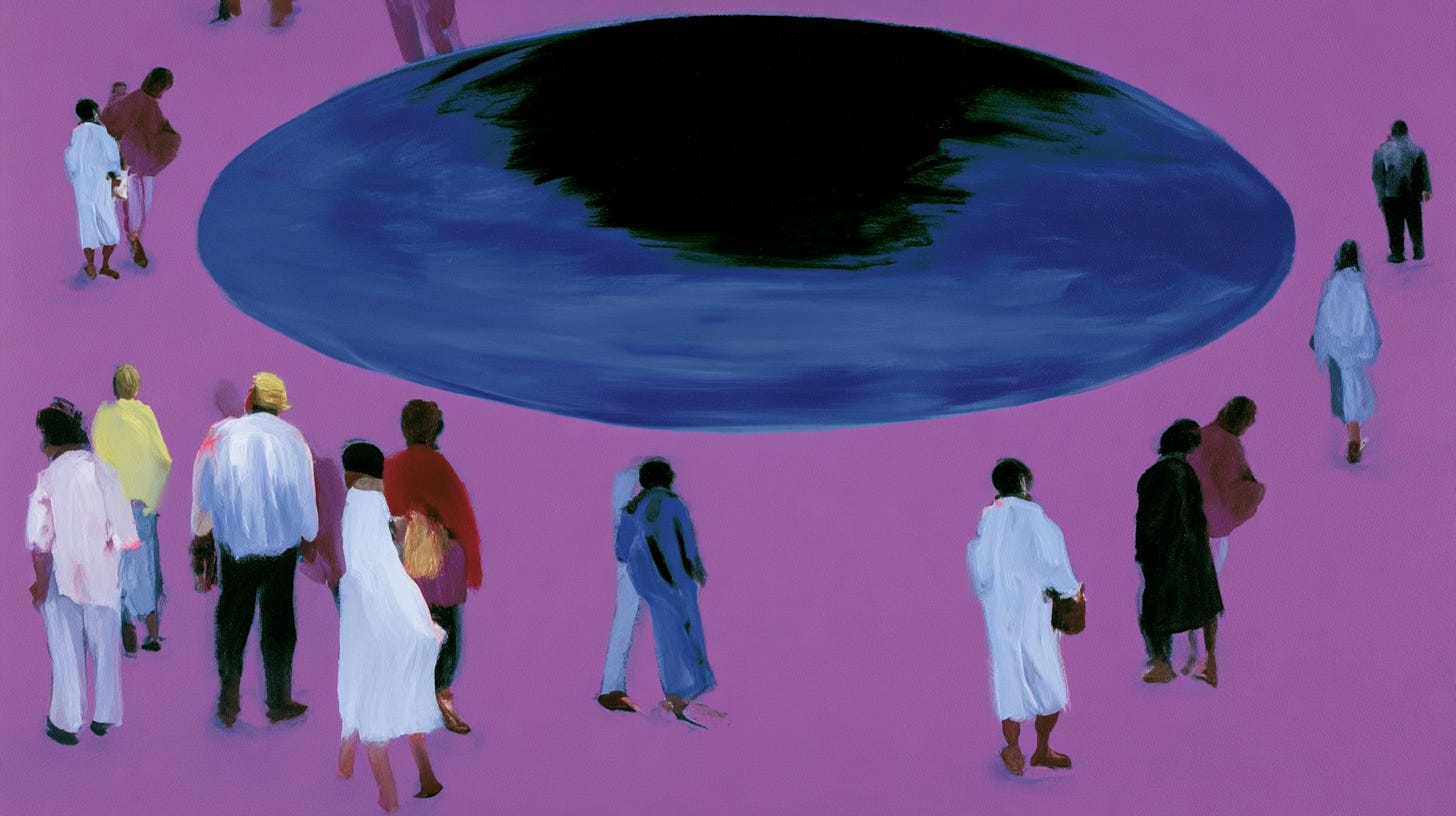
Terrain. A river counted by people who will never drink from it. A number, a budget, a recovery curve that climbs. The weather here is the distance between the ones who are looked at and the ones who get to look.
The question arrived at eleven at night and would not take an answer.
It was not a good question. It had no method, no instrument, nothing that could be run against it, and it kept its shape anyway, the way a splinter keeps its shape under skin. I want to say I turned it over carefully. I turned it over the way you work a tooth you already know is loose.

You may be the sort of tourist who would wonder why a Prime Minister would want an airport named after him—why not a school, why not a hospital, why not some great public monument. You are a tourist and you have not yet seen a school in Antigua, you have not yet seen the hospital in Antigua, you have not yet seen a public monument in Antigua.
Jamaica Kincaid, A Small Place

Why this one. Why here, why this body, why the particular set of walls and weather and language I woke into and have been answering to since.
I know how the question sounds. It sounds like a young man’s question, or a stoned one, the kind that dissolves by morning because nothing depends on it. Nothing dissolving is not the same as nothing being there. This one has been here since I was old enough to understand that other people were not me and had not agreed to that arrangement either.
There are four answers available and I have tried all of them.
The first is that I was placed. Someone did the placing, the placing was intentional, the intention was good. This is the answer I was raised inside and it has the advantage of taking the question seriously. It also requires a sorter. It requires that the same hand that set me here set someone else somewhere the sorting cost them, and that the difference was not accidental. I can hold a God who permits. I have never managed a God who assigns, and the people who tell me the assignment was mercy are always describing their own.
The second answer is luck, which costs nothing to say and explains nothing after it is said. It has the honesty of admitting there is no reason, and then it spends that honesty making the absence of reason feel settled. An absence of reason is not a resting place. It is a hole, and luck paves it.
The third answer is arithmetic. Base rates, birth cohort, eight billion outcomes distributed across the surface of one planet. Somebody had to be here. The math is correct and it answers a question I did not ask. It can tell you how many. It has never once told anybody why you.
The fourth answer is the one I use in public, and I am good at it. Name the privilege, hold it, be accountable to it, say the thing about the assignment out loud before anyone else can say it to you. I have done this well enough to be thanked for it in rooms where the thanking was the point. What I noticed late is that the move gives me something to do with my hands. An assignment carries no task. A position does, and a position can be held well, which means it can be graded, which means a question with no answer has quietly become a question I am able to pass. I do not think the accountability is false. Refusing it is worse and I have watched men refuse it. It arrives early, and it arrives in the shape of relief, and relief is the one thing this question was never supposed to give me.
Four devices for ending the question. I do not think they were built by liars.
I think they were built by people who could not stand in the doorway that long.
The actual shape of the question is not why some and not others.
Distributed like that it stays abstract enough to survive, and abstraction is another paving. The actual shape is why me and not him.
Him is where it breaks.
He is not asking. That is the finding, and it took most of a night to arrive at, and I have not been able to put it down since. Somewhere there is a man who has never heard the word Texas and never will. He does not lie awake wondering why he was not born into central air and a driver’s license and a store with eleven kinds of rice on one shelf. Not because he lacks the capacity for the question. The question requires materials he was never issued. He would need to know that I exist. He would need a picture of my life detailed enough to place himself inside it and find himself absent from it.
He does not have that. I have it about him.
So the question does not run between us. It runs at him, from here, one direction, and it was never a question about two lives. It is a question one life is equipped to ask about another, and the equipment is the answer I had been refusing to look at the whole time. To wonder why I was selected for this life, I had to be selected for the life in which the wondering is possible.
Guilt would be easier and I would have arrived faster. This is a matter of instruments, and the instruments have a paper trail.
Consider what it takes for me to know he is there at all.
Something had to go and look. Something had to carry a camera into water it did not live in, stay long enough to make images, come back, cut them, score them, and place them where I could receive them without moving. The traffic runs one way and the technology exists to make that invisible. Nothing of my room went the other direction. He has no footage of me. There was never going to be a reciprocal instrument, because the instrument is the asymmetry. It is not a bridge across it.
Then there is the counting.
The animals in that water have a number. They were hunted to almost nothing, and then somebody built a program, the program produced a census, and the curve climbed. Thousands now, where there were hundreds. This is a real accomplishment and I am not being sour about it. I am noting what a census is. A census is an instrument of care that requires the counted to be legible to the counter. It needs a budget line, an agency, a form with boxes on it. It converts a population into a figure that can be reported to people who will never stand in that water and who will nonetheless decide, from a room, whether the figure goes up.
The people on the bank do not get a census. They get a narration. They are described as vanishing, which is a word that arranges itself around them like weather, as if the thing happening to them were a season and not a set of signatures. The animal gets enumerated and funded. The people get an elegy. An elegy has no budget line and no one has ever been held to a target on one.
Nobody had to decide the people were worth less. Somebody only had to build a form for one and a story for the other.
Here is where I am supposed to go across.
You can feel the shape of what comes next, because it is the shape every piece like this takes. Now I imagine his morning. Now I render the sound of the water before light and what the smoke smells like from that side and what it is to hold a custom you did not choose and be held by it in return. Now the prose gets beautiful, and I am the one who made it beautiful, and something that belonged to him becomes something I am praised for.
I am not going to do it. Not from restraint, and not to be admired for stopping. I am not going to do it because I cannot, and the inability is the only honest thing I have in this. Everything I could write from that side would come from the same footage that started this, or from a book, or from the enormous corpus of other people’s looking. It would be assembled. It would read as intimacy and it would be inventory. The one thing I know about his interior is that I have no access to it, and the moment I pretend otherwise I have performed the small version of the exact taking I came here to describe.
That leaves the third instrument, and the third instrument is this.
I am writing about a man who will not read this. He cannot correct me. He cannot decline to be the occasion for somebody’s essay in a country he has no name for. Every protection I have built into this piece protects the piece. He is outside all of it. The refusal I just performed is still a use of him, and putting the refusal on the page in plain sight does not undo the use. It only makes me the kind of writer who noticed. I am aware of how that reads. It reads like credit. I do not have a way out of that either, and I have decided that continuing while saying so is better than continuing quietly, which is the only choice actually on the table.
The screen went dark and the room was still my room, cool the way a room is cool when no one has to think about it, the air arriving from somewhere in the walls without asking anything of me.
Six or seven in the evening, which in August here is not the end of anything. The sun holds until nine. The heat is still in the concrete and still in the grass and the day has stopped only because I stopped.
August in this city has a taste. Mineral and warm, the taste of a hose that spent the afternoon coiled on concrete. Both spigots wear a fitting placed on them, one at the back wall, one standing up in the flower bed out front, so the hose releases with a push and locks onto the other with a push. The water was already there. It was under the whole property before I arrived, in two places, waiting to be asked, and all I added was the part that makes it easy. The first thirty seconds come out hot enough to scald a root, so you hold the line away from the magnolias and the bougainvillea and stand in the grass with your arm out, waiting for the cold to arrive from somewhere underground. It always arrives. That is the thing about it. You learn very young that if you wait, the cold comes, and you never once wonder who ran the line, or when, or what had to be true about where you were standing for the cold to be under it at all.
The bougainvillea is not from here. It lives because I water it.
I did not earn the assignment and I cannot return it and I have no instrument that will tell me why it fell here. What I have is the flinch, and the thirty seconds, and the cold that comes, and a question I am going to keep in my mouth like a stone because every place I could set it down is a place that would answer it falsely.
I drink from it anyway. I always have.
Let that be enough — for now.

Author’s Note
I started this thinking the difficulty would be respect.
How to write toward people I do not know without flattening them. That was solvable and it was not the problem. The problem showed up when I understood that the question I had been carrying for years was not a question about him at all. It was a question my assignment manufactured, and I had been experiencing it as depth.
I do not know what to do with that.
I have not stopped asking it since I found out what it was, which tells me something about how much of my interior life is furniture I was issued and have been calling thought.
If this work matters to you, join the readers who keep it possible.
Subscribe to access the full UNSPUN archive.
UNSPUN publishes longform essays, editorial encounters, and visual documents tracing how power moves, hides, and speaks in real time. My commitment to myself and to you is that this work is, and will remain, independent of corporate and party money; it answers to the people willing to read it closely enough to be changed.
If this piece shifted your footing, that shift has a cost on this side of the screen: time, refusal, and the choice to keep writing as if clarity still matters more than access.
If you are able, a paid subscription or recurring contribution keeps this work answerable to its readers instead of to its silencers. If you are not in a position to support UNSPUN, your willingness to stay with work like this already counts.
UNSPUN continues for those willing to stay with the work as it unfolds.
