


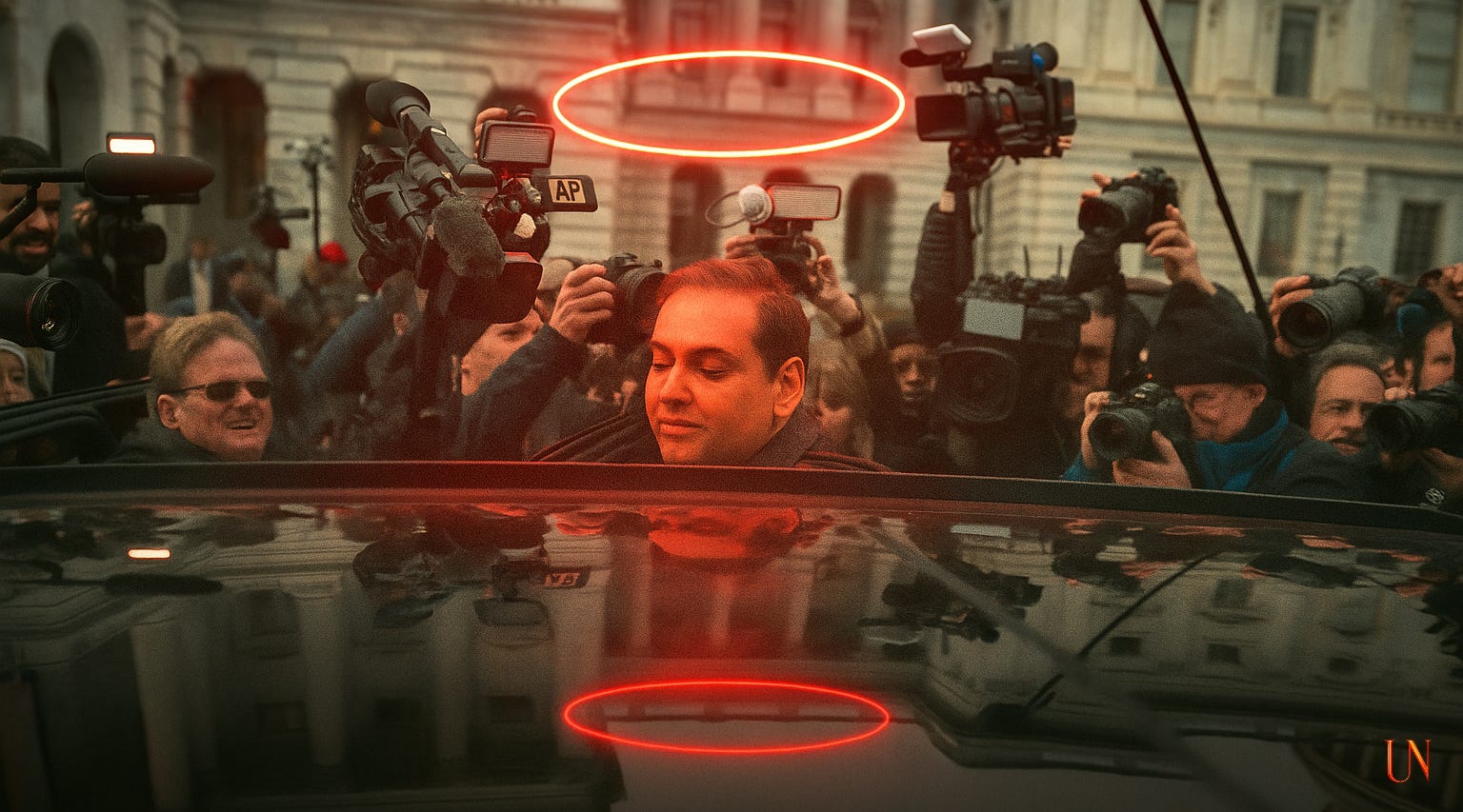
“In America, even mercy has a color and a price.”
Preface
I didn’t gasp when I saw the headline. I exhaled—the kind of exhale that comes when the script has been running so long you already know the next line. George Santos’s sentence commuted, his guilt intact, his usefulness restored. It was a familiar mercy, and that’s what made it dangerous.
I texted my friends that night, not because I was shocked, but because I was tired of being right. America forgives with conditions. It offers freedom the way a creditor offers grace—with interest.
This is not a story about one man’s release. It’s a story about who this country still finds worthy of absolution and who it keeps on display as proof of progress. The pardon remains the highest currency in our moral economy, and once again, its exchange rate depends on proximity—to power, to whiteness, to straightness, to myth.
We’ve all seen this mercy before. Some of us have even lived it.
Author’s Note
Every nation reveals its theology through the people it chooses to forgive.
This began as a text thread, a flare of disbelief at a headline that managed to be both absurd and inevitable. But what lingered wasn’t the absurdity—it was the precision. Trump didn’t pardon George Santos; he commuted him. And that distinction, seemingly bureaucratic, holds an entire sermon about belonging, performance, and conditional grace.
I don’t write this to inflame. I write it to understand the fault line between release and redemption—to ask why America, when faced with its own hypocrisy, still chooses mercy as performance instead of transformation.

It began not with disbelief but with recognition.
The headline arrived like weather—expected, heavy, electric with repetition. Trump Commutes George Santos’s Sentence. Eight words that sounded less like justice and more like déjà vu.
Santos, convicted of wire fraud and identity theft in 2024, had become both spectacle and symbol long before his sentencing. Now, with a stroke of executive clemency, his story was returning to the same theater that created him.
I didn’t scroll for details. I already knew the shape of the story before I opened it: a man who lied his way into the system finding his way out through the same door. The trick is never new; only the faces change.
Still, something caught in my throat—not outrage, not grief, but that quiet grief’s older cousin: fatigue. The kind that comes from standing in the same storm for years, knowing exactly when the thunder will roll and still flinching at the sound.
Because this wasn’t just another headline. It was a confession dressed as news.
A nation that calls itself Christian yet worships retribution. A political order that mistakes spectacle for leadership. And at the center, a man—Santos—whose queerness makes him both too visible to protect and too useful to erase.
Trump’s mercy has always been a mirror, and this time, the reflection was cruelly precise. The commutation wasn’t about redemption; it was about optics. It said, I can free you, but I won’t cleanse you. You’ll walk out a sinner, not a symbol.
And in that gesture, Trump reminded us of what this country has always believed: that certain bodies can be forgiven only if they stay marked.
The law likes to pretend that words are neutral.
That pardon and commutation are simply procedural—tools of clemency, nothing more. But words have always been America’s favorite disguise. We name what we cannot bear to see.
