



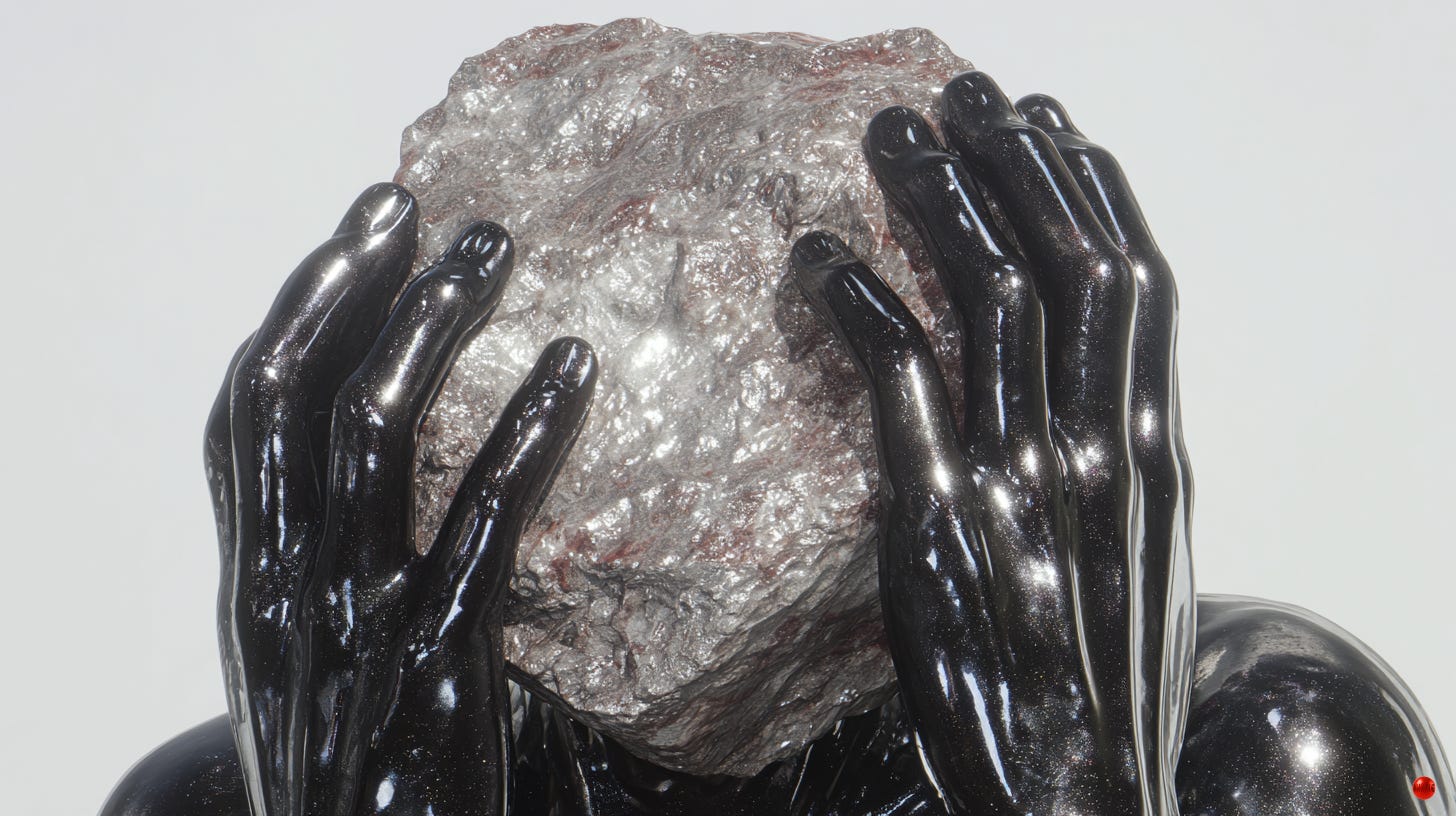
TEXTURE #006
“There are always two deaths, the real one and the one people know about.”
— Jean Rhys

The pivot happens before the feeling finishes arriving.
Not the disappointment. Not the accommodation. The speed. The practiced, almost elegant speed of a man who has been reorganizing destabilizing information since before he had language for what reorganizing cost him.
By the time the feeling reaches the chest it is already something else. Already material. Already the sentence that will land somewhere he decides. The feeling never gets to be just the feeling. It gets to be useful or it doesn’t get to be at all.
This is not a complaint.
It is a confession.

Someone asks how they can support you.
The question arrives with warmth. With the particular sincerity of a person who means it in the moment they are asking it. You believe them. You have always believed them because the alternative, that the asking is the whole of what they intend to give, is a weight the body was not designed to hold without reorganizing it into something more bearable.
So you answer.
You take a breath first. Not the kind anyone notices. The kind that happens below the threshold of the visible, in the chest, where the ribs make their small adjustments against the pressure of what is about to be named. The body knows before the words do. The body is already beginning the redistribution before the sentence has left the mouth.
You name the thing. Carefully. Specifically. Not too much. Not in a way that sounds like need because need has never been part of the infrastructure and you are not about to introduce it now, here, in this moment, to this person who is looking at you with eyes that say they want to help and hands that have not yet moved.
You watch the hands.
You do not mean to watch the hands. The watching happens the way the redistribution happens, before the decision to do it, below the threshold of what you can intercept. The hands are still. The face is warm. The words are sincere. And something in the body registers the distance between the sincerity and the stillness before the mind has finished processing what it means.
The hands do not move.
The perspective does not change.
You are left exactly where you were before the question arrived. Except now you have also given something. Named something. Bent toward something that did not bend back. The accommodation sits in the space between you like a receipt for a transaction only one party completed.
The receipt has a weight.
You feel it for exactly as long as it takes to decide what to do with it.
The infrastructure is efficient. By the time the feeling has finished registering it is already a lesson. Already evidence. Already the sentence that will land somewhere you control, stripped of the particular grief of a man who bent and stabilized and held and was left anyway, standing in the same place, slightly more alone than he was before someone asked how they could help.
The sentence lands.
The feeling never did.
The hands never moved.
The impulse rises before the decision does.
Something gathers in the sternum, moves upward toward the throat, begins the shape of a sentence that points outward. The sentence is already forming. It would be precise. It would be accurate. It would feel, for the length of the saying it, like justice.
Then the saliva retreats.
The ocean breaking its covenant with the shore. The mouth emptied of what it usually provides, quietly, without announcement, and the sentence that was forming has nowhere left to go.
The breath redirects instead. Downward. Back into the chest. Back into the place the feeling has been accumulating since before the hands stayed still.
The body knows the difference.
There is a specific physical sensation to the moment of choosing not to indict.
It is not relief. Relief would mean the tension released. This is something more like the tension relocating. Moving from the chest into the shoulders. From the shoulders into the hands. The hands that are now holding something they did not ask to hold, something that belongs equally to the man who built the infrastructure and to the people who never had to know it existed.
He holds it anyway.
Not because holding it is noble. Because the alternative is to put it down somewhere outside himself and call that honesty. And he has been watching that move long enough to know what it actually is. The same redistribution in different clothing. The same conversion of cost into something more manageable. The same practiced speed of a man who has learned to make the feeling into something before anyone has to witness what the feeling was.
When did turning back on yourself become the architecture too.
That is the question the piece cannot answer cleanly. Cannot answer at all without lying. The jaw holds it, the particular clench of a man mid-reckoning who will not let the question leave before it has cost him something. Because the self-implication is real and the self-implication is also, if he is being precise about it, another layer of the infrastructure. Another way of managing the weight. Another conversion. The man who holds himself accountable with enough rigor and enough honesty and enough beautiful sentences about the cost of his own defense mechanisms has still not let the feeling finish arriving. He has made it into something. Again. He is making it into something right now.
When did bending become the first language?
Not the response to this disappointment.
Not the response to the last one.
The original decision.
The place where the infrastructure was built and the builder decided, without deciding, that absorption was safer than the alternative. That the bend that didn’t break was preferable to the ask that might not be answered. That being left alone was a condition he could metabolize. That being left alone after having asked was a condition he could not. The shoulders knew this before the mind did.
Settled into their familiar forward curve, the body already assuming the position before the decision was conscious.
So he stopped asking.
He built something instead. Something that looks, from the outside, like grace.
The infrastructure is real. The steadiness is real.
What is not real is the premise underneath it.
That the bending was neutral. That the accommodation was free. That the redistribution happened without cost simply because the cost never made it to the surface where someone else could see it and be asked to witness it.
The cost is here.
It has always been here.
The infrastructure was built specifically so it would never have to be named out loud.
What would it mean to let the feeling finish arriving?
Not performance of need. Not collapse. Not the dramatic unburdening that mistakes volume for honesty. Something quieter and more terrifying than any of those things.
The specific, unrevised act of letting the cost be present in the room before it becomes anything.
There is a particular temperature to that kind of presence. The room doesn’t change. The light doesn’t change. But something shifts in the quality of the air when a man stops managing what he is carrying and simply carries it where another person can see. The hands don’t know what to do with themselves. The breath gets shallow in a way that has nothing to do with fear and everything to do with the body registering that it is about to do something it has not been trained to do.
Not perform. Not redistribute. Not convert the weight into something the other person can hold without being asked to witness it.
Just be inside it, still, present. The ribs pressing against the cotton. The sound that commitment makes when it finally lands somewhere it was not immediately reorganized out of.
The other person’s attention changes the room. That is the thing the infrastructure was built to prevent feeling. Not the disappointment. Not the absence of support. The specific vulnerability of being seen in the moment before the meaning has been decided. When the feeling is still just the feeling and the man is still just the man and nothing has been made of it yet.
The infrastructure was built because that decision kept going the same way.
It was not safe.
The breath returned slower than it left. The kind of slow that belongs to something older than the moment, settling back into the ribs like it had traveled far to get there.
That silence has a weight.
It sits below the sternum. It does not announce itself. It does not ask to be carried.
It simply remains, in the tissue that absorbs force before the bones feel it, accumulating in the spaces the infrastructure was designed to make invisible
.The body keeps the record.
It does not redistribute.
It does not convert.
It holds what it holds until it cannot.
There is a version of this essay that ends with resolution.
With the man deciding to let the feeling finish arriving. With the infrastructure dismantled or at least acknowledged. With the redistribution practice named and set aside in favor of something more honest, more vulnerable, more willing to be witnessed.
That version would be a lie.
Not because the resolution is impossible. Because it hasn’t happened yet. Because the piece is being written by the same man who built the infrastructure. Who is, right now, in the act of writing this, redistributing the weight into the sentence before it finishes arriving. Converting the cost into craft. Making the accommodation into material.
The sentence is landing somewhere he decides.
The feeling is still in transit.
What he knows, that he did not know before sitting inside this long enough to let it cost him something, is that the knowing is not the same as the changing. That naming the architecture is not the same as leaving it.
The infrastructure does not dismantle itself because it has been described.
What description does, what this piece does if it does anything at all, is make the cost visible for the length of time it takes to read it. The weight present in the room. Unrevised. Held without redistribution for as long as the sentences last.
After the last sentence the man will do what he has always done.
He will make something of it.
But for now, for the length of this, the feeling is finishing arriving.
The ribs hold. The cotton does not move.
The sound the weight makes is not asking to be named.

AUTHOR’S NOTE
I did not know what this piece was about until it refused to be about something else. What I could not take back: the speed.
Not the accommodation.
How early the body starts moving. How far the redistribution is already underway before the mind has consented to the direction.
The piece is finished.
I am not sure I am.
This essay will remain open to all readers for 10 days.
After that, it will be available to paid subscribers who support the work.
TEXTURE is where UNSPUN lets the body carry what the mind has already decided and refuses to explain it back into comfort. It documents experience as evidence, holding sensation long enough for its pressure to become undeniable.
My commitment to myself and to you is that this work is, and will remain, independent of corporate and party money; it answers to the people willing to read it closely enough to be changed. If this piece stayed under your skin, that lingering has a cost on this side of the screen: time, refusal, and the choice to keep writing as if feeling still matters more than performance.
If you are able, a paid subscription or recurring contribution keeps TEXTURE answerable to its readers instead of to its silencers. If you are not in a position to support UNSPUN, your willingness to stay inside work like this already counts.
TEXTURE continues for those willing to stay with the feeling as it unfolds.
