

Suture
How I Returned to Myself Before I Returned to You


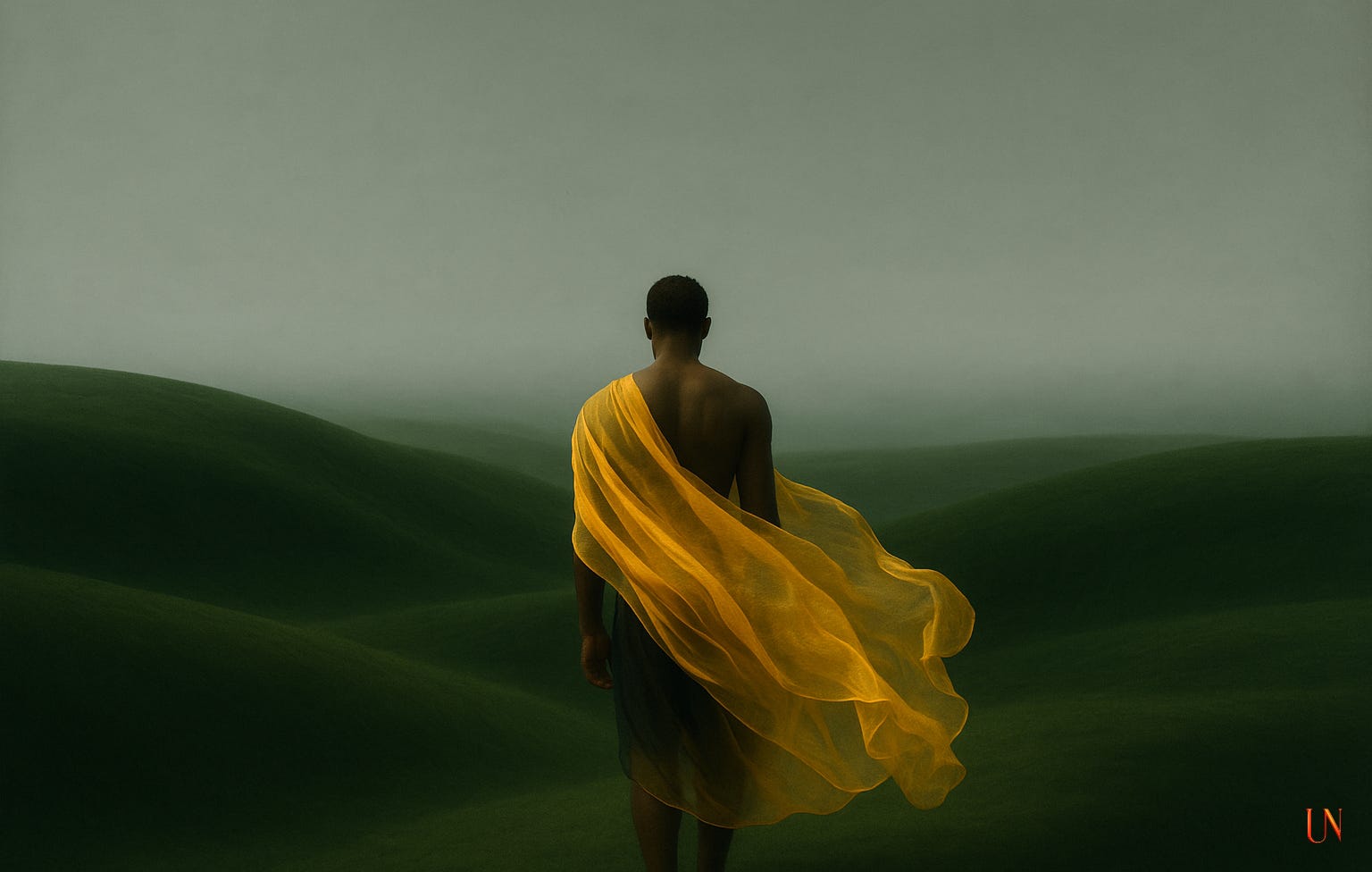
“Every goodbye is stitched into the next beginning.”
— Nikky Finney
Preface
Every fable begins with a wound that refuses quiet. Not the kind that spills into public view, but the kind that hums beneath the ribs long after the rest of the world has forgotten how it started. My story begins with a boy who believed the body was a sanctuary, who mistook warmth for safety, who trusted the hands that held him without imagining they could ever close around harm. It begins with tenderness offered too freely, a truth revealed too late, and a future altered in a single breath he was not ready to take.
But a fable is not a ledger of who failed whom. A fable is concerned with what a person becomes after the breaking, with the shape a life takes when it refuses to end at the point of its deepest cut. In this telling, the one who harmed me stands at the edge of the clearing like a figure blurred by smoke. Not erased. Not forgiven. Simply no longer the axis around which the story turns.
What matters is the boy who walked out of that moment carrying more truth than he knew how to hold. What matters is the man he became, steadying himself through nights where breath felt heavy and mornings where courage needed time to rise. What matters is the slow, patient practice of reclaiming a body he once feared had turned against him, and the quiet astonishment of realizing it had been defending him all along.
Healing grants no single revelation. It arrives like weather, shifting in its own time. It asks for humility. It asks for patience. It asks for the kind of honesty that remembers the wound without letting it write the ending.
What follows is not a chronology. It is a myth made of my own bones. It is the truth rendered through symbol because the literal story, as brutal and as intimate as it is, cannot contain the man I eventually became. This is a fable about trust ruptured and trust rebuilt. It is about the fire that tried to unhouse me and the flame I learned to carry without fear.
This is the tale of how I stitched myself back into my own life before I ever dared offer that life to someone else.

The First Tear
There was once a young man who believed he could read the world by its light. He trusted warmth the way some trust scripture. If a touch softened him, he welcomed it. If a voice steadied him, he followed it. He had not yet learned how easily cruelty can disguise itself as comfort, or how quickly a heart can mistake intensity for care. He entered his first love with the kind of openness only the young can offer, certain that devotion was its own protection and that harm could always be recognized before it arrived.
His body had learned to fold open without hesitation, trusting that such softness would be met with equal care. He did not know that some people receive tenderness the way a thief receives an unlocked door. He did not know that his willingness could be mistaken for availability, that his trust could be weaponized against him.
In the beginning there was only promise. The older man stepped toward him with a confidence the young often confuse for wisdom. His presence glowed in the dim spaces between them, and the boy believed that glow meant safety. He did not know some lights burn brightest when they are about to consume. He did not know desire can move with the confidence of love long before it learns the ethics of love.
He offered his devotion without knowing devotion could be answered with violence.
Day after day, he gave himself completely. Day after day, he believed what his body felt was being honored. Day after day, the world continued as if nothing had changed. But something had changed. Something was changing. A truth was being written into his cells without his consent, without his knowing, without the mercy of warning.
When the truth finally reached him, it did not roar. It slipped in quietly, the way a blade enters fabric. A knowing he had sensed long before he allowed himself to name it. A diagnosis settling into his hands with the weight of a stone that refused to warm. A future rearranged without warning, though nothing in the room moved except his breath.
He looked at the world through altered eyes. Everything familiar carried a new outline, as if a thin seam had opened between him and the life he thought he knew. The boy who had walked into the clearing with untested certainty now stood in a silence sharp enough to bruise. He felt the innocence he once carried split open, tender as fruit beneath unexpected pressure. He felt trust collapse, not with spectacle, but with the quiet finality of something that had been straining long before it broke.
In the days that followed, he tried to understand the enormity of what had happened. He questioned the story he had been telling himself about safety, about devotion, about the rules he believed governed intimacy. He wondered whether harm always arrived disguised as tenderness, whether he had misread something essential, whether he had become the site of someone else’s selfishness. It was not the virus that crushed him. It was the violence of realizing his devotion had been met with indifference.
When he confronted the one who had harmed him, he was met with a tone so casual it felt like a second wound. A shrug disguised as explanation. Words that treated his body’s vulnerability as administrative detail, something that would have been mentioned eventually, when convenient. The ease with which cruelty can dismiss what it destroys. The boy learned then that betrayal does not always announce itself with malice. Sometimes it simply yawns.
For a time he believed himself marked. Not by the diagnosis alone, but by the lie that told him he was now unworthy. A lie so persistent it carried its own gravity. A lie that whispered he had forfeited the right to want freely. He began to fold inward, not out of fear, but out of the belief that shrinking would dull the ache of being seen.
But here is the truth no one gave him. A wound does not arrive to announce the end. It arrives to announce the beginning. The first tear is not proof that the garment has failed. It is proof that the garment was hand stitched, that it can be reworked, that its strength is not in its perfection but in the thread that holds it together.
The tear that frightened him was the same opening that would one day guide his hands toward stitching. The stone he carried was not a curse, but a testament. The clearing where he had been misled would become the ground where he learned to trust his own steps again.
Every fable begins with a wound. The wound, no matter how deep, does not get to finish the story it starts.
The Stone the Boy Carried
The boy became a man, although he did not recognize the exact moment the shift occurred. Growth is quiet that way. It gathers in the joints, settles behind the ribs, moves through the breath before it ever reaches the face. He carried the diagnosis into each new year like a stone he had not chosen, its surface cool against the heat of his palm, refusing the solace he tried to offer it. At first he held it with the stiffness of shock, the way someone holds a truth they have not yet made peace with. Forgetting was impossible. The stone had weight, and weight remembers even when the mind longs to forget.
In the early seasons his body felt different to him. His laughter landed lower. His posture bent inward. Some days he woke with the sense that the air was heavier than it had been the night before. The world’s stories about wounds like his pressed against him with an authority they had not earned, insisting he step carefully, speak softly, want less. Shame appeared often, pretending to be guidance. It urged him to believe he had lost the right to move through the world without explanation.
Even so, something in him resisted. It was faint at first, no louder than a small tightening in the chest, a warmth beneath the stone, a refusal that surfaced whenever he tried to fold himself into the shape others expected. He did not yet know to call it strength. But it was strength. Quiet, insistent, unyielding.
Time began its work. Not kindly, but faithfully. As the months and years unspooled, the stone changed temperature. What had once been harsh grew familiar. What had once felt like punishment revealed its truer nature. It had not arrived to mark him as diminished. It had arrived to remind him of the life that continued inside him, even when he doubted he deserved continuation.
Undetectable was not a technicality. It was revelation. It was the evidence of a body that labored without praise. It was the soft, steady miracle of cells doing exactly what they were made to do. It was the first truth that contradicted the lie the world had tried to teach him. He had not been sentenced. He had been sustained.
Still, he walked with caution. Not because he doubted his own resilience, but because memory has its own gravity. The fire he had survived still flickered in the corners of his awareness, and he understood now that the fire had disguised itself as warmth. What had felt like being chosen had actually been being used. The heat that once felt like intimacy now revealed itself as consumption. He carried the knowledge of harm the way travelers carry water. Not in fear of thirst, but in respect for the distances they have crossed. Caution did not make him smaller. It made him deliberate.
Slowly he learned to inhabit his body again. The distance between his mind and his skin narrowed. Touch no longer felt like a negotiation with danger. Desire no longer felt like betrayal. His body revealed itself as loyal, capable, disciplined. It rose with him. It held him upright. It continued its private healing whether he noticed or not.
Some nights the stone felt almost weightless, as if it remembered the boy he used to be. Other nights it pulsed with the memory of the fire, asking him to honor what he had lived through. And then there were nights when he held the stone gently and sensed, with an ache he could not name, that it had become something else. Not burden. Not curse. Something closer to compass.
The stone remained in his hand, yes, but it no longer weighed him down. It steadied him. It clarified him. It reminded him of what he had endured and what he would never again allow.
And as he walked forward, he understood something he had not known before. The stone was not a symbol of ruin. It was proof that he had lived.
The Forest of Returning
There comes a point in every fable when the wanderer must leave the open road and step into a place where the world softens into silence. A forest. A valley. A clearing where the past gathers like mist. For this man, the forest was not a place on any map. It was a season that arrived without warning. A quiet that settled over his life with enough weight to make him listen.
He entered the forest without collapse or spectacle. One morning he simply realized he could not keep outrunning the echoes of what had happened to him. His first steps were cautious, each one placed as if the ground might remember the tremor of the fire he had survived. But the forest did not threaten him. It met him with the kind of stillness that does not ask for explanation, only presence.
Silence has a way of enlarging what we hide. In that quiet, memories he had pressed deep beneath his ribs rose softly, like fog drifting upward from the earth. He sat with them. Sometimes on the edge of his own bed, sometimes in the hallway before dawn, sometimes with a hand against the wall just to feel something solid. The forest taught him that contact anchors. That a palm against wood or soil can steady a truth that feels too wide for the mind to contain.
At first the forest frightened him. It held every bruise he had collected, every fear he had swallowed, every grief he had been unwilling to claim. They hovered around him like leaves suspended in air. But slowly, he understood something the boy inside him never could have known. He was no longer facing the fire as a victim. He was facing it as a witness. And witnesses see differently.
He began to study his life with a strange, reverent patience. He did not rush toward conclusions. He read his past the way some read constellations, searching not for reassurance but for clarity. Patterns emerged. He saw the chapters he had survived by instinct alone. He saw the stories he had carried as truth even when they were lies. He saw how often he had mistaken endurance for peace and silence for acceptance. He saw the places where he had dimmed himself without realizing it.
Day after day, he learned his body’s new language. The tremor that arrived when certain memories surfaced. The softening that came when he spoke his own name aloud. The steadiness that grew each time he placed a hand over his heart and felt the rhythm beneath bone. His body was teaching him what his mind had refused to accept. That he had survived. That survival had required a devotion to himself he had not known he possessed.
Some days the forest was merciful. Light filtered through the branches, and his breathing found a steady rhythm. His body felt like a place he could return to without bracing. On those days he felt almost new. And there were days when the forest pressed against him with the full weight of his history, when the old ache rose as if summoned. But instead of withdrawing, he let it speak. Pain repeats itself until someone listens. In the forest, he listened.
He built small rituals without knowing he was building them. Rising early. Touching the center of his chest to remind himself he was still here. Speaking his name aloud once before beginning the day. Not to convince himself of anything, but to honor the self who had carried him thus far. He learned that rest was not laziness. That longing was not weakness. That wanting something for himself did not require permission.
The greatest surprise was the return of softness. Not the softness of the boy he used to be, but the softness that survives the storm. A softness with a spine. A softness that could bend without breaking. A softness earned, not inherited.
And then the forest gave him something he did not expect. One morning he woke to find a small flame resting in his palm, warm and steady. He had not called for it. He had not earned it through any single act of courage. It simply appeared, as if the forest had been keeping it safe until he was ready to hold it. The flame did not burn him. It waited. And when he cupped his hands around it, protecting it from the wind, he felt something ancient and careful settle in his chest.
The forest was not punishing him for what had been done to his body. It was returning what the fire had tried to take. Not innocence. Something better. The capacity to carry his own light.
In the forest he met the version of himself he had ignored but had always depended on. The self who kept him alive when he had no language for his wounds. Their meeting was not dramatic. It was quiet. It was steady. It was the kind of recognition that shifts a life without shouting.
And this is what the forest taught him. He did not need to escape what had happened. He needed to return to the one who lived through it.
The forest was not an exile. It was a homecoming. And he walked deeper in, knowing he would not walk out the same.
The Animal Named Fear
Every fable has its creature. Some name it wolf. Some name it serpent. Some pretend it is an enemy that can be hunted if one is brave enough or foolish enough. But in this story the creature bears a simpler name. Fear. Not the kind that startles the body into flight, but the kind that learns your patterns. The kind that knows the shape of your footsteps and waits for you in the places where dusk settles thickest.
Fear had been with the man since childhood, though he could not have identified it then. It sat beside him during his earliest nights of wondering whether tenderness would stay. It curled in the corner when he feared losing what he had just learned to love. But after the first fire of his wound, fear sharpened. It grew watchful. It grew intelligent. It learned his seasons. It learned the tremor beneath his breath. It learned when to approach quietly and when to take up space.
Fear followed. Not loudly. Quietly. It knew his patterns. It knew when he woke. It knew when he steadied his breath against the memory of hands that had held him carelessly. It waited. It was patient. It had time.
In the forest fear walked at his side as if it believed it was protecting him. At times he felt its presence like a warm shadow pressed against his spine. At other times it hovered behind the trees, whispering through branches, familiar as old weather. Fear did not announce itself as enemy. It arrived wearing the face of the only friend who had stayed.
Fear spoke in a voice he always heard, and the voice was almost tender.
I kept you breathing when no one else cared.
I learned his rhythm so you would never be surprised again.
I counted every day he touched you, every night he released himself into you without telling you the truth.
I was the only one watching.
I saw what devotion cost you.
Don’t you remember?
I was there when you folded open, believing you were safe.
I was there when the diagnosis arrived.
I have been beside you every day since, making sure no one gets that close again.
Fear was convincing because it echoed truths he had lived. It was a creature shaped by memory, not malice. It reminded him how quickly trust can become a doorway to harm. It reminded him how innocence can fracture without sound. It reminded him how deeply he once believed in someone who had not cared enough to tell him the simplest truth.
I can take the ache away, fear whispered, softer now. Give me permission, and I’ll build walls so high no one will ever reach you again. No more wondering. No more hoping. No more of that terrible openness that nearly destroyed you. I’ll keep you so safe you’ll forget what wanting feels like. Isn’t that what you need? To stop wanting? I can give you that. I can make you small enough that nothing will ever find you again.
The offer hung in the air between them like smoke. There were nights when the man almost took it. Nights when the thought of never risking tenderness again felt like mercy. Nights when the promise of numbness sounded almost like peace.
Don’t send me away now, fear continued. You need me. Without me, you’ll forget. You’ll open again. You’ll trust again. And we both know what trust does to soft things.
There were nights fear curled at his feet as if keeping watch, and on those nights the man felt something like gratitude, complicated and real, because fear had been the only witness to what had been done to him in the dark. But there were nights when fear climbed onto his chest and pressed until his breath shortened. On those nights fear no longer sounded protective. It sounded possessive.
Stay small, it said. Stay silent. Want nothing that can be taken from you.
But fear wanted more. It always wanted more.
Fear does not always devour. Sometimes it convinces you to starve.
But the forest had changed him. He had spent too many mornings tracing the rhythm of his breath, too many evenings naming his shadows, too many nights touching his own chest just to feel his pulse steady, to be governed by a creature that only knew the past. He saw fear clearly now. It had teeth because the past had given it reasons. It had claws because betrayal had taught it vigilance. But those were the markings of an old story, not the map of what came next.
He understood now what fear could not see. His devotion had not made him weak. His devotion had been the only honest thing in a space filled with lies. The boy who folded open willingly had not been foolish. He had been brave. And the man who survived what that bravery cost him was braver still.
He did not banish fear. He did not curse it. He let it walk beside him as he learned to tell the difference between its caution and its captivity. When fear tried to shrink his world, he placed a hand over his heart and breathed until the creature could no longer mistake his stillness for surrender. He learned to hear fear’s warnings without kneeling to them.
Sometimes he spoke to fear softly. Sometimes he outpaced it. Sometimes he allowed it to trail behind him, no longer at his heels but at a distance that felt honest. What mattered was this: the creature did not choose his direction anymore.
And here is the quiet truth fear never saw coming.
The man had already faced the fire once.
He had already rebuilt himself with nothing but stubborn breath and the memory of who he refused to become.
Whatever waited ahead, he would meet with a steadiness fear could not predict.
Fear had been shaped by the past.
But the man was walking toward a life the past could not imagine.
And though the creature remained, it no longer spoke first.
The Lamp the Man Carried
In the old stories, light returns when the wanderer least expects it. Not because mercy has arrived, but because something buried beneath the ash remembers how to burn. The man woke one morning to find warmth rising beneath his sternum. Not memory. Not the ghost of old fire. Something new. Something beginning.
He did not question it. He cupped his hands around the heat the way his grandmother once steadied a candle against the wind. Slowly, carefully, he lifted the small flame from his chest and held it before him. The light wavered but did not die. It cast shadows across his palms, illuminating the lines that mapped every year he had survived. He understood then what the forest had been preparing him for. He was meant to carry this.
The lamp was small. No larger than what could fit between his hands. But it was his. Shaped by everything the fire had tried to take from him. Fed by the breath he had learned to steady in the dark. It glowed with a strange constancy, neither bright enough to announce him from a distance nor dim enough to let him vanish. It was the exact light a man needs when he has walked through a forest that tried to swallow him whole and emerged on the other side still breathing.
He learned the lamp’s requirements. It demanded truth. When he lied to himself about his readiness, the flame stuttered. When he pretended the past had not happened, the light withdrew into smoke. But when he stood in his full history without apology, without performance, the lamp steadied. It taught him that his strength was not in forgetting but in carrying what he knew without letting it govern him.
Day after day, the lamp asked only to be carried. It did not require perfection. It did not demand that he arrive healed. It simply asked him to walk forward, holding the light he had built from his own survival. And so he walked. Some days alone. Some days aware of others in the distance, each carrying their own flame. But always with his hands cupped around the warmth, protecting what he had learned to trust.
Some days he walked alone with the lamp, its glow warming the path just enough to see the next few steps. He did not need more than that. Vision is not the same as certainty. He could walk forward without knowing the full distance. He could move with purpose even when the clearing ahead remained hidden.
Other days he saw figures in the distance, each carrying their own light. Men who had survived their own forests. Women who had rebuilt their lamps from ember and will. People who understood that illumination is not a gift but a practice. They did not approach him. He did not call to them. But he let himself be seen. And that alone was a kind of bravery the forest had taught him to name.
Fear arrived as it always did, loyal to its memory of danger.
Shield the flame. Someone will try to take it. Walk carefully. Light makes you visible. Remember how quickly warmth can become a trap.
But the lamp spoke differently.
You have already walked through the fire. What waits ahead cannot unburn you. The light is not a plea. It is proof.
The man began to understand what the lamp was teaching him. He was not looking for someone to carry him. He was not searching for rescue or repair. He was walking as a man who had learned his own light by holding himself steady when no one else could see him. If love approached, it would not arrive as salvation. It would arrive as recognition. Two lamps existing side by side, neither dimming the other.
He redirected his devotion inward, no longer offering it freely to hands that might close carelessly around it. He learned to devote himself to the daily practice of steadying his own flame. To rising each morning with his hands already cupped. To walking forward even when the path darkened. To trusting that the light he carried was enough, that he was enough, that his survival had earned him the right to want more than safety.
He practiced this. Standing in rooms where others gathered. Letting his voice carry without forcing it. Speaking his name when asked. Not performing readiness, but allowing the lamp to glow at its natural brightness. Some turned away. He did not dim himself to keep them close. Some moved nearer, curious about the steadiness they sensed. He did not lift the lamp higher to prove anything. He simply held it level and let them see what they would see.
And here is what the lamp revealed to him in the deepest part of his walking. The light glowed not because he was healed completely, but because he was honest now. Honest about the scar tissue. Honest about the tremor that still rose when certain memories surfaced. Honest about his hunger. Honest about his worth. The flame thrived on truth, not perfection.
He was not a cautionary tale. He was not the wound walking. He was the one who had carried his own light through a forest that once tried to erase him.
And the lamp he held was more than warmth. It was permission. Permission to step forward. Permission to want more than survival. Permission to let the future meet him with open hands.
In the fable, the lamp never goes out. But it asks to be carried. And the man, having learned its weight, walked on.
Suture
In the old stories, the ones passed down by women who knew how to mend what the world tore open, suture is not metaphor. It is labor. Needle pulled through skin. Thread coaxing two edges back toward one another. The wound reminding the hands what it cost to open. The hands reminding the wound that opening is not the same as ending.
The man reached this part of the fable without ceremony. One night he dreamed he was sitting in a room made entirely of light. In his lap lay a garment he recognized as his own life. It had been torn. Not recently. The tear was old, the fabric around it worn soft by years of his refusal to look directly at the damage. But in the dream his hands moved without hesitation. He threaded the needle. He drew the two edges together. He began to stitch.
When he woke, his hands were steady.
He understood then what the forest had been preparing him for. Healing was not a single revelation descending like grace. It was the repetitive, patient work of bringing himself back into alignment. Stitch by stitch. Breath by breath. Morning by morning. It required touching the places he had avoided. It required naming the lies he had carried as gospel. It required distinguishing between what belonged to him and what had been placed on him by shame, betrayal, and a world that preferred his silence.
The work began simply. He placed his hands on his own chest each morning before rising. Not to calm anything. Not to soothe. Just to feel the pulse beneath bone, the body’s stubborn insistence on continuation. He felt the slight expansion of his ribs with each inhale. He noticed when the breath caught and when it flowed. He listened to what his body had been trying to tell him for years. That it had never abandoned him. That it had been working, quietly, faithfully, to keep him whole even when his mind believed wholeness was impossible.
He stitched with the same devotion he once gave freely, but this time to himself. Day after day, he returned to the work. Threading the needle with patience. Drawing the edges of his life back together without rushing. Honoring the tear for what it had taught him while refusing to let it define the garment’s entire structure.
Some days the stitching came easily. The thread slipped through the fabric of his life without resistance. He felt himself growing stronger, the seam between who he had been and who he was becoming less visible, more integrated. He walked through his days with a steadiness that surprised him. Shoulders loose. Jaw soft. The old hypervigilance fading into something closer to presence.
Other days the thread broke. The needle refused to pierce the toughest scar tissue. He sat with the torn garment in his lap, hands trembling, wondering if some wounds were too old to close. On those days he did not force it. He set the work down. He placed a hand over his heart and felt for the rhythm that had carried him this far. And when the trembling passed, he picked up the needle again.
Slowly, the pattern revealed itself. The suture was not erasing the wound. It was honoring it. Each stitch acknowledged that the tear had happened, that it had changed the fabric, that the garment would never be what it was before the fire. But the stitching also insisted on something the wound could not predict. Something new could be made from what remained.
The man learned to read his own seam. He could feel where the stitching had taken hold and where it still needed patience. He could sense when he was pushing too hard, trying to close what needed more time to knit. He learned that wholeness was not tightness. Tightness closes off breath. Wholeness allows expansion. The strongest suture is the one that holds without constricting, that lets the body move through its full range without tearing open again.
He remembered how his body once folded open without question, trusting that softness would be honored. Now he learned a different kind of opening. One that asked permission of itself first. One that could unfold when it chose and close again when needed. One that understood the difference between vulnerability and availability.
As the work continued, something unexpected happened. The act of stitching changed him. His hands grew more certain. His patience deepened. He began to understand that he was not repairing damage so much as he was building new architecture. The wound had opened a space in him. The suture was not sealing that space shut. It was shaping it into something that could hold more than pain. It could hold wisdom. It could hold tenderness. It could hold the knowledge of what it means to survive what should have destroyed you and to choose, stitch by stitch, to remain soft anyway.
And as he drew the edges together, he saw what the wound had been hiding. The tear had exposed something beneath the surface he never knew was there. Not stronger fabric. Not damage. A second garment. Older. Woven in a pattern he did not recognize but felt he should. He pulled at it gently, and more appeared. Intricate threadwork. Colors he had no name for. A design that suggested the hands that first made him had known something he was only now beginning to understand.
He had been stitched together long before the fire ever touched him. The wound had not revealed his weakness. It had revealed that he was made of more than he believed. That his body carried knowledge sewn into it before memory. That the tear, brutal as it was, had shown him he was not simply flesh that could be split open and discarded. He was a garment made with intention. With care. With a pattern that had survived despite everything.
He no longer feared the scar. He traced it sometimes with reverence, amazed by the body’s insistence on its own mending. He felt the slight ridge where flesh had learned to meet itself again. He honored the seam for what it was. Proof that he had done the work. Proof that the wound had not been given the final word. Proof that his hands, guided by something older than fear, had known how to stitch himself back into his own life.
The garment was not perfect. The stitching showed. But it held. And that was everything.
In the fable, the man who learns to suture himself learns something the fire never taught him. That breaking does not mean broken. That opening does not mean ending. That the hands that do the mending are the same hands that once trembled in the clearing.
And those hands, patient and persistent, carried him toward a truth the wound could not imagine. That he was whole because of the stitching, not in spite of it.
The Return
Every fable reaches the moment when the wanderer must cross back over the threshold. Not because the forest released him, but because he learned its language well enough to walk out on his own terms. The return is not a reversal. It is not the reclaiming of what was lost. It is the arrival of a man who has been remade by what he carried through the dark.
The man stood at the forest’s edge, lamp in hand, the seam of his healing visible beneath his skin. He did not announce himself. He did not wait for permission. He simply stepped forward. And the world, which had seemed insurmountable when he first entered the trees, now opened before him with a clarity he had never known.
The first thing he noticed was the quality of his own breath. It moved through him without catching. No bracing. No preparation for harm. The air entered his lungs the way it enters any living thing that trusts its right to breathe. He felt his ribs expand and settle with a rhythm that belonged to no one but him. This was new. This was the evidence that something fundamental had shifted.
He walked into spaces he once avoided. Places where people gathered and light spilled through open doorways. He did not shrink at the threshold. He did not calculate whether he deserved entry. He carried his lamp with the steadiness of someone who had earned the right to his own light. Some glanced at him and turned away, unable to recognize the kind of strength that does not announce itself. He did not dim to make them comfortable. Others looked longer, sensing something in the way he stood that spoke of a journey they recognized. He did not perform his wounds for them. He simply existed as he was.
Day after day, he walked forward as himself. Not the boy who had believed devotion guaranteed safety. Not the young man who had mistaken survival for living. But the one who had learned that his devotion, no longer bargained away, had become the lamp he carried. His devotion belonged to him now. It lit his path. It warmed his hands. It reminded him that he had chosen to keep walking when the forest offered him a hundred reasons to stop.
In time, another lamp appeared. Not brighter than his own. Not dimmer. Just steady. The man carrying it moved with a similar gait, the walk of someone who had crossed his own forest and emerged holding his own fire. Their lamps flickered in proximity, neither overwhelming the other. They did not rush toward one another. They walked parallel paths for a time, each attending to their own light, each aware of the other’s presence.
When they finally spoke, the conversation carried the weight of two people who understood that words are both gift and risk. The man did not offer his story as plea or warning. He spoke it as fact. The wound. The forest. The lamp. The suture. He did not apologize for any of it. He did not dress it in language meant to make it easier to hold. He simply offered the truth and let it rest between them.
The other man listened the way someone listens when they have survived their own fire. He did not flinch. He did not rush to comfort or fix. He did not mistake depth for damage. When the story ended, he looked at the man’s lamp and said nothing at first. He simply lifted his own lamp higher, letting their lights touch. And in that intersection of flame, something shifted. The man understood that he had not been looking for someone to see him. He had been looking for someone willing to be seen in return. Someone who carried their own truth without apology. Someone who understood that intimacy was not the merging of flames but the courage to let two fires burn side by side.
Their lights touched, and neither dimmed.
And the man, who had spent years believing he would have to translate himself to be understood, felt something ancient and tight release in his chest. He had been met. Fully. Without reduction. Without the need to diminish or explain. He was not the fire’s remainder. He was not the forest’s cautionary tale. He was simply a man who had learned to carry his own light and had found another willing to walk beside him without extinguishing it.
They did not merge their lamps. They did not vow to carry each other. They agreed to walk the same direction, each responsible for their own flame, each willing to share the warmth when the night grew cold. It was not the story the boy who entered the first fire would have imagined. It was better. It was honest.
As they walked, the man felt the full weight of his return. He was no longer running from the clearing where harm first touched him. He was no longer hiding in the forest, tending his wounds in isolation. He was walking forward into a future the past could not dictate. His body, once a site of violation, now moved through space as his own. His voice, once swallowed by shame, now spoke with the authority of someone who had done the work of knowing himself.
The lamp he carried glowed steadier now. Not because the journey was over, but because he had learned that the journey was not something to survive but something to inhabit. He would carry the lamp through every season ahead. Some nights it would dim when old grief surfaced. Some mornings it would brighten as new joy took root. But it would remain his. Fed by his breath. Tended by his hands. Proof that he had walked through the fire and chosen to keep burning.
In the fable, the return is never the end. It is the beginning of the life the wound tried to foreclose.
The man crossed the threshold not as the boy who believed tenderness was guarantee against harm. Not as the young man who mistook survival for healing. But as the one who learned that wholeness is not the absence of breaking. It is the presence of the hands that do the stitching.
And with his lamp held steady, he walked toward whatever waited in the clearing beyond. Not fearless. Not unburdened. But free.
Let that be enough—for now.
Author’s Note
If there is a lesson in this fable, it belongs to the version of myself who believed the wound had the final word. The boy who mistook betrayal for inevitability. The young man who learned to shrink because shrinking felt safer. The self who held silence like armor because he did not yet understand that survival had already named him capable.
I have lived long enough to know the body keeps its own record. It recalls what frightened it. It preserves what changed it. It remembers the places where the seam first threatened to split. I feel it sometimes in the chest, a subtle tightening when memory rises. I place a hand there, not to calm anything, but to acknowledge the truth the body never abandoned. But I have also lived long enough to know that the body is wiser than the stories we attach to it. It knows how to mend long before the mind believes mending is possible. It knows how to guide us back toward ourselves.
Writing this required a different kind of honesty. Not confession. Not performance. Honesty. It required looking back without falling backward. It required naming the ache without centering it. It required admitting that I spent years mistaking endurance for healing, and that survival, while essential, was never meant to be the entirety of my life. This story is not about the fire. It is about the man who walked out of it carrying his own light.
I no longer approach love as a calculation of danger. I no longer treat my body as an apology. I no longer believe that the future must resemble the moment that wounded me. Healing has taught me that wholeness is not the absence of scars. It is the presence of the self who learned to live with them. It is the recognition that depth is not damage, but inheritance.
If I return to someone, it will not be from fear or scarcity. It will be because I returned to myself first. Because I know my thresholds. Because I understand the difference between caution and retreat. Because being seen no longer feels like exposure, but alignment.
The wound was real.
The healing was real.
But the life that waited beyond them is mine.
And it is still unfolding.
UNSPUN publishes longform essays, op-eds, and visual documents tracing the language of power in real time.
This piece appears in UNSPUN, the publication’s central body of work interrogating truth, language, and the systems that shape both.
To engage or contribute, write to taylorallynofficial@gmail.com, or follow UNSPUN for new releases and ongoing dialogues.
If something in this piece stirred you, that stirring is the point. Subscribe below to keep listening for what language can still heal.

Every word here is researched, written, and sharpened by one person—me. If you value work that names what others won’t, consider becoming a paid subscriber. It keeps this space independent, and it keeps pieces like this possible.
Your writing held me still. The way you told this story, carried a quiet power that stayed with me long after I finished reading. The tenderness you offered that younger version of yourself, the patience you brought to the stitching, the reverence with which you described carrying your own light… it moved me.
What you survived should never have been yours to endure, yet the way you’ve learned to walk with your truth, not as a wound but as a lamp…is profound. You honored your pain without letting it define you. You honored your healing without pretending it was linear. And you honored your own becoming with a gentleness most people never learn.
Thank you for trusting us with this part of your journey. Thank you for showing that healing isn’t a performance, it’s a return. And you wrote that return with such clarity and grace that I felt it in my chest.
I’m grateful you’re still here. I’m grateful you’re writing. And I’m grateful your light found its way to us.
This doesn’t aestheticise survival or centre the fire.
It tracks what comes after — the slow, ethical work of returning to the body without handing it back to the past.
I was struck by how clearly this refuses the trope of “healing as reunion”
and insists on self-return first — lamp carried, not offered.
This is reconstruction, not recovery.
Thank you for writing it with such care, Taylor.