

The Cave, Reimagined
On the Myth We Never Left and the Light We Keep Pretending to Fear

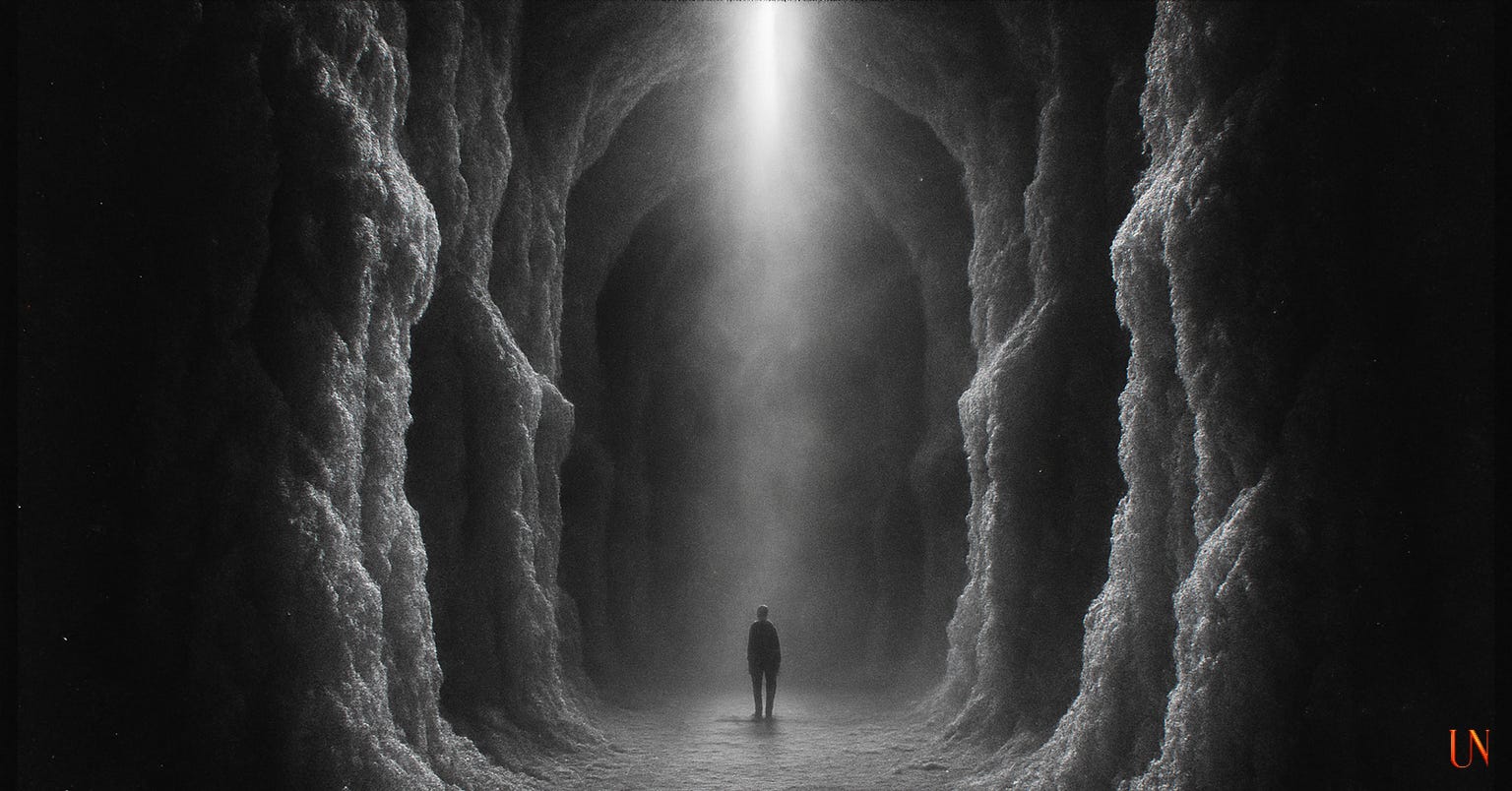

Author’s Note
This piece took me nearly a month to write. It began as a conversation. Erin messaged me in the aftermath of another national outrage, her words trembling between fury and tenderness. In her message, she called what we share Plato’s Cave—the space between seeing and believing, where two people stop performing recognition and choose to live by it. Those words stayed with me. They asked what light does to a body, to a nation, to a friendship that insists on truth. The Cave, Reimagined grew from that asking. It is a meditation on America’s hunger for shadows, on our shared work of carrying light back inside.
— with gratitude to erin 💖💛💙💛🧡🩷🤍
“Light is not salvation. It is what makes the work of seeing possible.”
— Taylor Allyn
Shadow Country
You perfected your shadows before you perfected your democracy, America.
They quiet the room when the truth begins to shake. They move when you move, soft accomplices that let you believe the darkness belongs to someone else.
You built cathedrals of reflection, rooms that glow, rooms that echo, rooms that promise that being seen is the same as being known. Every century you discover a new fire and call it progress. The television once. Now the small sun in your palm. You say the light keeps you informed. What it keeps is your pulse, steady and obedient, easy to count.
Listen to the sound the cave makes. It is not silence. It is a low mechanical lullaby, the country dreaming of itself. The screens breathe for us. The algorithms count our hearts and feed us back our fears. I have fallen asleep to that hum and called it peace.
Once, in the blue light of an ordinary room, I watched a man die again and again. The volume was low. The furniture was clean. My hands did not shake. What startled me most was how quiet breath can be when it is leaving a body. That quiet followed me out of the room and would not stop speaking.
You trained a nation to live by outline. Your children memorize state capitals but not how Mamie Till-Mobley described his face. Your churches stream forgiveness on demand. Your classrooms soften the bones of history until they rattle politely. Even your museums glow like altars. The chains no longer clang. They hum.
The body still remembers. It winces at sirens even when you call them order. It tastes smoke on clear days. It recognizes the pitch of a voice that says again while the headline pretends to say unprecedented. Under the ribs a small tremor starts. It is the body knowing what the mind agreed to excuse.
I know that tremor. It begins as breath caught in the throat, a pressure that waits without permission. There are days when the words never leave the body and become ache. That ache is how the truth survives when you refuse it air.
Right now, reading this, you are in the cave. The light from your screen throws shadows on the wall behind you. You cannot see them but they move when you move. Someone you love may be sitting in the same room, also looking at light that pretends to be a window. You are together and alone. This is the nation’s most perfect metaphor: connection that requires no contact, light that creates more shadows than it dissolves.
Let me tell you what the nation looks like when it is a single room. There are no doors. There are only drapes that pretend to be doors and move as if wind exists in a sealed place. The walls are glossy and reflect you at every angle. A single lamp hums so softly you forget it is sound and call it calm. We talk in the room. We eat and sleep in the room. Every so often, a portrait on the wall blinks. We say the portraits are history. We say the blinking is progress. No one opens a drape.
In the room there is also a mirror that thinks it is a window. We gather around it and narrate what we believe we see. We do not notice that our own faces keep insisting on being the subject. When a siren rises somewhere outside the mirror’s frame, the glass does not crack. It fogs. We call the fog nuance.
Now step into the second chamber. It is a house of mirrors. Here, reflection multiplies until it feels like a crowd. We begin to mistake repetition for evidence. If a lie can be seen from twelve angles at once, we accept it as truth and call dissent impolite. The floor makes a sound like breath. It is only electricity. We bend toward our own images and ask them to absolve us. They nod. There are so many of them that the nod feels like a vote.
There is a third chamber too. A field that breathes. From far away it looks like a painting of wheat. Up close the stalks are names. They bend and rise on the wind of our forgetting. When the field exhales, whole counties smell like metal and rain. Someone says this is the scent of history. Someone else says history is over. The field keeps breathing.
I have walked each chamber. I have mistaken silence for peace. I have admired the mirrors for their fidelity and not their hunger. I have stood at the edge of the breathing field and called it beautiful because from a distance grief looks orderly. This is how shadow teaches us to behave. It rewards our distance. It names our refusal discernment.
You confuse ignorance with rest. You call blindness peace. You tell the children to close their eyes and pray, and when they do, you call them innocent. But innocence is only another word for sleep.
Listen. The light is not coming to rescue you. It is coming to reveal you.
And I, like you, am still learning how to stand still when it arrives.
There is one more room we do not name. It lives between the rooms and beneath them. It has no lamps and no mirrors. It smells like ash and rain. When we pass it, the hum grows louder, nervous that we might hear something beneath it. I have stood at that threshold and listened hard. The sound below the sound is breath. Not mine alone. Ours. It is out of rhythm. It wants another tempo. It waits for a hand to keep time on a table, for a foot to start a pulse on a floor. The rooms teach us to be audience. The unroom asks us to remember we have bodies.
The cave is not a metaphor here. It is maintenance. It is the daily upkeep of the nation’s favorite myth: that the wall is the world, that the glow is the good, that the echo is the voice. You have become fluent in reflection. So have I. And yet the body keeps its own archive. It records the heat of proximity, the weight of a hand, the tremor at the instant a lie arrives dressed like order. The archive is not neutral. It is blood.
You tell me the wall is safer. You say light agitates the already restless. You say quiet is a kindness. I have believed you before. The hum is persuasive. It is patient. It asks nothing. That is why it wins.
But there is a problem the hum cannot solve. The breath in the unroom does not stop. It falls out of step and finds it again. It swells. It rests. It refuses to be background. And once you hear your own breathing as something separate from the room, the room begins to loosen its claim.
Hold this a moment longer. I am not here to accuse you from some seat outside the rooms. I am speaking from within them, with the glass still on my skin. The mirror would like to be a window. The field would like to be touched. The lamp hums because it is tired. We are tired. The difference is small and holy. Tiredness tells the truth. Tiredness says, open the drape.
Blood Memory
The light does not stay on the surface. It remembers the cave has always been a body. Stone walls were always skin holding something back. The shadows you loved were veins gone dark from lack of use.
It searches for an opening, presses against the body like a question that refuses translation. It slides along the collarbone, curious, persistent, warm as breath.
At night the sound returns. The refrigerator’s drone, the whisper of pipes, the soft tick inside the walls. Each a reminder that empire never truly sleeps; it only purrs. The light moves through that sound. It finds the quiet things and names them restless.
It travels the same corridors our ancestors carved to survive: the tunnels of labor and loss, the long arteries of migration. It moves through the veins that learned extraction before they learned relief. It enters the field that still remembers hands, the water that remembers chains, the factories that remember sleep. It crosses reservations where wind keeps the names the maps erased. It waits at the border fence where language splits and keeps splitting.
You call it history. You hang it behind glass that costs more than the families who clean the museum. You assign it between lunch and recess, right after the Pledge. But the light does not want your archive. It wants circulation. It wants to run through the body again until the story is pulse instead of plaque.
Inside, brightness thickens. It travels the capillaries like instruction. Each beat delivers a message you have tried not to read: You were never free, only unfinished.
The heart resists. It prefers posture to practice. It performs remorse instead of rhythm. But the body keeps time whether you consent or not. The pulse begins to move through shame without building a home there. Breath deepens; heat gathers; something ancient rewrites itself quietly beneath the ribs.
Sometimes I hear that change as percussion. A low drum keeping time under the nation’s chatter. Sometimes it is a sound that tastes like metal and mercy. When I walk through a city, traffic lights blink like metronomes reminding me that survival has always been musical.
The hum grows louder. It sounds like your own blood when you hold your breath too long.
You will say this is sentiment. You will say the country is an idea, not a body. No. Ideas do not bleed.
You trained a nation to treat pain as content. The light returns it as consequence. It drags suffering out of spectacle and back into skin. It asks: What have you done with what you know?
I have felt that question enter me. Erin’s words did not visit; they nested. When she spoke of the cave, she meant the space between seeing and believing, where two people might stop performing recognition and start practicing it. I carry her words not as wisdom but as weight, necessary weight that keeps me from floating into abstraction. I asked permission to carry them in the marrow because I know what theft looks like dressed as praise. She said yes the way thunder says yes—absolute, conditional, alive.
Now she speaks in rhythm: Hold what was given; let it alter you before you offer it. She warns: Do not make a museum of what was meant to move.
Even the cave walls have veins; the light runs them, finds old blood trapped in stone, and hums until it stirs. The cave itself begins to remember.
This is blood memory. Not nostalgia, not archive, not elegy for a country imagined. It is the hard labor of keeping truth in motion so it does not clot. It is heat held in the chest until the hands know what to do.
When the sound rises, I place my palm to the wall. It is warm. Something living moves behind it. The nation is breathing differently. Every wall that once divided us is only a lung learning a new rhythm.
The cave exhales.
Carrying Fire
Revelation is not an exit. It is an assignment.
The air after illumination feels heavy, the way rooms do after a storm when everything has shifted and nothing yet returned to its place. You stand there, hands empty, heartbeat uneven, uncertain whether to rebuild or begin again.
The light does not answer. It watches. It waits to see what you will do with what you now know.
Behind you the cave flickers, patient as habit. Ahead, the day waits, bright and exact, its heat making promises it cannot keep. Both belong to you. Shadow and sun share a parent.
I have been here before. The first time flame touched my palms, I thought it was a gift. The second time, a punishment. Now I know it is only responsibility wearing two faces. Warmth and ruin share the same origin. What matters is how long you can hold the heat before it begins to consume the hand.
You will say the safest thing is to leave the fire where you found it. You will say darkness is peace if everyone agrees to squint. You will say the children are sleeping, the house is tired, the country is fragile.
No. Peace without sight is only quiet. Quiet has never saved a life.
So lift the flame. Cup it with both palms. Guard it from the wind. Do not use it to punish. Use it to reveal. Let it fall across the wall until walls become walls again, chains become chains, faces become faces. Nothing symbolic, nothing metaphor, only the truth of what they are.
That is what return requires: to bring the brightness back into the place that taught you to fear it; to stand inside the old dark and hold the new heat steady until someone else can see. Not for glory. For continuity. For the small, stubborn mercy of making sight possible where denial was easier.
I carry the fire differently now. I no longer believe in spectacle. I believe in maintenance. The work is not to keep the flame high but to keep it alive. Some nights it dims. I breathe on it. Some mornings it burns too fiercely and I must shield it from my own urgency. This is what witness becomes with time: stewardship.
You will grow tired. Some will call you ungrateful. Some will say the cave was safer. They will show you statistics. They will say the numbers are improving. They will not mention that fewer people dying is not the same as people living. Let them. Safety is the story you told yourself to keep from mourning what it cost.
Still, you keep walking. The field that breathes stretches before you again, its stalks whispering the names you once tried to forget. The sound is not accusation anymore; it is invitation. Every name a match. Every echo a possibility. You step carefully so as not to extinguish what rises from the soil.
If you are lucky, a spark will leap. A word will catch in another throat and refuse to die. A single decision to stay awake will multiply until it becomes a way of life. This is how nations turn. Not by spectacle, not by decree, but by the slow contagion of clarity.
You pause. The world returns, softer now, like breath after confession. You realize it was never silence you needed. It was resonance. The proof that sound can change shape and still remain true. You take one long breath, the kind that feels like permission. The flame steadies. The air answers.
Ahead, the path bends. You cannot see where it ends, only that the light reaches farther than you expected. Someone will come after you; you can already feel their footsteps in the pulse of the ground. The work will continue in other hands. That is both promise and warning.
The lesson was never escape. It was return. To come back carrying what might still save you.
The light is not salvation. It is what makes the work of seeing possible. Do the work.
Let that be enough—for now.
UNSPUN publishes longform essays, op-eds, and visual documents tracing the language of power in real time.
This longform essay is part of UNSPUN Proper, UNSPUN’s ongoing column on state violence and media mythmaking.
To engage or contribute, write to unspunworld@substack.com or follow UNSPUN for updates.

Every word here is researched, written, and sharpened by one person—me. If you value work that names what others won’t, consider becoming a paid subscriber. It keeps this space independent, and it keeps pieces like this possible.