

THE LIE IS TENDER
Purity, at Two Price Points


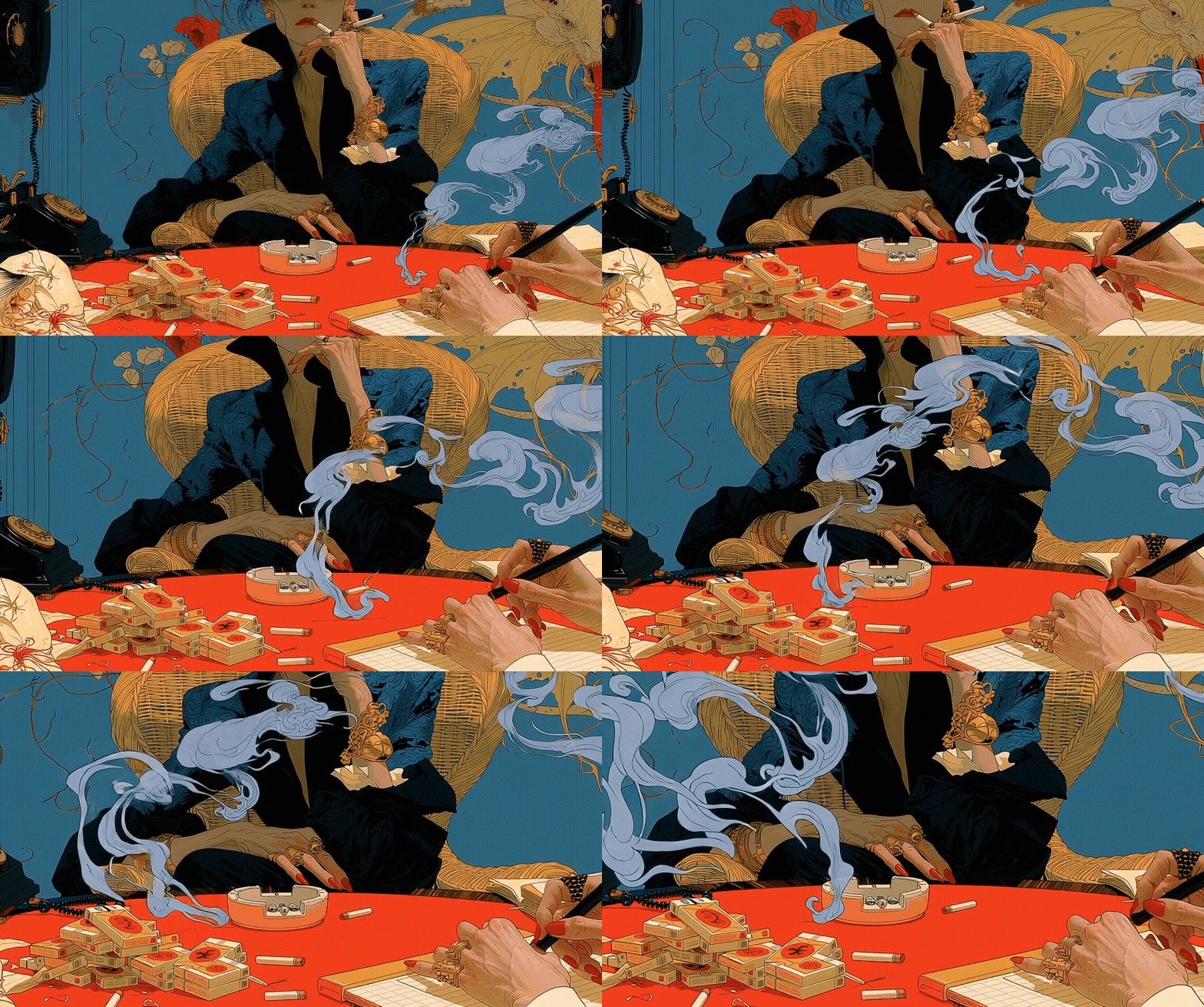
TERRAIN: The verdict is written on the plate; taste performs the sorting and white bread passes as the ground everyone else must cross. This essay refuses the neutrality that disguises those arrangements and keeps the remedy and the removal visible together.
Neutrality is a costume worn by power when it wants to pass for weather.
It smooths its face, lowers its voice, and calls itself common sense. But the plate was never neutral. It was chosen, arranged, defended.
The silence around that choice is the lie the essay will not keep.

“People who eat white bread have no dreams.”
— Diana Vreeland

The bread came first because the lie always does.
It arrives soft, pale, easy to swallow, which is how power likes to enter the mouth. White bread is not merely food here. It is a method. It is what happens when a culture peels history away until only surface remains, then calls that surface clean.
The industrial beauty of the loaf is that it makes subtraction look like progress. Remove the grain, bleach the color, standardize the shape, extend the shelf life, and the thing begins to look like order itself. What was once rough and variable and local is remade into something that can travel without protest. The shine is the point. It teaches the eye to mistake processing for care.
But subtraction is only half the operation, and it is the half everyone remembers.
The country noticed what it had taken. The nutritional surveys came back through the late thirties and they were bad, and then the draft began and the numbers stopped being academic. Selective Service turned men away by the hundreds of thousands, and its director named the reason to the Los Angeles Times: malnutrition. A country cannot fight a war with bodies it has already hollowed.
In May 1941 Roosevelt convened the National Nutrition Conference for Defense, and nine hundred delegates came to the Mayflower Hotel to discuss the health of the nation. That same year the FDA wrote a standard of identity for enriched flour. Thiamine. Niacin. Riboflavin. Iron. Not restored. Added. The mill stripped the wheat, a standard sprinkled the difference back in, and the result got a name.
Enriched.
That is the most honest word in the history of the loaf and nobody hears it. Enrichment is not repair. Enrichment is what an institution does after it has decided the damage will continue and the accounting is optional.
Follow the sequence, because the sequence is the argument. The state knew. It ran the numbers, it saw the deficit, and it did not stop the milling. It supplemented the milling. It let the extraction stand and administered a correction on top of it, and the correction became the evidence of care.
Then watch who received the correction first.
In February 1942 the Army announced it would buy only enriched flour. The soldiers were fed. By the end of that year roughly three quarters of the white bread on the market carried the vitamins. The remaining quarter came from small mills still selling the cheap unenriched flour, and cheap flour goes where cheap flour goes. The people who needed the remedy most were last in line for it, and they stayed there until 1943, when the War Foods Administration banned the unenriched loaf outright and compliance finally reached everyone.
Read that again. The remedy was distributed by usefulness. The bodies the state required got it in February. The bodies the state was merely responsible for waited two more years, eating the loaf the state had already measured and found empty.
Erasure would be simpler. Erasure you can accuse.
This is erasure with a remedy attached, and the remedy is real, and the remedy has a queue.
The whiteness was never only visual.
Aaron Bobrow-Strain has traced the loaf up through the Pure Foods movement and the early century’s dreams of purity and contagion, where clean meant disciplined, modern, safe, and where those words were already doing other work: separating civilized from uncivilized, reliable from suspect, fit from unfit. The bread was not being sold. It was being recruited. Bernarr Macfadden, health guru in a leopard-skin tunic, warned that white bread was sapping the vitality of the white race. He meant it against the loaf. Hear what he granted while swinging: that a bread could carry a race, that a diet could hold a hierarchy, that the fitness of a people ran through what they were willing to chew.
He lost the argument and kept the premise. The premise is still working.
February 10, 1967. RE: HAIR ON SITTINGS.
“For goodness sakes, beware of curls.”
She dictated most mornings from her bathroom, where she kept an installed phone, a wicker armchair, and cigarettes, and the memo closes with the ruling:
“We are not looking for endless variety—we are looking for fashion.”
Read it as what it is. Not a witticism. A directive, dated, subject-lined, and circulated to people whose livelihoods depended on receiving it. Standardization issued from the top, in house style, by a woman in a chair beside her cigarettes. She is refusing variety in the same decades the mills were refusing grain, and she is doing it through the same instrument: the memo, which is how an institution makes a decision look like a fact.
The same woman said that people who eat white bread have no dreams.
She is not this essay’s witness. She is a co-author of its form.
Because the loaf lands on a tray. The cafeteria slice is the afterlife of industrial beauty, white bread stripped of romance and set under fluorescent light, where its blandness becomes policy in miniature. A lunch tray is a small administrative state. It decides what counts as enough, what is efficient to serve, what can be repeated without complaint, what kind of body the institution intends to maintain.
The tray and the memo share a grammar. Both hide force inside ordinariness. Both understand that people are easier to govern when the terms of their lives are made to feel practical, temporary, budget-conscious, unavoidable. Nobody signs the tray. That is the genius of it. A form letter can end something without raising its voice, and a schedule of eligibility can close a life in a font nobody reads. The lie is small because it has to be. Big lies get noticed. Small ones become climate.
And the child learns, before language can explain it, that policy comes disguised as taste.
RELATED ESSAYS: AN EXTRAORDINARY WHITE LIFE, NOTHING LIKE IT
Now a different object, because the loaf only tells half of what purity does.
Some years ago I was at a fragrance counter in Nordstrom, looking at Bond No. 9’s Signature Scent. Four hundred ninety dollars. The house sells it on concentration: thirty percent, which exceeds the eau de parfum standard and moves it into a category the brand calls rare. The category is pure perfume. Oud extract. Rose. Tonka bean. Musk. Resin, flower, hay, animal. Everything the mill takes out, in a bottle, at a markup.
Pure.
The loaf is pure because everything was removed. The bottle is pure because nothing was. Same word, opposite operation, and the word never blinks. At the bottom of the market purity means stripped. At the top it means undiluted. One is administered to you and the other is sold to you, and the people who receive the first are told they are being given simplicity, while the people who buy the second are told they are being given the truth.
The woman behind the counter did not want to help me. When I finally asked, she said they didn’t have any. Curt. Finished. A sentence with no edge on it anywhere.
We don’t have any.
Hear it. A decision dressed as a default. It is the tray’s sentence and the memo’s sentence, and it is white bread: everything that would make it accusable has been milled out, and what is left is a surface you cannot get a grip on. She did not say no. She arranged for the shelf to say it.
I clocked it. I said, all right, I’ll buy it.
Her eyes lit up. Then the samples came out of nowhere.
Here is the part I did not understand for years. Bond No. 9 gives complimentary samples with every order. It is printed on their own page, twice, as house policy. The samples were never hers. Not generosity, not warmth, not a gift extended across the glass. They were already mine by the terms of a transaction she had spent the previous four minutes refusing to let me enter. She withheld what was policy and produced it as kindness the instant she recalculated my credit.
That is enrichment. Not like it. It.
The mill takes the grain and the standard doses the vitamins back and the result is called care. She takes the service and produces the samples that were already owed and the result is called service. The remedy is real in both cases. In neither case is the remedy the thing that was taken. And both remedies have a queue: the Army in February, the poor in 1943, and me at the exact second my credit cleared. She did not decide I deserved the samples. She decided I had become useful.
I told her she wasn’t getting the sale. I asked if she felt proud. I said I would have no dignity left if I let her lie to my face and then paid her for the privilege, that what she had done was racial and we both knew it, and that her willingness to turn around and take my money four minutes later should alarm her more than it offended me. Her foundation was fractured. I was not going to help her put it back together.
Then I looked down the counter and had him sell me the cologne.
Now go back to the epigraph, because I did not find it where you would think.
I found it in Bobrow-Strain’s own book, on his opening pages, deployed as evidence and immediately explained. His reading is that Vreeland meant those people don’t dream the right dreams, the current ones, the hip ones. Fashion snobbery. A woman with an eye for what is next, dismissing the unfashionable.
That reading is too kind and it is too small, and I know it is too small because I have stood on the receiving end of the sentence.
She is not saying those people are behind. She is saying those people are empty. She took a fact about what a person can afford and converted it into a finding about the contents of their skull, which is not a comment on taste. It is a comment on interiority, and it is the oldest one there is. Every hierarchy this country has built runs on it: that the people at the bottom of the distribution are not merely receiving less, they are containing less. Fewer dreams in there. Less going on.
She wrote it down.
There is another memo. Curls again, because it was always curls.
“I really don’t think we ought to carry on with these awful looking curls — they do nothing for the clothes and nothing for the girl — it all gets depressing. I assure you this association with people with broken hair, no hairdresser, no money, no vitality — and the will to live is none.”
Follow her list. It begins as a list of hairstyles and it does not stay one. Broken hair. No hairdresser. No money. No vitality. And then, in an office memo about how to photograph a woman’s head, the finding: the will to live is none.
That is not a claim about being current. That is a claim about whether anything is alive in there, and the evidence submitted for it is a budget. She looked at a woman who could not afford a hairdresser and concluded the woman did not want to be alive. She put it in writing. She sent it to her department. Her grandson published it.
Bread and hair. Two objects, two rooms, one sentence. People who eat white bread have no dreams. People with no money have no will to live. Bobrow-Strain read the first as fashion and never met the second.
So it is not my reading against his. It is hers.
Vreeland explains her method in D.V. She credits her success to never worrying about a fact. She was projecting to the public. That was the job. She always had a clear view of what was possible for the public, and her working instruction was to give them what they never knew they wanted.
That is the mill. That is the tray. That is the counter.
The public is not asked. A read is taken of what is possible for it, and then it receives what someone decided it never knew it wanted. The wheat gets a read taken. The lunchroom gets a read taken. I got a read taken, in about three seconds, by a woman with a clear view of what was possible for me.
She never worried about a fact either.
So I refused the enrichment. Now I have to be exact about what the refusal cost, because it is the only fully honest sentence available to me here.
It cost four hundred ninety dollars.
The refusal was available because the purchase was available. I could push the samples back across the glass because I could put the bottle on the card. A person who could not afford the bottle takes the samples, and is right to, and goes home with a small vial of something and a large piece of information. The kid on the tray cannot refuse the vitamins. The vitamins are not an insult. They are dinner.
And Nordstrom got the four hundred ninety anyway. That is the part that will not land in my favor. I moved a commission four feet. The store never felt it. I took something from a woman and left the institution whole, which describes a great many acts that feel, in the moment, like justice.
The critique of the trained palate is not hard to come by. Bobrow-Strain makes it himself, elsewhere, and makes it well: the paternalism inside food reform, the smugness, the back-to-the-land whole-wheat vision that never stopped to ask who was left out of it, invariably white and propertied. That argument is available to anyone who reads. You can hold it without leaving the library.
What is not available from the library is standing in two places at once.
I have the palate. I also have the face that made the palate invisible. Both were in the store. The connoisseur and the suspect arrived in the same body, at the same counter, in the same three seconds, and she resolved the contradiction the way the country resolves it, by not seeing the first one. I am not making a claim about how much that hurt. I am making a claim about position. The argument in this essay requires both halves, and no amount of reading assembles them, because they do not occur in a book. They occur in a man who can price a thirty percent concentration and still be told there isn’t any.
Which is where the essay is supposed to conclude, and where I decline.
The available ending is that we should want the whole grain, the crust, the difficulty, the loaf with its life still in it. Recover discernment. Sharpen the appetite. Refuse to let plain pass as innocent. I believe most of that and I will not write it down as an ending, because as an ending it performs the loaf’s own trick. It takes a fact about distribution and hands back a preference. It answers a question about who gets fed with instruction on how to taste. That is the most expensive advice in the world, sold as the cheapest.
The vitamins were real. I cannot get past it. The enrichment worked. Pellagra fell. Beriberi fell. People who would have been sick were not sick, and it remedied a harm the same hand was still committing, and refusing it would have been a crime against the people who needed it, and accepting it meant agreeing that the milling would go on forever, in a queue, by rank. Two true things. They produce an outcome that is neither.
The loaf is light because someone took weight out of it. Then someone else weighed what was taken, wrote a schedule, and put back the part that could be measured. What could not be measured did not come back. There was no line for it on the form. The absence of a line is how a thing stops existing, and nobody has to hide anything, because nobody built a column for it.
The body still knows. Not the tongue.
Taste is purchasable and I have purchased mine. Something further down, under the ribs, that can tell being fed from being managed, and that knows a thing can be easy to swallow and impossible to trust.
The package stays the same. The meaning does not.
Let that be enough — for now.

AUTHOR’S NOTE
I went in to write about bread and came out holding a receipt.
The Nordstrom counter had been sitting in me for years as a story about her, and it is not. It is a story about what four hundred ninety dollars bought, which was a bottle and a position: the standing to push the samples back across the glass. I have told it at dinner and enjoyed telling it. I did not know until this essay that I had been telling it as though the refusal were free, and I cannot un-know that.
What I keep turning over is the man four feet down the counter who rang me up, who did nothing wrong, took the commission, and has no idea he is in an essay.
The store closed out fine that night. It always does.
That is the part I cannot take back: not what she did, which I understood inside of three seconds, but what my dignity cost at retail, and who is priced out of buying it.
If this work matters to you, join the readers who keep it possible.
Subscribe to access the full UNSPUN archive.
UNSPUN publishes longform essays, editorial encounters, and visual documents tracing how power moves, hides, and speaks in real time. My commitment to myself and to you is that this work is, and will remain, independent of corporate and party money; it answers to the people willing to read it closely enough to be changed.
If this piece shifted your footing, that shift has a cost on this side of the screen: time, refusal, and the choice to keep writing as if clarity still matters more than access.
If you are able, a paid subscription or recurring contribution keeps this work answerable to its readers instead of to its silencers. If you are not in a position to support UNSPUN, your willingness to stay with work like this already counts.
UNSPUN continues for those willing to stay with the work as it unfolds.

SOURCES
Aaron Bobrow-Strain, White Bread: A Social History of the Store-Bought Loaf (Beacon Press, 2012). The Vreeland epigraph, the Pure Foods movement, dreams of purity and contagion, and Bernarr Macfadden.
Aaron Bobrow-Strain, “What Would Great-Grandma Eat?”, The Chronicle of Higher Education.
Institute of Medicine, Dietary Reference Intakes: Guiding Principles for Nutrition Labeling and Fortification (National Academies Press), ch. 3, “Overview of Food Fortification in the United States and Canada.” The 1941 FDA standard of identity and the National Nutrition Conference for Defense.
National Park Service, “Nutrition on the Home Front in World War II.” The Mayflower conference, the 1942 enrichment rate, the January 1943 mandate.
Diana Vreeland Memos: The Vogue Years, ed. Alexander Vreeland (Rizzoli, 2013). Both memos. An edited selection was first published in The New Yorker, 17 September 2001, and in Visionaire 37, “Vreeland Memos,” 2006.
Diana Vreeland, D.V. (Alfred A. Knopf, 1984).
Lindsay Silberman, “Famous Last Words: Diana Vreeland,” DuJour, 30 September 2013. “Diana Vreeland: Take a Memo,” W, 3 October 2013.
Bond No. 9, Signature Scent product page, bondno9.com. Retrieved 14 July 2026.
Ugh. People are so fucked up. I will never understand those like the saleswoman. They make me sick.
This essay is giving me a lot to think about. The word “enrichment” is really interesting. In many contexts, it would be assumed to mean that something is better than baseline, purely an addition. In the context of white bread, it’s what happens when good things are removed and only partially returned, leaving the result at less than baseline. This enrichment of white bread allows the people eating it to stay healthy enough so that work can be extracted from them, thereby enriching those doing the extracting.