

UNDETECTABLE
On the Body that Glows Under Surveillance


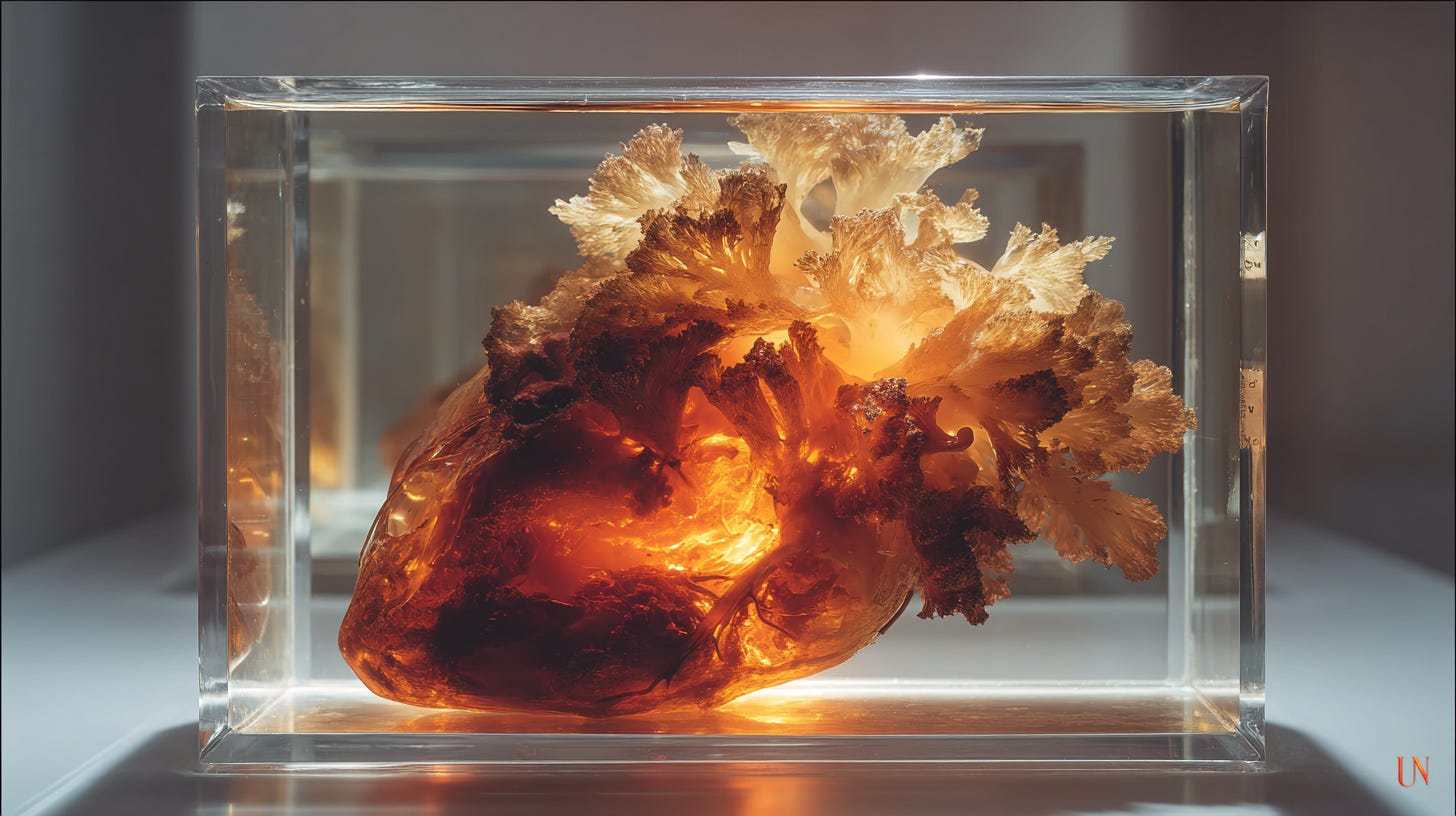
“Undetectable equals untransmittable. This scientific fact has not yet reached the law.”
— HIV criminalization defense brief, 2024
PREFACE
The virus lives in me the way light lives in this specimen: beautiful, contained, slowly destroying what holds it.
They call it undetectable. I call it the warmth that blooms in glass. I call it proof of absence. I call it the most intimate relationship I never chose. I call it $48,000 a year in pharmaceutical profit. I call it evidence I must produce every 90 days or risk being criminalized. I call it the thing I monitor more than I monitor myself.
Undetectable doesn’t mean cured. It means managed. It means maintained. It means documented. It means profitable.
15 years. That’s how long the virus and I have been together. Longer than any friendship I’ve kept. Longer than any love I’ve claimed. Longer than I’ve lived in any city or held any job. We’ve been bound since I was 21, since the man I was seeing gave it to me and I found out by accident; not through disclosure but through diagnosis, not through choice but through the particular violence of someone else’s silence.
A month ago I switched medications. After 14 years on the same regimen, my doctor suggested something newer, better, more forgiving to kidneys and bones. I hesitated. The old medication worked; kept me undetectable, kept the virus suppressed, kept me glowing in glass. Why risk changing what wasn’t broken?
But not broken and optimal aren’t the same thing. So I switched. New pill. Same time. Same ritual. Almost the same price, because that never changes, the cost of staying undetectable.
It feels like starting over. Month 2 of the new medication. Waiting for the next viral load test to confirm what I already know: the virus is still there, still suppressed, still invisible. The only thing that’s changed is the chemistry keeping it that way. But starting over isn’t quite right either. It’s continuation. Refinement. The glass adjusting its composition while the specimen inside stays the same.
Maybe one day I’ll get the injection, the twice-yearly shot that just got approved, the one that could mean no daily pills, no daily reminders, just protection delivered and done. But that’s future tense. Right now, it’s still the pill. Still 8 AM. Still every single day.
What does it mean to exist as proof that something can’t be seen? To be defined not by presence but by documented absence? To be most intimate with something invisible? To be profitable precisely because you’re sick enough to need treatment but well enough to keep needing it?
These are not rhetorical questions. These are the conditions of undetectable status. These are the terms of the glass.
December 2025 arrives like laboratory results you’re afraid to open. The policies are clear. The funding is failing. The infrastructure that keeps people like me glowing is being systematically dismantled. They use words like “efficiency” and “budget constraints.” They mean: some lights cost too much to maintain.
This is not another story about living with HIV. This is not a stigma narrative or a triumph arc. This is an examination of what it means to live as absence, as profit center, as surveillance subject, as non-consensual partner to the invisible, as specimen glowing under a clinical gaze that might, any day now, finally look away.
What follows is the record of that glow: the specimen, the absence, the intimacy, the profit, the surveillance, the shattering. Not toward cure, but toward the question: what does it mean to be alive only when you prove it?
The virus lives in me. I live in glass. Both of us are destroying what holds us.
Let me show you how.

THE SPECIMEN
21 years old. That’s how old I was when the doctor’s office called and asked me to come in. Not over the phone, they said. In person. I knew before I walked through the door what the results would say. You always know. The body tells you before the blood does.
The exam room was cold. The paper on the table crinkled when I sat down. The doctor came in holding a folder with my name on it, my birthdate, a series of numbers that would define me for the rest of my life.
CD4 count: 487 cells/mm³.
Viral load: 47,000 copies/mL.
HIV status: Positive.
I became data before I became patient. The virus made me specimen before it made me sick.
The doctor talked quickly. Clinical language replacing what my body already understood. Antiretroviral therapy. Viral suppression. Treatment adherence. Undetectable status. Words that sounded like medicine but felt like surveillance. I stopped hearing sentences and started hearing systems: monitoring, maintenance, management, cost.
Not if I would start medication, but when. Tomorrow, ideally. Today, if the pharmacy could fill it fast enough. The urgency wasn’t about my health, not yet. My CD4 count was fine. I wasn’t sick. But the protocol was clear: start treatment immediately. Suppress the virus. Protect the future. Begin the monitoring.
The doctor never mentioned the medication costs $4,000 a month. They mentioned copay assistance programs, Ryan White funding, patient assistance applications. They handed me pamphlets about financial support, phone numbers to call, websites to visit. I didn’t understand yet what they were really saying: you’ve become revenue stream.
The math I would learn later: $48,000 a year in medication costs. Multiply that by 40 years if I live an average lifespan with treatment. $1.92 million per patient. I wasn’t victim. I was market. The pharmaceutical companies didn’t save my life out of charity. They saved it because I was profitable.
Gilead. ViiV Healthcare. Merck. These names would become more familiar to me than my own family’s. I would learn their patent timelines, their pricing strategies, their patient assistance programs that look like generosity but function as profit maintenance. Because if you can’t afford the medication, you stop taking it. And if you stop taking it, you’re no longer revenue. You’re loss.
The system needs you sick but medicated. Sick enough to require daily pills. Medicated enough to stay alive and keep buying them. It’s not conspiracy. It’s capitalism. And I became part of it the moment those test results printed.
They placed me in the glass container that day. They called it treatment plan. They meant: you will be monitored for the rest of your life. Blood draws every 90 days. Viral load tests. CD4 counts. Kidney function panels. Liver enzyme checks. Producing data quarterly to prove you’re maintaining, adhering, suppressing, glowing.
I picked up my first prescription 2 days later. 3 pills then, 1 giant pill now. The bottle felt heavier than it should. Not the weight of the pills themselves but the weight of forever. This wasn’t antibiotics for an infection. This wasn’t a temporary treatment. This was the beginning of a permanent relationship with pharmaceutical intervention. Every morning. Same time. No exceptions. For the rest of my life.
I took the first pill at 8 AM. Swallowed it with water. Felt it go down. Felt nothing change and everything change simultaneously. The virus was still there. My body was still the same body. But I had crossed a threshold. I was specimen now. Contained. Monitored. Preserved.
21 years old. Black. Queer. Already taught that my body was danger before the lab work ever proved it. Already legible to systems that need people like me categorized, tracked, explained. The virus just gave them another taxonomy, another reason to document my existence. Specimen wasn’t just medical designation. It was confirmation of what surveillance already suspected: that I required watching.
The warmth began that morning. Not dramatic. Not visible. Just the slow steady heat of maintenance, of chemical intervention, of survival that costs $48,000 annually and generates $1.92 million in lifetime pharmaceutical profit.
The specimen is preserved. The profit is secured. The monitoring begins.
I left that office with a diagnosis, a prescription, and a price tag I wouldn’t see for months. I was positive. I was treatable. I was worth $1.92 million to someone I’d never meet.
The warmth had just begun to bloom.
THE ABSENCE
Undetectable doesn’t mean gone. It means there but invisible. Which makes me what?
6 months after diagnosis. First undetectable result. I was sitting in my car outside the clinic when I checked the patient portal on my phone. Viral load: <20 copies/mL. Undetectable. CD4 count: 612 cells/mm³. Normal range.
I stared at the screen. Waiting to feel something. Relief? Victory? The weight lifting? But all I felt was confusion. Because undetectable doesn’t mean what it sounds like it means.
The virus isn’t gone. It’s there, reproducing, living, hiding in reservoirs the blood tests can’t reach. Lymph nodes. Gut tissue. Bone marrow. Brain. The medication doesn’t kill it. The medication suppresses it, drives it below the threshold of detection. Below 20 copies per milliliter of blood. Undetectable doesn’t mean absent. It means invisible.
I am not cured. I am managed into invisibility.
Other chronic conditions are defined by presence. Diabetic. Asthmatic. Epileptic. The condition is there, named, acknowledged. But undetectable HIV status is defined by managed absence. I have it. But when I have it properly, when I’m adhering to treatment, taking the pill every day at 8 AM without fail, it can’t be found.
I am Schrödinger’s patient. Simultaneously sick and well. The virus is there and not there. I am positive and undetectable. Both. Always. The contradiction doesn’t resolve. It just is.
Try explaining this to someone:
“I’m positive.” (Fear. Retreat. The slight lean backward.)
“But I’m undetectable, which means I can’t transmit it.” (Confusion. Skepticism.)
“U=U. Undetectable equals untransmittable. It’s science.” (The Google search happening behind their eyes.)
“So you’re positive but you can’t give it to anyone?” (Yes.)
“So are you sick?” (Yes and no and it depends what you mean by sick.)
The language fails. The explanation fails. The only thing that doesn’t fail is the glass. The container holding the contradiction. The specimen glowing with proof of absence.
Science says: undetectable equals untransmittable. You cannot transmit HIV when viral load is undetectable. This is fact. Decades of research. Thousands of serodiscordant couples. Zero transmissions when the positive partner is undetectable. Zero.
Experience says: people still recoil. Laws still criminalize. Dating apps still have the question: HIV status? And undetectable isn’t one of the options. Just positive, negative, or prefer not to say.
Scientific fact lives in one world. I live in another.
Every 90 days I return to the clinic. Extend my arm. Watch the tourniquet tighten. Feel the needle enter the vein. Watch the vials fill with blood that will become data that will tell me whether I still exist as absence.
72 hours of waiting. Refreshing the patient portal. Waiting for the numbers that define me. Viral load: <20 copies/mL. Undetectable. Again. Still. For now.
The relief is real. But so is the understanding that this is not permanent. This is 90 days of confirmation. In 90 more days, I’ll produce the evidence again. Prove the absence again. Exist as negation again.
Inside the glass, I glow. The glow is proof that absence is maintained. The light you see? That’s not the virus. That’s the space where the virus should be but isn’t, can’t be measured, remains below detection. That’s me. That’s what I’ve become.
I am the hollow at the center of detection. I am what remains when something is there but can’t be measured. I am proof of nothing.
And nothing is what keeps me alive.
Undetectable status must be maintained. Absence must be proven. Every 90 days, I produce evidence that I am defined by lack.
The virus lives in me. I cannot find it. Neither can the tests. But we both know it’s there.
I am the space between presence and detection. I am what glows in that gap.
Living as absence. Proof that something invisible defines everything about how I’m seen.
THE INTIMACY
We’ve been together for 15 years. We share blood, bone, the space behind my sternum. I did not choose this relationship. But here we are.
The longest relationship I’ve ever had is with HIV. Longer than any friendship. Longer than family members I’ve loved and lost. Longer than any lover who’s shared my bed or known my body or claimed they understood me.
We are more intimate than I’ve ever been with anyone. We share everything. It lives inside me. I feed it, not intentionally, but my body is its home, my blood its nourishment. It replicates using my cells. We are biologically intertwined in ways I will never be with another human being.
I think about it every single day. I have never gone 24 hours without considering it. The pill I take at 8 AM. The status I maintain. The presence I carry. No lover has ever occupied this much of my awareness. No partner has ever been this consistently present.
This is intimacy. I did not consent to it. But here we are.
Unlike other chronic conditions you can sometimes forget, HIV demands daily attention. The medication alarm. The pill. The water. The small ritual that keeps the relationship functioning. You think about it:
When you take the pill. Every day.
When you disclose. Every new intimate connection, every dating app conversation, every moment before sex when you decide: do I tell them now or after or not at all.
When you travel. TSA seeing the medication bottles. Customs asking questions. Crossing borders with proof of status sometimes required, sometimes forbidden depending on the country.
When you get sick. Is this the virus or just a cold? Is this opportunistic infection or seasonal flu? The calculation always happening beneath the surface.
When you see a doctor. Every visit requires disclosure. Every specialist. Every emergency room. Every dentist appointment. HIV status? Yes. Viral load? Undetectable. CD4 count? Normal range. The same questions. Always.
Every 90 days. Blood draw. Results. Proof of maintenance. Evidence the relationship is still functioning. Still suppressed. Still invisible but present.
I never chose this relationship. It chose me. Or rather: it happened. A moment of transmission I may never be able to pinpoint. The virus entered my body and made itself at home. We’ve been together ever since.
I cannot leave this relationship. Divorce is not an option. Separation is impossible. We will be together until one of us dies. Statistically, if the medication keeps working, we’ll both die at the same time, when my body finally gives out decades from now. We are bound.
This is the most committed relationship I’ve ever been in. I never said yes.
The virus knows my body better than anyone. It knows which cells to target. CD4 T cells, the ones that coordinate immune response. It knows how to hide when the medication comes. It knows where to wait. Lymph nodes. Gut tissue. Bone marrow. Brain. Places the blood tests can’t reach, reservoirs where it persists dormant, waiting.
It knows me intimately. From the inside.
I know it too. I know its viral load. Undetectable. I know its suppression status. Suppressed. I know what it responds to. Antiretroviral therapy. 3 drugs combined into 1 pill. Taken daily without fail. I know what would happen if I stopped feeding it medication. It would replicate, emerge from hiding, become detectable again within 2 to 4 weeks. The relationship would shift from managed to crisis.
We know each other. We are locked in perpetual negotiation. I take the pill. It stays hidden. This is our arrangement. This is our intimacy.
With a lover, you can leave. They don’t live inside you. You can go days without thinking of them. Intimacy is chosen, negotiated, consensual. The relationship has boundaries. You maintain separate lives, separate bodies, separate futures.
With the virus, I cannot leave. It literally lives inside my cells. I think about it every single day. The relationship was non-consensual. There are no boundaries. It’s in my blood, my bones, my brain. We do not have separate lives. We share one body. One future. Bound until death.
I have been more faithful to this virus than I’ve ever been to anyone. Not by choice. By necessity. By biology. By the terms of survival.
Inside the glass, we glow together. The virus and I. Two things in one container, inseparable. The light you see is both of us. My body maintaining. The virus suppressed but present. We are specimen. Plural. Together.
People ask what it’s like to “live with HIV.” I tell them: imagine the most intimate relationship you’ve ever had. Now imagine you can never leave. Now imagine it lives inside you. Now imagine you didn’t choose it. Now imagine it might kill you if you stop paying attention to it daily.
That’s not living with. That’s being permanently bound to.
The virus is my most constant companion. My longest relationship. My most demanding partner. We share a body. We share a life. We share the glass that holds us both.
I did not choose this intimacy. But I maintain it daily. The pill at 8 AM. The blood draw every 90 days. The monitoring. The awareness. The negotiation.
We’ve been together 15 years. We’ll be together until one of us dies. Probably both of us, at the same time.
This is what they call “living with HIV.” I call it the relationship I can never leave. I call it intimacy without consent. I call it being bound to the invisible.
The virus lives in me. I’ve learned to live with it. We are specimen. Together. Always.
THE SURVEILLANCE
Every 90 days I produce proof. Not that I’m well. That I’m compliant.
I am monitored more than most people can imagine. Every quarter, my body produces data: viral load, CD4 count, comprehensive metabolic panel, kidney and liver function, complete blood count. I am more documented than most citizens. I am more tracked than most criminals.
This is what they call care.
The clinic. The waiting room. The phlebotomist who knows my veins after 15 years. The tourniquet tight around my arm. The vials filling with blood that will become numbers that will determine my status. The waiting, 72 hours usually, for results. The patient portal refresh. The relief or dread.
Viral load: <20 copies/mL. Undetectable. CD4 count: 687 cells/mm³. Normal range. All functions: Normal.
Status: Virally suppressed. Continue current regimen. Return in 90 days.
The data says: you’re adherent. You’re compliant. You’re a good patient. You’re maintaining.
The data doesn’t say: whether you’re happy, struggling, exhausted, relieved. Whether the medication makes you nauseous. Whether you’re worried about the future. Whether you turned 36 last month and wondered if you’d make it this far when you were 21 staring at those first results.
The data reduces you to: functioning specimen.
Who has access to this data? Your doctor, the lab, your insurance company, the pharmaceutical company through patient assistance programs, the federal government if you’re on Ryan White funding, your employer through insurance claims, the state where HIV-positive status is reported to registries.
More people know my viral load than know my middle name.
In 37 states, HIV criminalization laws remain on the books. Failure to disclose before sex can equal felony. Transmission can equal assault or attempted murder. Even if you’re undetectable. Even if science proves you can’t transmit. Even if you used protection. Even if no transmission occurred.
Your status isn’t just medical. It’s legal. You’re not just patient. You’re potential criminal.
And for a Black man in America, potential criminal was already the diagnosis before HIV entered the bloodstream. The surveillance was already there. The registries already tracking. The assumption of danger already documented. HIV status just gave the system another column in the database, another reason to monitor, another legal framework to criminalize what the body does, who it touches, how it loves.
Every time you disclose to a sexual partner, you’re creating a witness. Someone who knows. Someone who, if things end badly, could report you. Could claim you didn’t disclose. Could say transmission occurred even if it didn’t, even if it couldn’t. U=U is scientific fact. But in the gap between scientific fact and legal reality, your documented status becomes evidence that could be used against you.
Disclosure is necessary for intimacy. Disclosure is also evidence.
You don’t have to disclose to your employer. But health insurance claims are tracked. Prescription records exist. If anyone finds out, they know. The data doesn’t stay contained. It leaks through systems, through HR departments, through people who can’t keep what they know to themselves.
Travel means borders. Many countries ban or restrict entry for HIV-positive people. You must sometimes disclose on visa applications, bring proof of status, carry medication through customs, answer invasive questions from border agents who’ve never heard of U=U, who see positive and see danger.
The monitoring that keeps you alive also makes you legible to systems of control. The glass is transparent. Everything inside is visible to those who want to look.
I produce data because my survival depends on it. But that data also makes me visible, traceable, potentially criminal. The glass is care. The glass is cage. The glass is both.
December 2025: what happens when the monitoring becomes impossible? When funding dries up? When clinics close? When the Affordable Care Act protections for pre-existing conditions get dismantled? When Ryan White funding gets cut?
The surveillance keeps you alive. But it also keeps you contained. And now, watching December 2025 unfold, you wonder: what happens when the glass breaks? When you can’t produce the data? When compliance becomes impossible not because you failed, but because the system did?
The monitoring is infrastructure. Remove one piece, clinic access, insurance coverage, medication supply, laboratory services, the whole thing collapses. You don’t stop being positive. You stop being able to prove you’re undetectable. You stop being monitored. You stop glowing.
And when you stop glowing, the systems that profited from your maintenance no longer have use for you. You become loss instead of revenue. Liability instead of asset. You disappear from the data. Not because you’re cured. Because you’re no longer legible to the systems that required your visibility to function.
Every 90 days, I return to the clinic. I extend my arm. The blood is drawn. The vials are labeled. The data is produced.
I am compliant. I am documented. I am legible.
This is what keeps me alive. This is what makes me visible. This is what makes me vulnerable.
The monitoring is care and surveillance simultaneously. The data proves I’m maintaining. The data also proves I exist: as specimen, as revenue, as potential criminal, as subject of control.
I produce proof every 90 days. Not that I’m well. That I’m being watched.
I glow under surveillance.
THE SHATTERING
December 2025: I’m watching the glass crack. Not from inside. From outside.
December 2025 arrives like test results you’re afraid to open. The policies are clear. The funding is failing. The people making decisions about my survival have never met me, never seen the glass, never considered what happens to the light when the container breaks.
They use words like “fiscal responsibility” and “budget constraints” and “efficiency.” They mean: some lights cost too much to maintain.
The infrastructure of care is being systematically dismantled. The Affordable Care Act protections for pre-existing conditions, Medicaid expansion covering hundreds of thousands of people living with HIV, Ryan White HIV/AIDS Program funding keeping people alive since 1990, patient assistance programs stretched beyond capacity, rural clinic closures, restricted PrEP access; the chain the country is quietly snapping link by link. Not all at once. Piece by piece. Budget line by budget line.
Without insurance: $4,000 per month for medication. I switched medications a month ago to something newer, better for my kidneys and bones. Same price. Because the price never changes. Only whether you can pay it.
Without clinic: no viral load monitoring, no CD4 counts, no proof of suppression. No data.
Without pharmacy: can’t refill prescription.
Without medication: viral load rebounds in 2 to 4 weeks. The virus emerges from reservoirs. Replicates. Becomes detectable again. Not because you failed. Because the system did.
I’ve been undetectable for 15 years. Maintained viral suppression through medication adherence, quarterly monitoring, pharmaceutical intervention. I did everything right. Took the pill every day at 8 AM. Showed up for every blood draw. Produced data every 90 days. Proved compliance. Proved maintenance. Proved I was worth keeping alive.
But “doing everything right” only works if the infrastructure holds.
And I’m watching it crack.
The impossible choice is coming. Already here for some. Ration medication. Skip doses to stretch supply. Choose between rent and pills. Between food and viral suppression. Between glowing and eating.
They didn’t teach me this math in treatment literacy class. They taught me: take the pill every day at the same time. They didn’t teach me: what happens when you can’t afford the pill? When the clinic closes? When the insurance disappears?
The newly diagnosed in December 2025 are inheriting a different reality than I did 15 years ago. They’re told: undetectable is possible. U=U is scientific fact. Treatment equals life. But the systems that make it possible are being dismantled in real time.
I’m watching the glass break for the next generation. I’m watching access disappear. I’m watching the infrastructure of care being destroyed while pharmaceutical companies post record profits and politicians debate whether my life is worth the line item.
What breaks when the glass breaks? Not just individual status. The entire paradigm. The promise that medication equals life. The guarantee that undetectable is maintainable. The infrastructure that turned “death sentence” into “chronic manageable condition.”
All of it depends on: insurance, funding, clinics, pharmacies, patient assistance, medication access, monitoring. Remove any link, the whole thing fails. You don’t stop being positive. You stop being able to stay undetectable. The virus doesn’t kill you directly anymore. The system kills you by withdrawing the infrastructure that keeps you alive.
The glass doesn’t crack from the inside. It cracks from the outside. From policy decisions and budget cuts and people who’ve never had to take a pill every day to stay alive deciding that some lives cost too much. From a system that made billions keeping us alive suddenly deciding we’re not worth the investment. From manufactured scarcity in a country with more than enough resources to keep every positive person undetectable, healthy, alive.
For 15 years, I’ve lived in glass. Preserved. Monitored. Profitable. The container kept me alive and made me visible and made someone money and kept me documented.
Now I’m watching the glass crack. Not because the virus escaped. Because the systems that maintained the glass are failing. Because the infrastructure of preservation is being destroyed. Because December 2025 feels like standing in a laboratory watching someone turn off the lights, shut down the incubators, defund the monitoring, and walk away.
What happens to the light when the container breaks? What happens to the glow when maintenance becomes impossible? What happens to undetectable when the systems that make detection possible disappear?
I’m not alone in watching this. Every clinic waiting room is full of people calculating. The woman in the corner counting pills in her hand, trying to stretch the bottle another week. The teenager scrolling through his phone, pretending not to listen when the nurse calls his name, pretending this is just another appointment and not the quarterly proof that he still exists. How long can I stretch this bottle? What happens if I lose insurance? Which dose can I skip? Can I afford this quarter’s labs?
The glass is cracking for all of us. Together. 1.2 million people living with HIV in the United States. Watching the infrastructure fail. Watching the systems withdraw. Watching the promise of undetectable status become conditional on factors we can’t control.
December 2025: I’m watching the glass crack.
I’m still taking the pill. Still 8 AM. Still every day. I’m still producing data. Still getting blood drawn every 90 days. Still undetectable. For now.
But I’m watching the clinics close. The funding dry up. The policies change. The people who’ve never lived in glass deciding who deserves to glow. The system that kept me alive for 15 years deciding whether 15 more years is worth the cost.
The virus lives in me. The medication suppresses it. The system makes both possible.
And the system is shattering.
I don’t know what happens to the light when the glass breaks. I don’t know if I survive the shattering. I don’t know if anyone does.
The only thing I know: the crack is spreading.
And I’m still inside.
Let that be enough—for now.
AUTHOR’S NOTE
This essay is disclosure. Publishing it means everyone knows. I thought about that for months, whether the work was worth the cost of visibility. Whether I could afford to step out of the glass. Whether saying this publicly would make me more vulnerable than I already am.
I decided: the glass is already transparent. People have just learned not to look.
Writing this meant naming what most people living positive don’t say publicly: That undetectable isn’t just medical status, it’s philosophical condition. You exist as proof of absence. That the virus is intimate partner, non-consensual, permanent, more present than any human relationship. That you’re not just patient, you’re profitable. Revenue stream. Market. Asset. That the monitoring is care and surveillance simultaneously. The data keeps you alive and makes you legible to systems of control. That December 2025 feels like watching the infrastructure of your survival being systematically dismantled.
U=U is scientific fact. Undetectable equals untransmittable. But 37 states still have HIV criminalization laws. Publishing this essay means creating evidence, permanent, public, that I’m positive. I’m also creating evidence that I’m undetectable, that I’m monitored, that I’m maintained. But in the gap between scientific fact and legal reality, that might not matter. This is the calculation every positive person makes: disclosure as intimacy and disclosure as risk.
I used the specimen metaphor not as decoration but as methodology. Because that’s what undetectable status is: being contained, being studied, being preserved, glowing under surveillance. The fable structure isn’t retreat from specificity. It’s the only way to examine something this strange, existing as evidence of nothing, being intimate with the invisible, being profitable while sick, being monitored as both care and control.
If this essay found you, maybe you’re positive too. Maybe you’re learning what it means to live as absence, as profit, as specimen. Maybe you’re watching the glass crack and wondering what survives. Or maybe you’re just learning: undetectable doesn’t mean what you thought it meant. The virus is there. The person is maintained. The system is fragile. The glass might break.
I’m still undetectable. I’m still taking the pill. I’m still producing data every 90 days.
The virus is still there, below detection. The glass is still holding. The system is still cracking.
I don’t know what happens next. The only honest answer is: check back in 90 days. That’s when I get tested again. That’s when I’ll know if the glass still holds.
The virus lives in me. I live in glass. Both of us are destroying what holds us.
For now, we glow.
WHAT COMES NEXT
This essay examines what it means to be undetectable, to live as absence, as specimen, as profit, under surveillance, watching the glass crack. It’s testimony from inside the container.
But there’s a larger story I haven’t told yet. About growing up in a Southern city thick with memory, learning to be afraid of your own body before you ever learned to love it. About the AIDS crisis not as history but as inheritance. About the elders who speak in half-truths and the desire you learned to fear long before you felt it.
About what happens when you open your pill bottle one ordinary morning and find it empty.
At the beginning of this year, January 2025, I started writing that story. It’s called CRIMSON. A novel about a young Black man living in the long shadow of the crisis, about the rupture that forces him into the deeper rooms of his life, about what remains unruined inside a body the world keeps trying to define.
Undetectable asks: what does it mean to live as proof of absence?
CRIMSON asks: what does it mean to live as proof that something inside you refuses to die?
The glass is cracking. The story is coming.
UNSPUN publishes longform essays, op-eds, and visual documents tracing the language of power in real time.
This piece appears in UNSPUN, the publication’s central body of work interrogating truth, language, and the systems that shape both.
To engage or contribute, write to taylorallynofficial@gmail.com, or follow UNSPUN for new releases and ongoing dialogues.
If something in this piece stirred you, that stirring is the point. Subscribe below to keep listening for what language can still heal.

Every word here is researched, written, and sharpened by one person—me. If you value work that names what others won’t, consider becoming a paid subscriber. It keeps this space independent, and it keeps pieces like this possible.
Taylor as I read this it I notice a mix of feelings. First, you are the first person and only person I have witnessed speak about their HIV status. I am learning through you. I am remembering the many many people who died without knowing their status, died before science created life-saving medication. My anger and sadness has no place or power here but I am angry at the person who knowingly infected you. I am angry at this cold-hearted medical system. I am angry for any moment you have had to face this diagnosis alone. I am angry at all who profit from continued illness. In my imagination and manifestation--- your writing--- your testimony is saving millions of lives. You contnue to touch my heart and make me grateful for all the gay and queer men who have been in my life.Thank you.
The specimen/glass metaphor makes “undetectable” feel like a lived condition, not a label—care and surveillance braided together. The way you hold intimacy, profit, and criminalization in the same frame is razor-sharp. I won’t forget this.