

What About Me‑izims?
On Black Risk, White Innocence, and Why I Don’t Trust You


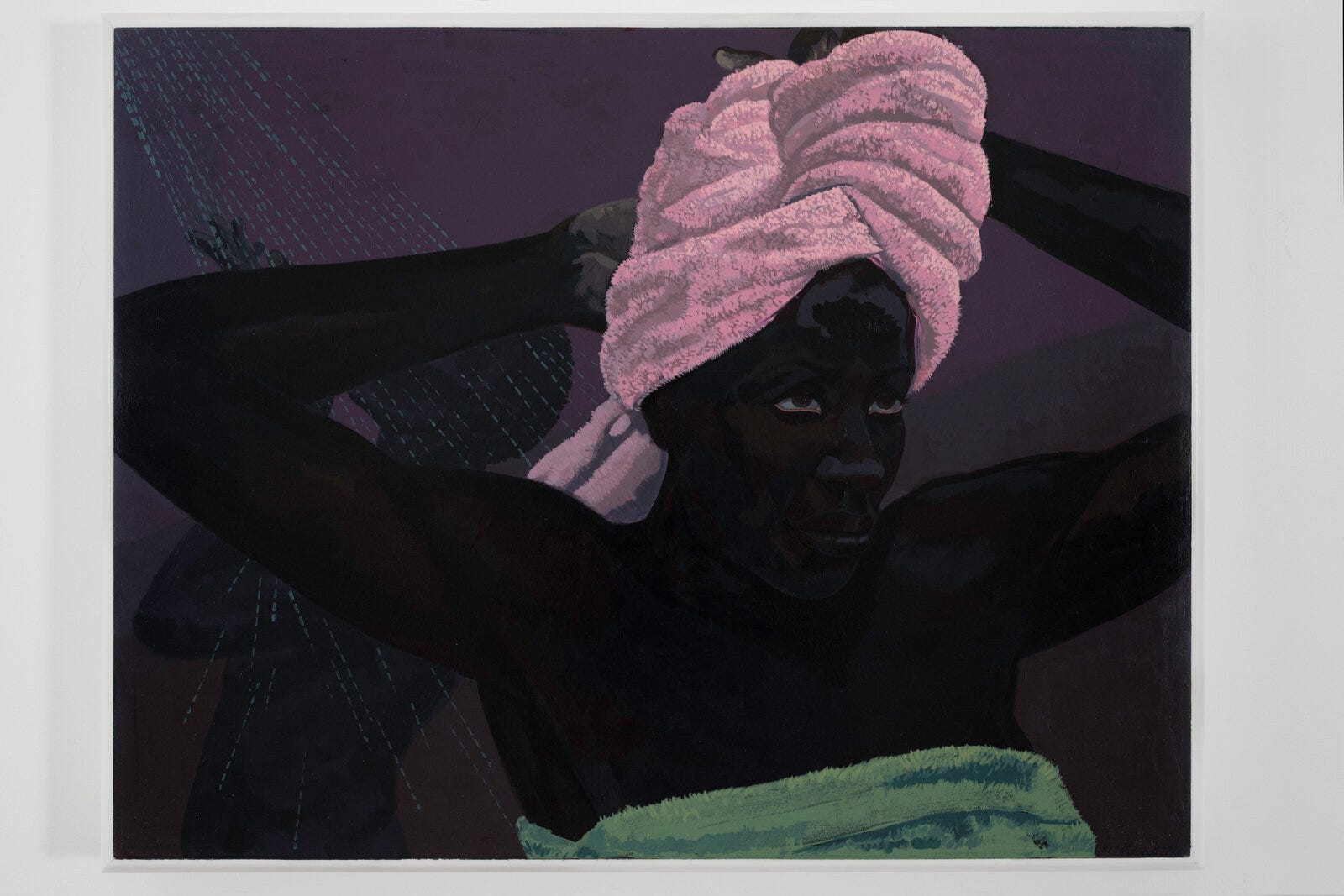
View more work by Kerry James Marshall1
“The first thing you do is to forget that I’m Black.
Second, you must never forget that I’m Black.”
— Pat Parker
This essay was written in February 2026, during what America calls Black History Month. It is not a celebration. It is not a commemoration. It is not an education.
It is an accounting.
In January 2025, Donald Trump was inaugurated for a second term as President of the United States. Within days, the apparatus of enforcement was activated. ICE raids. Executive orders targeting immigrant communities. The mobilization of federal power toward punishment. And in the days that followed, I watched to see who would appear. Who would resist. Who would show up when danger arrived at the door.
This is not surprising. It is the pattern.
When Black people are in danger, the response is structural.
When white people are in danger, the response is sympathetic.
When Black communities face crisis, we are told the problem is internal.
When white communities face crisis, we are told the problem is systemic.
This essay examines that asymmetry, not to persuade anyone of its existence, but to ask a question that remains unanswered:
Why should we trust you?
Not you, the reader, necessarily. Though perhaps. But you, the institutions.
You, the allies. You, the friends who claim solidarity until solidarity requires risk.
February is when we are supposed to look backward.
To honor history. To remember.
I am looking at right now.

The greatest threat to white people is white people.
You have never heard this sentence.
You will never hear it.
Not from politicians. Not from pundits. Not from policy experts or law enforcement officials or academic researchers studying social problems in America. The phrase does not exist in our national discourse.
This is not because the statement is untrue. Most white people who are murdered are murdered by white people. Most white people who are victims of violent crime are victimized by other white people.
No one calls it “white-on-white crime.” No one frames white poverty as a failure of white culture. No one points to white addiction rates and concludes that whiteness itself is the problem, that white communities need to “look inward” and address their “internal pathology.”
When white people kill each other in rural communities, we don’t get think pieces about white family structure. When white teenagers commit school shootings, we don’t get national conversations about white parenting. When white neighborhoods are devastated by opioid addiction, we don’t get sermons about white responsibility.
We get economics. We get mental health. We get the social determinants of health, the crisis of deindustrialization, the loss of community, the failure of institutions. We get structural analysis.
Black people get moral diagnosis.
It is the architecture.
The language we use to describe social problems in Black communities, language that locates the problem within Blackness itself, that treats Black suffering as evidence of Black failure—that language is never applied to whiteness. Not because white communities don’t experience the same problems. They do. But because the frame is different. The frame has always been different.
When Black people are in danger from each other, we are told we are the danger.
When white people are in danger from each other, we are told to examine the systems that failed them.
But let us say the danger is not internal.
Let us say the danger arrives from outside.
In January 2025, within days of inauguration, ICE was activated. Raids in sanctuary cities. Executive orders targeting immigrant communities. The mobilization of federal enforcement toward people who were already vulnerable, already afraid, already living on the margins of legal protection.
I watched to see who would appear.
I watched to see which institutions would resist. Which allies would show up. Which friends, the ones who had claimed solidarity during easier times, who had posted statements and attended marches and used the right language, which of them would be there when resistance required risk.
Some did. Most did not.
Progressive organizations that had been vocal in 2020, that had raised millions in donations, that had built entire brands around racial justice, many went silent. Or released carefully worded statements expressing “concern” while doing nothing to interrupt the machinery of enforcement.
Liberal politicians who had campaigned on immigrant rights, who had promised sanctuary, who had used the language of protection, many discovered urgent reasons to focus on other priorities.
To wait for a better moment.
To avoid being “too divisive” when unity was needed.
Celebrity activists who had posted black squares, who had attended protests, who had leveraged their platforms to signal solidarity, many found that their activism had a limit, and that limit was risk. Personal risk. Professional risk. The risk of being labeled extreme or unreasonable or, worst of all, unpopular.
This, too, is the pattern.
And yes, some Black people disappeared too. Some of us had made it far enough into proximity to power—into certain jobs, certain zip codes, certain circles—that we chose safety over solidarity.
Some of us decided our class position, our professional status, our respectability mattered more than showing up for the most vulnerable. I am not exempt from this examination just because I’m Black; the question “Why should I trust you?” can be asked of anyone who claims solidarity and then stays home when the state comes to the door.
You know who disappeared in your own life. The colleague who was outspoken until it became uncomfortable. The friend who cared deeply until caring required confrontation. The organization that supported justice until justice became inconvenient. You know them. You watched it happen.
When danger arrives, the people who call themselves your friends have an opportunity to prove it. Not with language. Not with sentiment. Not with performances of allyship that cost them nothing. But with action. With risk. With the willingness to put themselves between you and the apparatus of harm.
And when they do not, when they are silent, when they are absent, when they are suddenly very concerned about “complexity” and “nuance” and “not being divisive,” then the question becomes unavoidable:
Why should I trust you?
Not as rhetoric. As a genuine inquiry.
If you claim to be my friend, but when I am in danger you are nowhere to be found, if you claim to care about justice, but when injustice is activated you have other priorities, if you claim solidarity, but solidarity evaporates the moment it requires you to risk something, then what, exactly, are you offering me?
Friendship is tested in danger, not in comfort.
Allyship is proven in crisis, not in calm.
And what I have observed, over and over, is that when the test arrives, many people fail it.
It is fine to be friendly with them.
But these are not your friends.
This is not new.
When Black communities were devastated by crack cocaine in the 1980s and 1990s, we got the War on Drugs. We got mandatory minimums. We got three-strikes laws. We got militarized policing and mass incarceration. We got a political consensus that the problem was criminality, that the solution was punishment, that the danger was us.
When white communities were devastated by opioid addiction in the 2010s, we got a public health crisis. We got treatment programs. We got Narcan distribution and harm reduction strategies. We got empathy. We got op-eds about the pharmaceutical industry and the failure of regulation and the loss of economic opportunity. We got structural analysis.
Same drug.
Same addiction.
Same communities being destroyed.
Different response.
When gay men, especially Black and brown gay men, were dying by the thousands from AIDS in the 1980s, we got silence. The federal government did not respond. The president did not speak. Resources were not mobilized. Research was not funded. What we got instead was stigma. Moral judgment. The framing of a public health catastrophe as a consequence of sexual deviance, as punishment for a lifestyle, as evidence that the people dying had brought this upon themselves.
It took years, years of bodies piling up, years of communities organizing their own care networks, years of activists forcing the country to pay attention, before the government treated AIDS as a crisis worth addressing. And even then, the response was shaped by the assumption that the people suffering were responsible for their own suffering.
When Black workers lost manufacturing jobs in the 1970s and 1980s, we got narratives about welfare dependency. We got stories about “wrong choices” and “lack of work ethic” and “cultural pathology.” We got lectures about personal responsibility. We got policies designed to punish poverty, to make survival harder, to ensure that being poor in America was also being humiliated in America.
When white workers lost manufacturing jobs in the 2010s, we got a presidential campaign about the forgotten class. We got economic anxiety. We got sympathetic profiles of struggling towns and displaced workers and the dignity of labor lost. We got an entire political movement organized around the idea that when white people suffer economically, it is because the system has failed them.
The pattern is exhaustive. The pattern is everywhere.
And the pattern is this:
When Black people suffer, the problem is located within Blackness.
When gay men—especially Black gay men—were dying, the problem was located within us.
When white people suffer, the problem is located within systems.
This is not accidental. This is not rhetoric. This is not a failure of empathy or imagination. This is policy. This is how resources are distributed. This is how enforcement is activated. This is how America decides who deserves punishment and who deserves protection.
And it has been this way for as long as any of us have been alive.
So when danger arrived in January 2025, when the enforcement apparatus was activated, when vulnerable people needed allies to show up, and many did not, I was not surprised.
I was watching the pattern repeat itself.
I should tell you something.
There was a period in my life when I was not as involved as I have been in recent years. I knew I was Black. I knew I was gay. I knew I was living with HIV, undetectable, managing a condition that had killed so many before me. But I also knew how to code-switch. I knew how to navigate spaces in ways that allowed me to fly close to under the radar.
That doesn’t mean I was completely immune to the American condition. I understood what was happening. I saw the patterns. But the cover I had, tattered as it was, incomplete as it always would be, allowed me a certain distance. I could observe the danger without feeling it was knocking directly on my door.
And then something shifted.
I was in therapy. Taking stock of my life. And the question became unavoidable: Where do I fall within these conditions? Some manufactured, some not. Where do I stand in relation to the people who are most vulnerable, most targeted, most at risk?
I couldn’t sit with myself in that lane anymore. Coasting. Observing. Keeping my head down while staying adjacent to the struggle but not fully within it.
Because so many others have fought for me. People I don’t know. People I will probably never meet. People who risked everything so that I could have the life I have, so that I could be Black and gay and undetectable and still here.
And I have a responsibility to be active. Not to wait for something to directly affect me. Not to wait for danger to knock on my door and tell me to wake the fuck up.
I had to reckon with my own silence. My own distance. My own unwillingness to show up when showing up required risk.
So when I ask “Why should I trust you?” I am not asking from a position of moral superiority. I am asking as someone who knows what it’s like to keep your head down. Who knows what it’s like to code-switch your way through danger. Who knows what it’s like to tell yourself that staying safe is enough, that survival is enough, that you don’t owe anyone your risk.
I know that impulse. I have lived it. And I am telling you: it is not enough.
So I return to the question.
Why should I trust you?
You, the ally who disappeared when enforcement was activated. You, the institution that went silent when silence was safest. You, the friend who claimed solidarity until solidarity required something from you.
You have shown me who you are. You have shown me what your friendship is worth. You have shown me that when I am in danger, I cannot count on you.
And this is not new information. This is the same information Black people have received for decades. For centuries. The same lesson taught over and over: when we need you, you will not be there. When we are suffering, you will explain why it is our fault. When we are being targeted, you will find reasons to look away.
The pattern is not breaking. It is repeating.
So why should I trust you?
I am asking sincerely. I want to know what you are offering me. What does your friendship mean if it evaporates under pressure? What does your allyship mean if it requires no risk from you? What does your solidarity mean if you withdraw it the moment solidarity becomes dangerous?
You do not have a good answer. I know this because if you had a good answer, you would have demonstrated it already. You would have shown up. You would have resisted. You would have put yourself between me and the harm you claim to oppose.
You did not.
And so the question stands. Unanswered. Unanswerable, perhaps.
Why should I trust you?
I am not asking you to change. I am not asking you to do better next time. I am not asking you to prove yourself or redeem yourself or perform some act of contrition that will restore my faith in your goodness.
I am asking you to sit with the question. To sit with the fact that you do not have an answer. To sit with the discomfort of knowing that your friendship was tested and you failed.
February is when we are supposed to celebrate. When we are supposed to honor history. When we are supposed to remember the people who fought so we could be here.
I am honoring them by refusing to pretend.
By refusing to accept friendship that costs you nothing. By refusing to trust institutions that abandon us when we need them most. By refusing to participate in the performance of solidarity while the architecture of harm continues, uninterrupted, exactly as it was designed to do.
I am asking you to understand that it is fine to be friendly.
But you are not my friend.
Let that be enough—for now.
Author’s Note
I’m writing this at the end of January, a few days before Black History Month begins. I already know what reactions it will get. I know it violates expectations about what February is supposed to be for.
I’m publishing it anyway.
UNSPUN has never been a space for performing what people expect. Not celebration for its own sake. Not education that makes people comfortable. Not commentary that refuses to name what it sees.
I wrote the personal section last. I didn’t want to, initially—it felt like it might dilute the force of the indictment. But I realized I couldn’t ask the question “Why should I trust you?” without being honest about my own failures to show up. That honesty doesn’t soften the argument. It sharpens it.
If this essay makes you angry, good. If it makes you defensive, sit with that.
If you have an answer to the question it asks that actually holds up under scrutiny, I want to hear it.
If you don’t, then we both know what that means.
UNSPUN publishes longform essays, editorial encounters, and visual documents tracing the language of power as it operates in real time.
This work appears as part of UNSPUN’s ongoing inquiry into how authority circulates, how permission is granted, and how silence functions as structure rather than absence.
If something in this piece altered your footing, that alteration is intentional.
What follows does not ask for agreement. It asks for attention.
UNSPUN continues for those willing to stay with the work as it unfolds.
Cover Image Citation
Kerry James Marshall (American, b. 1955), Untitled (Bathers), 2017. Acrylic on PVC panel. © Kerry James Marshall. Courtesy of the artist and Jack Shainman Gallery, New York. View more of Marshall’s work
I don’t know how I missed this essay, but consider it reposted. Also Maya Angelou said it best, “There is no such thing as friendship among people who are not equals.”
"The greatest threat to white people is white people."
That sentence, all by itself, is a word, and an entire essay. It is poignant, accurate, and deadly. I'd add to it only by saying the greatest threat to PEOPLE is white people (or the system of whiteness).
As for your question... You shouldn't trust me. Not because I haven't stood up before, not because I haven't taken any risks, but because even within those risks, even when I stood up, I had a privileged safety that many never will have, and lately I haven't stood up. Well, I haven't done a damn bit of anything lately that requires me to leave my house besides go to work, though my fight has never left. I've never been one to laud myself for what I have done, to claim my allyship, I learned many years ago that the label of ally, the right to praise, doesn't belong to me, and I am not the one who can put that on myself. "Why should anyone trust you?" is a question that I ask of myself regularly, and not one that I ever have a good answer for. I have people who will tell me why they trust me, but those are people who know me inside and out, who have seen the lines I've drawn, and seen the things/people/jobs that I have lost when I held that line, but why should anyone else trust me? They shouldn't. Not because I don't care, but because those who need me to stand up have far more to lose, and gain, than I do. Don't trust me, not because I love you less than it seems, but because I'm terrified of what your trust means. But here's the really painful part of this answer, when I tell you not to trust me, even that is a self-protection device because it effectively (even if unintentionally) justifies the work I don't do. Don't trust me because I don't even trust myself.