

You Can't Seduce Goodness
On What Survives When Performance Ends


“The truth is not always beautiful, but the hunger for it is.”
— Nadine Gordimer
Preface
I asked my dad what it felt like when he turned fifty-eight—the age his mom never reached. We were on the phone, our weekly call, the one we promised to keep even though he lives thirty minutes away with my mother, even though I see them regularly. He reads everything I write. The conversations give him deeper access to how I think, he tells me. Give me deeper access to how he carries grief. When I ask about her, I say your mom, not Lula Mae. It’s a respect thing. She’s his mother first, his loss before she’s my absence. My access to her goes through him, through his memory, through what he’s chosen to preserve and share. So I asked about turning her age, about surpassing it, about living in years she never saw. And he gave me the raw truth: it felt like robbery.

Lula Mae was born in 1930 and died in 1987 at fifty-seven. Bone cancer accelerated by medical error, wrong dosage, preventable, gone. Two years later, in 1989, I was born. Which means I was robbed too. Robbed of a grandmother my dad wanted to share with me, robbed of her teaching firsthand instead of filtered through his memory and shaped by his grief. All I got was what survived those two years of his carrying her alone: God doesn’t like ugly. And He doesn’t care too much for pretty.
I was young when I first heard it, or rather, young when I first understood what my dad was giving me. I didn’t know he was translating his mother’s voice, passing down what she had taught him about how to see the world, how to measure people, how to recognize goodness when everything else is performing. I thought he meant the surface of things, skin and bone and the features we inherit. But my dad was never that simple. Neither was his mother.
Ugly, she meant, is the hand that breaks bread only to count who didn’t get a piece. Ugly is the voice that wounds and calls it wisdom. Ugly is the man who mistakes cruelty for strength and demands respect without offering reverence. Ugly is the woman who keeps score in a relationship and calls it self-protection. Ugly is the country that builds cages and calls them necessary. Ugly isn’t about appearance. It is about appetite, the kind that consumes without nourishing, that takes without giving, that breaks without building.
And pretty? Pretty is how evil survives in plain sight. Pretty is the deception, the mask that smiles while it destroys, the blade hidden behind charm, the violence that arrives in expensive clothes, the harm that remembers your birthday. Pretty performs goodness so convincingly you almost forget to ask questions until the performance ends, until the lights go down and the rot seeps through, until you realize you have been watching theater, not truth.
My dad tells me his mom was like that, unperformed, unbothered by staging. Once, when he was thirteen, she told him they had errands to run. Normal afternoon, nothing announced. They ended up at a bus stop, and as the bus was pulling away she nodded toward one of the windows: “Yeah, that man right there is the man I’m seeing.” No preparation. No ceremony. No “I want you to meet someone important.” Just fact delivered like facts get delivered when you are a woman who doesn’t dress up truth. The man on the bus became his stepfather. And she introduced them the way goodness introduces everything, without performance, without apology, without needing the moment to be more than what it was.
Lula Mae knew both ugly and pretty. She had seen ugly dressed in Sunday best, had watched pretty destroy families while everyone applauded the show. She knew that God doesn’t like ugly not because it is unpleasant to look at, but because it refuses to see itself clearly. She knew God doesn’t care too much for pretty not because beauty is wrong, but because pretty is performance, and God knows the difference between what shines and what illuminates.
Evil needs both ugly and pretty to survive. It dresses its ugliness in pretty’s clothes, calls cruelty strength, calls violence necessary, calls exploitation opportunity, calls extraction progress. Then it wonders why goodness will not sit at its table, wonders why integrity will not compromise, wonders why wholeness will not break itself into pieces to make evil feel less alone.
You can’t seduce goodness. I know because I have watched evil try. I have watched it perform humility with its chest out, watched it apologize with conditions attached like fine print, watched it offer love like a loan expecting interest, watched it promise change while keeping the same pattern in its back pocket.
I have watched evil try to convince me my HIV status was something I deserved. But here is what ugly and pretty look like when they join forces: a lover who knew their status, knew what they were passing to me, chose silence over honesty, intimacy over integrity. Then watched as the world asked me what I did to deserve it.
Evil does not always announce itself. Sometimes it arrives as love. Sometimes it holds you close while poisoning you. Sometimes it lets you take the blame for the violence it delivered.
That is pretty—harm that smiles, betrayal that whispers sweet things, cruelty that performs devotion while stealing your health and letting you carry the shame for what it did.
Goodness does not even look up from its work. It does not stop what it is doing to acknowledge the performance. It just keeps tending its garden, just keeps breathing, just keeps being.
Goodness looked at my status after that betrayal and saw: you didn’t deserve this, you were harmed, and harm does not become your identity just because someone you loved made you carry it.
Goodness did not ask what I did wrong, because goodness knows that trust is not deserving of punishment, that intimacy is not consent to violence, that loving someone who lies does not make their lie your fault.
Because here is what evil mistakes for power: the ability to make people flinch, to fill a room with its name before its body arrives, to turn heads and break hearts and collect debts like trophies. Evil thinks presence is the same as permanence, thinks volume is the same as truth, thinks attention is the same as respect, thinks hunger is the same as purpose. But hunger is just hunger, loud and endless and always, always empty.
Evil is predictable in its patterns. It recycles the same lies in different packaging, returns with the same arrogance wearing a new face, feeds on the same fears it helped create. It needs applause, needs an audience, needs someone to look its way and flinch or freeze or follow. It cannot breathe in solitude, does not survive without spectators. Evil lacks humility because humility requires honesty, and honesty would mean admitting that all this noise, all this performing, all this hunger dressed as power, is just fear trying to look like confidence.
Evil surrounds itself with mirrors, but only the kind that lie, only the kind that reflect what it wants to see, not what it is. It mistakes volume for truth, confuses attention for relevance, thinks if enough people are watching it must matter, thinks if it says something loud enough it becomes true. But Lula Mae always knew: noise is just noise until it says something worth hearing.
Goodness does not need any of that. It does not need to convince you it exists, does not rehearse its entrance or exit, does not check if anyone is watching before it acts with integrity, does not make you sign anything in blood or ink or promise, does not keep receipts to prove it loved you. That is why evil hates it. That is why evil cannot stop trying to seduce it.
Because you cannot seduce something that is not hungry. You cannot tempt what is already whole, cannot break what does not fear shattering, cannot corrupt what knows the difference between appetite and need. Evil arrives with offers, power wrapped in opportunity, safety that requires surrender, belonging that costs your integrity, love that looks like love if you do not look too closely. Goodness just keeps tending its garden, just keeps doing the work, just keeps showing up without announcement.
Evil raises its voice while goodness keeps humming. Evil demands an audience while goodness closes its eyes and rests. Evil performs generosity and waits for applause while goodness gives and forgets it gave. Evil needs you to see it being good. Goodness does not need you to see it at all.
But goodness can still be taken. Not through seduction or corruption, through negligence, through error, through someone’s carelessness accelerating cancer that was already stealing her. Wrong dosage. Medical mistake. And suddenly fifty-seven years is all she got. My dad lost more years with his mother. I lost all years with my grandmother. Not because evil seduced her or broke her. Just because someone made a mistake and her body could not survive it.
When my dad talks about turning fifty-eight, about surpassing his mother’s age, about living in years she never saw, he does not label the feeling. I did. Listening to him, listening to what went unsaid, I understood the only word large enough for it: robbery.
He wanted to share her with me. Wanted me to experience her teaching firsthand, not filtered through his memory. Wanted me to witness her goodness myself instead of inheriting it as language curated by grief. But someone gave her too much medication and her cancer accelerated and she died two years before I was born.
So what I got was stories. What I got was his selection of her wisdom. What I got was “God doesn’t like ugly, and He doesn’t care too much for pretty” and the ache of knowing I should have gotten more. Should have gotten her hands holding me, her voice teaching me directly, her presence without translation. Medical error didn’t just take her from my dad. It took her from me before I could even reach for her.
I have tried to seduce goodness myself, more times than I want to admit. I dressed up my own ugly in pretty’s best outfit, called it self-preservation when it was really self-protection, called it strategy when it was really fear, called it survival when it was really just refusing to heal. I tried to negotiate with integrity like it was a business deal, offered compromises to wholeness like it might be interested, performed vulnerability while keeping my real self hidden.
Goodness watched and said nothing. It did not argue, did not try to convince me I was wrong. It just waited, just breathed, just kept being whole while I exhausted myself pretending. Then, when I was finally tired of performing, tired of the costume, tired of the script, tired of pretending hunger was the same as having an appetite for life, goodness offered me water. No conditions, no contract, no receipt to prove it cared. Just water, just presence, just the quiet truth that I didn’t have to earn rest.
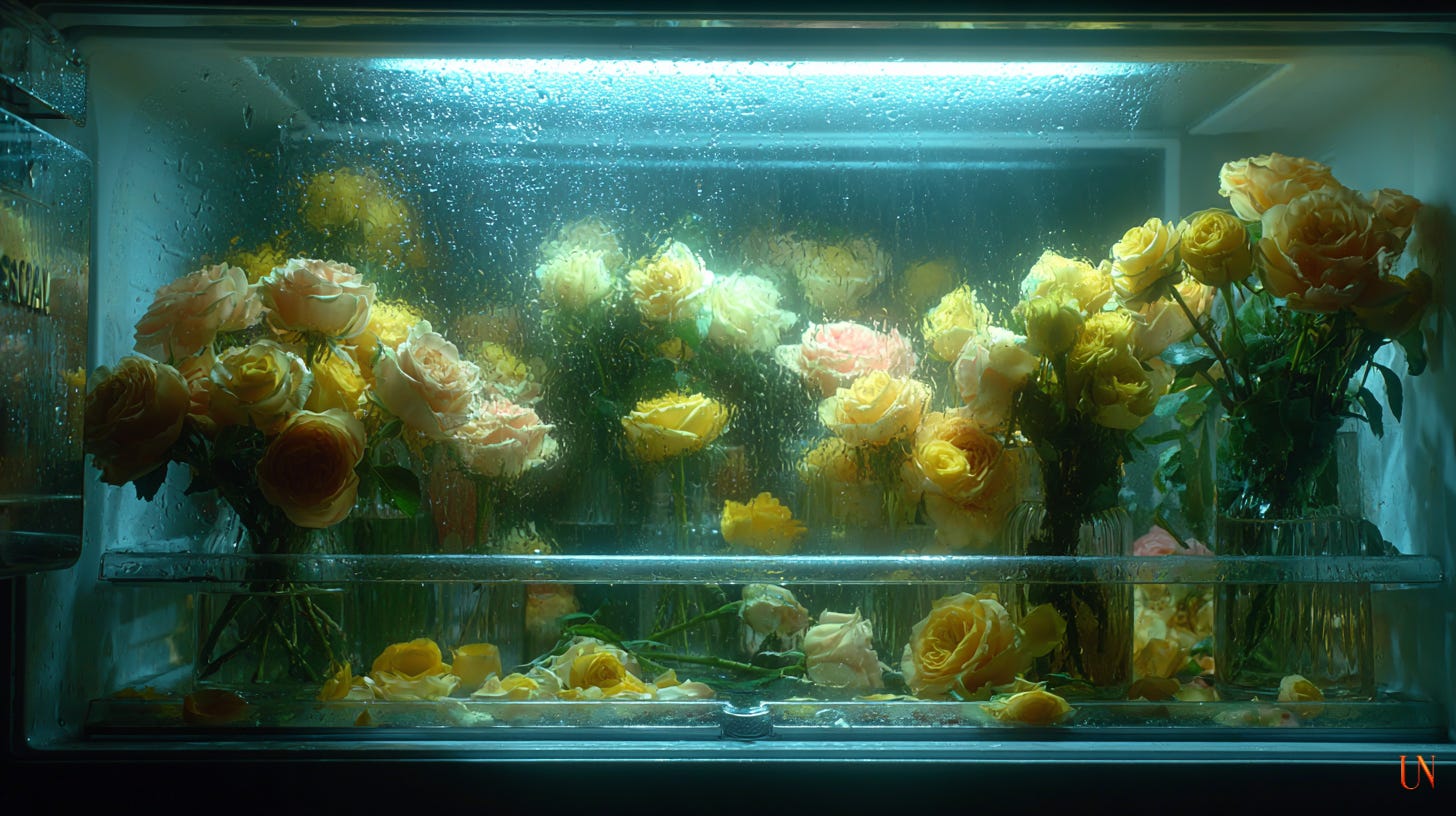
Years ago, before I understood what I was doing, I tattooed my grandmother’s name on my forearm. Lula Mae —I can say her name on my body, make it permanent in ink, but when I talk to my dad about her, I say your mom. It is a respect thing. She is his first. I know her through him. Her name made into a stem, blooming into a yellow rose because my dad told me she loved yellow roses. It was my second tattoo, back when I didn’t know I would eventually have fifteen, back when my dad could still reasonably hope I would stop. Back when I was still figuring out what I wanted to carry permanently on my body, what mattered enough to make permanent.
I chose her. Chose to wear a woman I never met, chose to make her visible on my skin when she had never been visible to me in life. Yellow rose blooming on my forearm where I can see it when I write, when I gesture, when I reach for things. Her name the stem of what grows.
When I showed my dad, he touched the tattoo, his mother’s name in ink on his son’s arm, and said she would have loved it. Not “she would have been proud” or “she would have appreciated the gesture.” She would have loved it. Present tense in his mouth, like she was still here to have opinions, still here to see what I had done, still here to love me for making her permanent.
I didn’t get the tattoo to perform. Didn’t post it, didn’t explain it to strangers who asked, didn’t make it a statement about grief or inheritance or anything else requiring audience. I just wanted her on me. Wanted to carry Lula Mae the way my dad carries her, not as memory fading but as presence blooming. Every time I write, I see her. Every time I reach for something, she is there. Every time someone asks about the tattoo and I say my grandmother, I am telling the truth even though we never met.
That is what goodness does. It makes you want to carry it. Not because it performs for you, not because it seduces you, but because once you understand what it is, once someone like my dad shows you through weekly calls and honest answers and reading every word you write, you want it permanent. You want it visible. You want it blooming on your body like proof that love does not require presence, that inheritance does not require meeting, that you can honor someone you never touched by making them part of your skin.
That is when I understood what Lula Mae meant. God doesn’t like ugly, the kind that harms and calls it help, that wounds and demands gratitude, that takes and rebrands it as giving, that breaks and calls the breaking necessary, that destroys and claims it was for your own good. God doesn’t care too much for pretty, the performance of goodness without the practice, the rehearsed humility that needs an audience, the charity that requires a photographer, the love that keeps score, the kindness that comes with terms and conditions.
Because neither one survives silence. Neither one exists when no one is watching. Neither one can rest without an audience to validate its existence. Both require constant feeding, both starve without attention, both die in the presence of genuine wholeness.
But goodness? Goodness is already full, already satisfied, already whole. So when evil comes begging, dressed in its Sunday best, voice honeyed with promises, mouth full of everything you think you need, arms full of gifts that come with invisible strings, goodness just closes its eyes. It does not argue, does not defend itself, does not try to prove it is worthy, does not perform for an audience that came to see a show. It just breathes, just rests, just is.
And evil, loud and hungry and performing evil, realizes it has been talking to itself this whole time. Realizes that all its noise, all its promises, all its carefully constructed seductions, have been echoing in an empty room. Because goodness was not listening, not because it couldn’t hear, but because it had nothing to gain from the conversation.
That is why you cannot seduce goodness. Not because goodness is perfect, not because it never stumbles or falls or fails, not because it is some untouchable ideal floating above human mess. But because goodness knows the difference. It knows the difference between hunger and appetite, between wanting and needing, between love and the performance of love, between giving and taking with both hands, between rest and running, between being seen and being whole.
Goodness has already eaten. It is already satisfied, already knows what it needs and what it does not. So it does not beg at tables where the bread comes with conditions, does not bow to gods who require blood sacrifice to prove devotion, does not break itself into pieces to feed what should have learned to feed itself, does not starve itself to make others feel less hungry, does not shrink to make insecurity feel safer. Goodness knows its own fullness, trusts its own wholeness, does not need validation to know it exists.
My dad has been carrying his mother for thirty-eight years now, longer than I have been alive, longer than the time she had to shape him, long enough for her presence to outlive her body. I have been learning her for thirty-four years without ever meeting her, without hearing her voice except through his voice, without knowing her except through what he chose to preserve when grief forced him to decide what mattered most. And every week, when we talk on the phone, when he reads what I write and tells me honestly what he sees, when I ask him hard questions about his mom and he gives me raw answers, we are practicing what she taught. Not performing it. Not staging it for anyone watching. Just showing up. Just being present. Just offering each other what goodness always offers: attention without condition, presence without applause, love that does not need to be seduced because it is already full.
My dad wanted me to experience her teaching firsthand. Medical error made sure I would only ever get it secondhand, filtered through his memory, curated by his grief. But maybe that is its own kind of teaching. Maybe learning goodness from someone you never met means learning it pure, voice without body, wisdom without the complication of physical presence, inheritance that cannot be performed because the person who left it cannot perform anymore. She is already gone. Already whole. Already impossible to seduce with my need or my questions or my hunger to have known her.
So when evil arrives, and it always arrives, hungry and loud and desperate for attention, I think about Lula Mae at that bus stop. I think about my dad reading my essays every week without needing credit. I think about how goodness moves through generations not as grand gesture but as regular presence, as promises kept, as truth told even when it costs something to tell it. I think about the yellow rose blooming on my forearm every time I reach for my keyboard, every time I write about inheritance and presence and what survives when the original teacher is gone.
I think about the weekly calls. The thirty-eight years my dad has carried her voice. The two years between her death and my birth that shaped everything I would inherit. The medical error that robbed us both but could not rob her of her goodness, could not make her perform even in memory, could not seduce her into being anything other than what she was.
And I close my eyes. And I rest in what she left. And it is enough.
Not because I do not want more. I wanted to meet her, wanted her hands to hold me, wanted her voice to teach me directly instead of through translation, wanted years with her that medical error stole before I even arrived. But because goodness teaches you this above all else: wanting more does not mean what you have isn’t whole. Hunger does not mean you are not fed. The inheritance came through robbery, yes. But it came. And it is still here. And it is still teaching.
My dad calls every week. Reads every essay. Answers every question about his mom with the kind of honesty that costs him something to give. That is her, still alive, still teaching, still refusing to perform. That is goodness that survives medical error and time and death itself, not as memory fading, but as practice deepening, as sons teaching sons what mothers taught first, as yellow roses blooming on forearms while essays about inheritance get written.
God doesn’t like ugly. And He doesn’t care too much for pretty. But goodness? Goodness He recognizes on sight. Recognizes it in the phone call kept, the essay read, the question asked, the truth told. Recognizes it in the space between what was stolen and what remains. Recognizes it in my dad’s voice carrying his mother’s voice carrying something older than both of them, the knowledge that you cannot seduce what is already satisfied, cannot break what is already whole, cannot take what is already given everything it had to give.
Every week when my dad and I talk, when he tells me another story about his mom, when I look down at my forearm and see Lula Mae blooming yellow while I take notes, I understand what she was teaching. Not just about ugly and pretty, not just about goodness and evil, but about what survives when performance ends. About what remains when the person is gone but the practice continues. About how you carry people you never met by living what they taught people who taught you.
She introduced her future husband at a bus stop without ceremony. My dad reads my essays without needing praise. I tattooed her name on my body before I could articulate why. Three generations of refusing performance, of showing up without announcement, of practicing goodness when no one is watching because goodness does not need anyone watching to know what it is.
And every time I write, Lula Mae is there. Blooming on my forearm. Present in my dad’s voice. Alive in the practice of showing up weekly, reading honestly, asking hard questions, giving raw answers. She died in 1987. I was born in 1989. And somehow, across that two-year gap where medical error tried to end what she started, goodness survived. Survives still. Will keep surviving as long as someone carries it forward, on their body, in their voice, through their practice of presence without performance.
That is what you cannot seduce.
That is what remains when everything else performs and fades.
That is what blooms yellow on forearms and in weekly phone calls and in the space between dad and son learning how to honor a woman who never got to meet one of them but shaped both completely.
Let that be enough—for now.
Author’s Note
I wrote this during a week when I watched people perform goodness for applause and call it morality, when I saw harm dress itself in the language of liberation and expect gratitude. A week when I remembered what it feels like to be on the receiving end of someone else’s silence, to carry a wound that was never mine to earn, to watch the world ask the wrong questions of the wrong person.
When I called my dad, our weekly call, the one we promised to keep, I asked him what it felt like to surpass his mother’s age. He didn’t name the feeling, but I heard it anyway. I listened to what sat in the pauses, in the breath behind his answers, and I understood the only word large enough for it: robbery. I looked down at her name blooming on my forearm and felt how inheritance survives in the body long after the body that taught it is gone.
Some things cannot be seduced because they are already whole, cannot be taken because they have already been given, cannot be lost because they live in practice rather than performance. This is for everyone who is tired of pretending. For everyone who knows the difference between hunger and wholeness. For everyone who has been harmed by someone who called it love. For everyone who carries someone they never met but loves them anyway. For everyone who has learned that goodness does not need audience. It only needs someone willing to practice it when no one is watching, to carry it forward, to let it bloom.
UNSPUN publishes longform essays, op-eds, and visual documents tracing the language of power in real time.
This piece appears in UNSPUN, the publication’s central body of work interrogating truth, language, and the systems that shape both.
To engage or contribute, write to taylorallynofficial@gmail.com, or follow UNSPUN for new releases and ongoing dialogues.
If something in this piece stirred you, that stirring is the point. Subscribe below to keep listening for what language can still heal.

Every word here is researched, written, and sharpened by one person—me. If you value work that names what others won’t, consider becoming a paid subscriber. It keeps this space independent, and it keeps pieces like this possible.
Thank you for sharing such intimate parts of yourself. Genuine, unadorned goodness and immovable character are a rarity in our superficial culture.
There’s a line running through this piece … that goodness doesn’t perform, it endures.
I felt that in my bones.
The way you wrote about inheritance… that’s not sentimentality, that’s survival wisdom passed hand-to-hand.
Some essays illuminate. This one remembers for us.
Thank you, Taylor.